Minimum wage in Uganda remains a question of verified law, not an online salary chart: no newly implemented general national rate was verified in the official material checked on 19 November 2026. Uganda has a legal framework for setting wage floors, but that is not itself a current monthly rate. Your agreed wages and other employment protections still matter.
That distinction matters when you are offered a factory job in Jinja, domestic work in Kampala or a shop position in Mbarara. A search result may display a historical amount, a campaign promise or a government salary grade as though it were the minimum every employer must pay. Those are different kinds of information.
This guide separates the wage-setting law from an actual wage order, explains what changed in the 2026 employment amendment and shows how to document unpaid or reduced wages. It does not invent a market salary or a legal floor for your occupation. For a particular claim, a labour officer or Ugandan advocate should check your employment terms and any applicable order or collective agreement.
Last checked: 19 November 2026 against the Office of the President’s minimum-wage statement, the gazetted Employment (Amendment) Act, 2026 and the Employment Act, Cap. 226, as amended. This is general information, not individual legal advice.
Table of Contents
Is there a general minimum wage in Uganda?
The official sources reviewed did not establish a newly implemented general national wage floor as of 19 November 2026. The government’s January statement said implementation remained pending, and the June employment amendment sets no national amount. Do not turn an old rate, recommendation or salary table into a verified entitlement for your job.
The Office of the President’s statement was published on 5 January 2026 and reported remarks made in Buikwe. It described plans to reduce business costs before implementing a minimum wage. That statement explains the government’s position at that time; it is not a wage order and supplies no commencement date or payable rate.
The Employment (Amendment) Act, 2026 commenced on 5 June 2026. Its reforms include domestic-worker definitions, recruitment-agency provisions and changes affecting dismissal and severance. Reading about stronger worker protection therefore does not establish that Parliament also fixed a national minimum salary. The gazetted amendment must be read for what it actually changes.
The May 2025 Guide to Employment Rights for Uganda says Uganda had no minimum wage. It is useful background, but it predates the June 2026 amendment and is more than a year old. It cannot, by itself, prove the position in November 2026 or settle the legal status of every historical wage instrument.
Some websites describe an old rate as dormant; others simply say there is no minimum wage. This guide does not certify the repeal, currency conversion or present application of a historical order it could not verify. For a live dispute, ask for the actual instrument and advice on its scope rather than relying on either simplified description.
How to check whether a claimed wage rate applies
Start with the legal instrument, not the size of the number. The Minimum Wages Advisory Boards and Wages Councils Act on the Ministry’s website distinguishes recommendations from published orders. Its sections 3, 6, 9 and 10 describe routes from investigation and proposals to an order and its effective date.
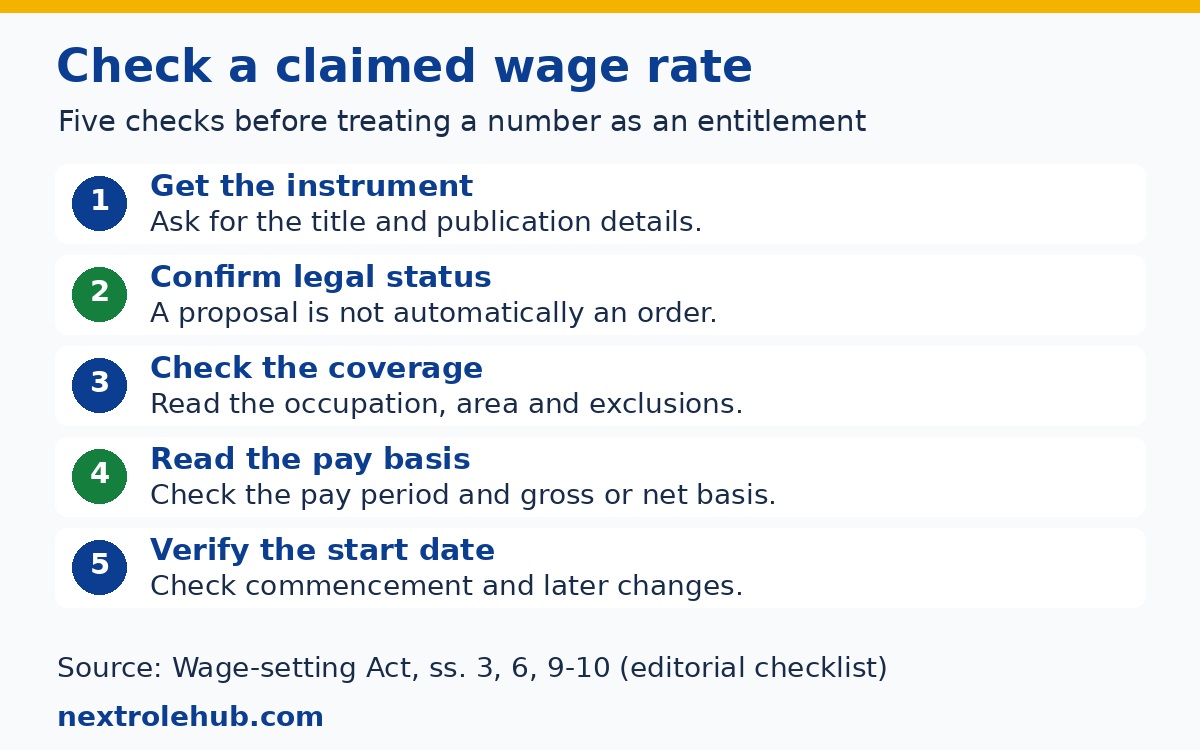
The Ministry’s PDF is an older edition labelled Chapter 221. The Uganda Law Reform Commission’s revised-law collection lists the Act as Chapter 229. Identify the edition when discussing a provision; a changed chapter number does not, on its own, establish a new wage amount.
- Request the complete instrument: title, issuing authority and publication details, not a cropped social-media table.
- Check its legal status. A board recommendation, Bill or policy announcement is not automatically an operative wages regulation order.
- Read the coverage: occupation, area, employer category and any exclusions. A rate for one group is not necessarily national.
- Check the pay period and basis. Hourly, daily and monthly amounts are not interchangeable, and gross pay differs from take-home pay.
- Find the commencement wording and check for later changes. Ask a labour officer or advocate if the instrument’s current application remains unclear.
The Uganda Printing and Publishing Corporation’s Gazette directory identifies the Gazette as the official publication of record and provides issues to consult. Opening that directory is not the same as checking every supplement. No claim is made here that every historical or recent Gazette instrument has been exhaustively reviewed.
If an employer, recruiter or adviser says a new rate has started, ask them to identify the order and the clause covering your work. A confident statement without that evidence is not enough to establish a statutory claim. Equally, this guide’s inability to verify an order is not proof that no specialised obligation can exist.
A government scale, a living wage and your contract are different
Before comparing pay figures, identify what each figure measures. A proposed policy amount, an occupational salary survey and a contractual promise can all be relevant to a pay discussion without carrying the same legal effect. Mixing them up makes both negotiation and a wage complaint harder.
| Pay reference | What it tells you | What it does not establish |
|---|---|---|
| Published wage order | A legal rate for the employees and period it covers, subject to its current validity. | That every worker in every sector is covered. |
| Government salary scale | Pay attached to specified public-service posts and grades. | A universal private-sector wage floor. |
| Employment agreement | The remuneration promised for your work and its payment terms. | Permission to remove protections imposed by applicable law. |
| Collective agreement | Negotiated terms whose coverage needs checking. | Automatic entitlement for employees outside its scope. |
| Living-wage estimate or personal budget | A measure of needs using stated assumptions. | A statutory rate merely because the amount seems reasonable. |
For a public-service advert, use our government salary scales guide to understand the grade. Do not transfer the lowest listed government salary to a private shop or household as a national legal minimum. The wage-setting framework itself excludes government employment from its application.
If your question is what to request rather than what you are already owed, use our salary negotiation guide for Uganda. That is a different conversation from enforcing an agreed wage. An employee asking for better future pay should not be told that negotiating is pointless merely because a general national rate has not been verified.
Which wage rights still apply without a verified national floor?
The absence of a verified new general rate does not erase the Employment Act. Section 3 prevents agreements from limiting the Act to an employee’s detriment. Its wage provisions address payment, deductions and statements, while other provisions address discrimination, hours and leave. Whether a particular person falls within a provision still depends on the employment relationship and applicable exceptions.
The section numbers below follow revised Cap. 226. Older copies can use different numbering, so compare provision headings as well as numbers. Read them with the 2026 amendment rather than assuming a historical PDF contains the whole current law.
| Issue | Protection to check | Record to keep |
|---|---|---|
| When wages are paid | Section 42 sets payment intervals in the absence of a prior written agreement to the contrary. | Agreed payday, pay period and actual payment dates. |
| Deductions | Sections 44 and 45 prohibit some deductions and specify permitted categories. | Payslip, authorisation where relevant and explanation of the deduction. |
| Pay statements | Section 49 requires an itemised written statement with each wage payment. | Statement showing deductions, their purpose and net wages. |
| Unequal remuneration | Section 5 requires equal remuneration for men and women doing work of equal value. | Role responsibilities and relevant evidence lawfully available to you. |
| Access to help | Sections 11 and 12 provide for labour-officer handling of employment complaints. | Employment details, chronology and supporting documents. |
For example, section 45 permits taxes and contributions imposed by law, certain pension deductions with prior written consent, agreed reasonable accommodation charges and union dues under the relevant procedure. It also prohibits charging employees through wage deductions for protective gear or tools of trade the employer provides. Written consent is not a universal cure for any deduction.
Section 42 also addresses remuneration and accrued benefits after employment ends. Do not confuse that rule with notice pay, severance or compensation, which raise separate questions. Ask an adviser to identify each head of entitlement instead of putting every requested payment under the label salary arrears.
Low net pay is not automatically evidence of an unpaid-wage breach. First compare the promised gross wage with earnings, lawful deductions and the amount received. Our PAYE and NSSF payslip explanation covers those lines; this guide does not repeat tax bands or contribution calculations.
Build a wage-shortfall record before making a demand
Record the exact disagreement. Is the employer paying less than agreed, paying late, making an unexplained deduction or refusing a payslip? Those are different issues from offering a low starting wage. A short, accurate record helps the person handling the complaint identify what must be checked.
Use this original evidence sheet for each pay period. It is an organising tool, not an official Ministry form and not a finding that money is legally due. Leave uncertain entries marked as uncertain until the underlying document or calculation is available.
| Evidence-sheet field | What to enter |
|---|---|
| Employment basis | Employer’s legal name, workplace, job, start date and agreed remuneration. |
| Period and due date | The dates worked and the payday supported by the agreement. |
| Expected earnings | Agreed earnings for that period, with the document or calculation supporting them. |
| Actual payment | Amount received, date and payment reference. |
| Deductions or adjustments | Each amount, its stated reason and whether you dispute it. |
| Outstanding question | The precise missing payment, unexplained difference or document requested. |
For a hypothetical shop assistant in Mbarara, the useful account is that the agreed monthly wage and the payment received do not match, supported by the agreement and payment record. It is less useful to claim an amount from a viral minimum-wage chart that does not identify an applicable law. Do not invent a salary figure to make the complaint sound more credible.
Keep your own appointment messages, pay records and correspondence where you are entitled to retain them. Preserve dates and context. Do not take customer information, payroll files about colleagues or other confidential employer records to prove your personal claim. A lawyer can advise on lawful evidence requests where necessary.
If the work was agreed orally, explain the arrangement honestly. Section 24 recognises oral contracts of service, subject to writing requirements imposed elsewhere. The absence of a signed contract does not automatically decide the claim against you, but evidence of the actual employment and agreed pay becomes particularly useful.
Raise unpaid wages with the employer or a labour officer
Where it is safe and useful, send payroll or the employer a focused written query. Name the pay period, the agreement you rely on and the difference you need explained. Ask for the relevant statement and a written response. You do not have to claim a new national minimum wage to ask about wages already promised.
Original sample request: “Please review payment for [period]. My agreed remuneration is recorded in [document or message], but the payment received on [date] differs from the amount I expected. Please provide the itemised pay statement, explain [specific deduction or shortfall] and confirm how any error will be corrected. I have attached my relevant records.”
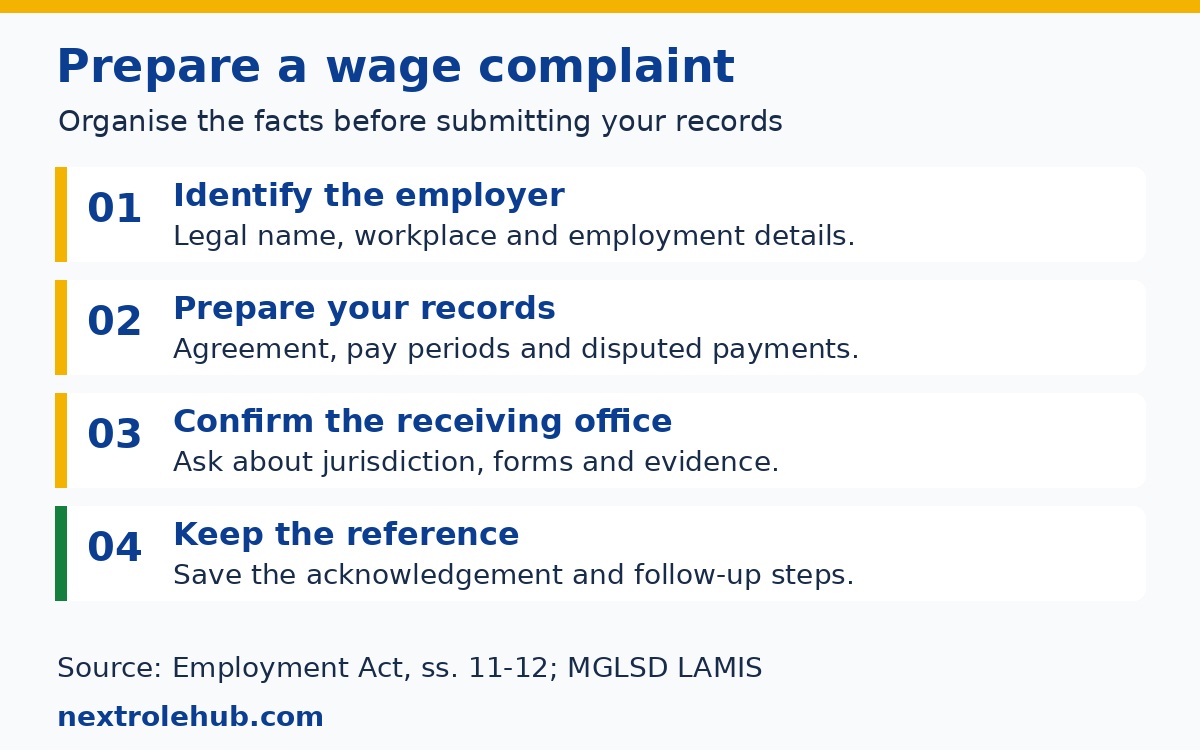
If there is no safe internal channel, the query is not resolved or you need advice on your rights, contact a district labour officer. Sections 11 and 12 of the Act provide a complaint-handling route. Confirm the appropriate office and applicable time limits promptly; an internal discussion should not become a reason to miss a legal deadline.
- Identify the legal employer and workplace, especially where an agency or contractor placed you at another organisation’s site.
- Prepare a short chronology, copies of relevant records and a clear explanation of the help you need.
- Confirm jurisdiction, any required form and how to submit evidence with the receiving labour office.
- Keep an acknowledgement or case reference and follow the instructions for the next step.
The Ministry also provides an online LAMIS complaint form. Its public form asks for complainant and employer details, includes a representative section and says saving produces a case reference. Follow the live form and retain the reference. This is confirmation of the published reporting route, not a promise about response time or the outcome of your case.
Seek individual advice before resigning, signing a settlement or accepting a document stating that everything has been paid. If threats or harassment accompany the wage issue, record those separately. Our workplace grievance guide covers that reporting problem without treating every pay disagreement as harassment.
Questions about low pay and minimum-wage claims
Is an old minimum-wage amount online safe to quote as current law?
Not without checking its source and present application. A historical figure can be repeated for years without explaining the instrument, covered workers or subsequent legal changes. Ask for the order itself and take it to a labour officer or advocate if you plan to rely on it. This guide deliberately does not reproduce an amount it could not verify as applicable.
Do domestic workers have a separate national minimum salary?
No separate current national amount for domestic workers was verified in the material reviewed. That is not a statement that household employment falls outside all employment protection. The 2026 amendment expressly defines domestic work and domestic workers within an employment relationship. Keep the agreed pay and working arrangements clear, and obtain advice about the protections applying to the actual arrangement.
Can meals or accommodation replace the cash wage I was promised?
Do not assume so. Section 40 addresses wage payment and the legal treatment of allowances in kind; section 45 separately addresses agreed reasonable accommodation deductions. A household or employer supplying meals does not, by itself, explain a reduction in promised cash pay. Ask for the contractual and legal basis, with an itemised statement, and get advice if the explanation is disputed.
Does being called a casual worker mean wage rules do not apply?
The label alone does not settle your rights. The 2026 amendment includes specific casual-employment and piecework provisions, so older online summaries may be incomplete. Explain how often you work, who directs the work and how pay is calculated. A labour officer can assess the actual relationship and relevant rules without assuming that the word casual removes every employment obligation.
Can a Ugandan minimum-wage guide determine pay for a job abroad?
No. The Employment Act generally concerns employment in Uganda, while recruitment abroad raises separate contract, agency and destination-country requirements. A Ugandan recruiter’s involvement does not make this domestic guide the wage rule for another country. Verify the destination’s applicable law and the approved employment terms through the relevant official channels before travelling or paying recruitment-related charges.
Is a minimum wage the same as the amount needed to live in Kampala?
No. A statutory rate depends on law and coverage, while a living-cost estimate depends on assumptions about housing, household size, transport and other needs. Your own minimum acceptable pay is a budgeting decision. Neither a budget nor a salary survey becomes a legal wage floor just because it identifies an amount below which the job is difficult to sustain.
Verify the rate, then act on the pay you can document
Treat any minimum wage in Uganda claim as a request for evidence: which instrument, which workers, which pay period and which effective date? The sources checked here did not verify a newly implemented general national amount. They do establish that wage-setting machinery and other employment protections must not be confused with a single current salary figure.
For an offer, use our job-offer and employment-terms checklist before accepting. For money already owed, organise the agreement, pay records and disputed difference, then choose the appropriate employer query or labour-officer route. A documented claim about your actual remuneration is more useful than an unsupported number copied from a search result.