A UGX 1.35m salary leaves about UGX 989,250 after PAYE and NSSF. See how every payslip line is worked out and how to spot payroll errors early.
PAYE NSSF Uganda questions usually start on payday, when the amount that lands on your account is smaller than the salary in your offer letter. The gap is not a mystery. It is a short list of deductions that your employer must show, line by line, on every payslip.
This guide is for the payslip itself: what each line means, what to set up before your first salary (TIN, NSSF number, bank details), one full worked example in UGX, and the errors worth catching early. If you only want a quick gross-to-net figure, our take-home pay calculator for PAYE and NSSF does that in seconds. If you want to know whether you were overtaxed in July or August 2026, read our guide to the new PAYE rates and refunds.
The short version: PAYE is income tax on your taxable pay, using URA’s monthly bands (nil up to UGX 335,000 for residents). NSSF takes 5% of your gross cash wage, and your employer adds 10% on top. Local Service Tax appears only from July to October. Net pay is gross minus all three and any agreed deductions.
Payroll treatment can differ if you are not tax resident in Uganda, hold two jobs or receive taxable benefits such as housing or a car, so treat the figures here as a way to check your payslip, not as a tax ruling.
Last checked: 7 November 2026 against URA’s Employment Income guidance and the NSSF membership rules.
Table of Contents
What Each Line on a Ugandan Payslip Means
Payslip layouts differ from one employer to the next, but the building blocks are the same. The law also backs you here: the Employment Act (section 49 of the revised Cap. 226) says every payment of wages must come with an itemised written pay statement showing each deduction, what it was for, and your net wage.
| Payslip line | What it means | What to check |
|---|---|---|
| Basic salary | The fixed monthly pay in your contract | It matches your appointment letter or latest increment letter |
| Allowances (housing, transport, airtime, lunch) | Extra cash paid with salary | Whether payroll treats each one as taxable; URA lists most cash allowances as employment income |
| Overtime, bonus, commission, arrears | Variable pay for the month | The hours or targets behind it, and that arrears name the months they cover |
| Gross pay | Total earnings before any deduction | Basic plus every earning line adds up to this figure |
| Taxable (chargeable) pay | The amount PAYE is calculated on | Gross, plus taxable benefits in kind, minus items URA allows (such as LST in July to October) |
| PAYE | Income tax sent to URA by your employer | It matches the URA band for your taxable pay |
| NSSF employee (5%) | Your share of the retirement saving | 5% of your gross cash wage, and that it shows up on your NSSF statement |
| NSSF employer (10%) | Your employer’s share, paid on top | It is shown for information only and is not deducted from you |
| LST | Local Service Tax for your district or city | It appears only in July to October and the year’s total fits the official scale |
| Other deductions | Salary advance, staff loan, SACCO, union dues, insurance | You agreed to each one, and the balances fall month by month |
| Net pay | What the bank or mobile money wallet receives | Gross minus all deductions equals the amount credited, to the shilling |
Two lines cause most of the confusion. The first is “gross” itself, because some employers call basic salary “gross” and list allowances separately. The second is the employer NSSF line, which many first-time earners read as money taken from them. It is not.
Before Your First Payslip: TIN, NSSF Number and Bank Details
HR will usually ask for four things in your first week: your National ID number (NIN), a Tax Identification Number (TIN), an NSSF membership number and a bank account in your own name. Sorting them out before day one means your first payslip is processed on time instead of being held back for missing details.
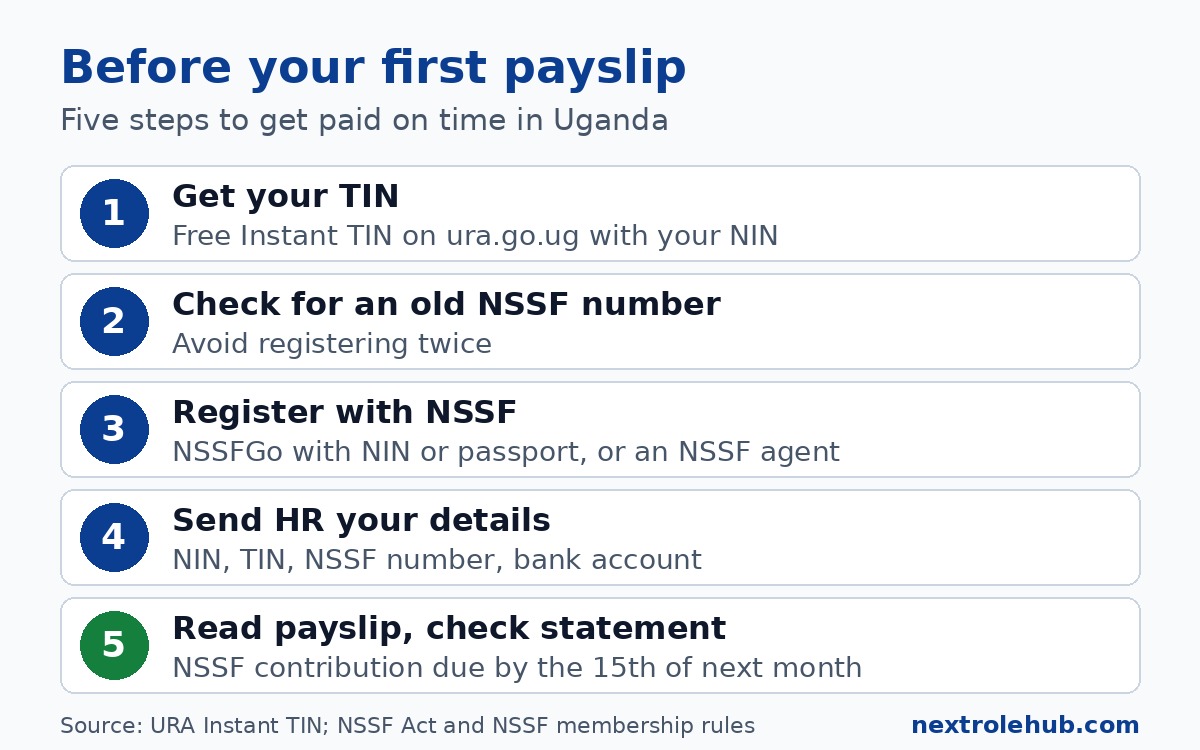
- Get your TIN. URA issues it free of charge. If you have a NIN, the Instant TIN application on ura.go.ug needs only the NIN and a working phone number, and URA says the TIN comes within about five minutes. It is a 10-digit number you keep for life, even when you change jobs.
- Check whether you already have an NSSF number. If you did paid work before, even a short contract, you may already be registered. Ask your old employer or NSSF before registering again, so all your savings sit under one number.
- Register with NSSF if you are new. NSSF lets employees register online through NSSFGo with a NIN or passport number. NSSF also lists certified Quickteller agents where registration is free; carry your NIN and a phone line registered in your own name.
- Hand HR your details in writing. Send your NIN, TIN, NSSF number and bank account name and number in one email, so there is a record if a field is typed wrongly.
- Read the first payslip line by line using the table above, then confirm the NSSF contribution on your statement the following month.
Under the NSSF Act, an eligible employee must register as a member and show proof of membership to the employer. Since the NSSF (Amendment) Act 2022, NSSF says every employer must contribute, whatever its number of staff, including for temporary, casual and subcontracted workers. So a small company is not a reason to skip NSSF.
If your first job comes after a long search, our guide on getting hired without experience in Uganda covers the routes many graduates use to land that first payslip.
How PAYE Is Worked Out on Your Pay
PAYE (Pay As You Earn) is income tax your employer deducts and pays to URA on your behalf. URA’s employment income guidance says the employer must remit it and file the monthly return by the 15th day of the following month, and must keep payroll records for at least five years.
From 1 July 2026, these are URA’s monthly bands for resident employees:
| Monthly chargeable income (UGX) | PAYE for a resident employee |
|---|---|
| Up to 335,000 | Nil |
| 335,001 to 410,000 | 20% of the amount above 335,000 |
| 410,001 to 485,000 | 15,000 plus 25% of the amount above 410,000 |
| 485,001 to 10,000,000 | 33,750 plus 30% of the amount above 485,000 |
| Above 10,000,000 | As above, plus an extra 10% on the amount above 10,000,000 |
Source: URA, PAYE rates for resident individuals, under the Income Tax (Amendment) Act 2026.
For anyone earning more than UGX 485,000 and less than UGX 10 million, there is a fast check: PAYE = 33,750 + 30% × (taxable pay − 485,000). Run that on your taxable pay line. If the answer is off by more than a few shillings of rounding, ask payroll why.
What goes into taxable pay
URA counts wages, salary, leave pay, overtime, commission, gratuity, bonuses and cash allowances for things like housing, transport, utilities and cost of living as employment income. Benefits in kind count too, such as a company car you use privately, a house your employer provides or a low-interest staff loan above one million shillings.
Some items stay out. URA lists reimbursed medical expenses, refunds of costs you met while doing your job, meals given to all staff on equal terms at the workplace, and any benefit worth less than UGX 10,000 in the month. Your own 5% NSSF contribution is not on that list; URA notes that an employee’s own retirement fund contribution remains taxable.
How NSSF Is Worked Out, Including the 10% You Never See Deducted
NSSF says the employer must deduct 5% of the employee’s total gross monthly wage, add 10% of the same wage, and pay the full 15% to the Fund by the 15th day of the following month. Mandatory cover applies to employees aged 16 to 55, except those under the Government pension scheme.
“Wage” is wider than basic salary. The NSSF Act defines wages as all emoluments payable in cash under your contract of service before any deductions. Cash allowances paid under your contract therefore usually sit inside the NSSF base, while a non-cash benefit such as a company house does not. If your NSSF line equals exactly 5% of basic salary while you also receive cash allowances, ask HR which figure they use.
Because your contribution goes in a month after it is deducted, the October deduction should appear on your statement after 15 November. You can check through the NSSFGo app or the NSSF website, or call NSSF on the toll-free line 0800 286 773.
From our editor, who has worked in Ugandan banking since 2019: keep your payslips with your bank statements. When you apply for a salary loan, the lender usually asks for recent payslips alongside your account statement, and a payslip whose net pay matches the bank credit to the shilling saves you a round of questions.
Local Service Tax: The Line That Appears Only From July to October
Local Service Tax (LST) is an annual tax for your local government, not URA. KCCA’s published LST guidance says salaried employees pay it in the first four months of the financial year, which starts in July, and Nansana Municipal Council’s LST FAQs say employers may deduct it in four equal instalments. That is why a deduction suddenly appears in July and disappears after October.
| Monthly income (UGX) | LST per year (UGX) | Per instalment if split in four |
|---|---|---|
| 100,000 or less | Nil | Nil |
| 100,001 to 200,000 | 5,000 | 1,250 |
| 200,001 to 300,000 | 10,000 | 2,500 |
| 300,001 to 400,000 | 20,000 | 5,000 |
| 400,001 to 500,000 | 30,000 | 7,500 |
| 500,001 to 600,000 | 40,000 | 10,000 |
| 600,001 to 700,000 | 60,000 | 15,000 |
| 700,001 to 800,000 | 70,000 | 17,500 |
| 800,001 to 900,000 | 80,000 | 20,000 |
| 900,001 to 1,000,000 | 90,000 | 22,500 |
| Above 1,000,000 | 100,000 | 25,000 |
Source: KCCA Local Service Tax FAQs (June 2014 edition, the schedule set by the Local Governments (Amendment) Act 2008). The instalment column is the annual figure divided by four.
Two details matter. First, KCCA defines the income band using “take-home salary”, meaning gross pay after PAYE, so check which figure your employer uses if you sit near a band edge. Second, URA says LST is deductible before computing tax, so your PAYE is slightly lower in the four LST months. Members of the UPDF, Uganda Police and Uganda Prisons are among the groups KCCA lists as exempt.
A Worked PAYE NSSF Uganda Payslip: UGX 1.35 Million Gross
Take an example: Grace is a resident accounts assistant in Ntinda with one employer. Her contract pays a basic salary of UGX 1,100,000, a transport allowance of UGX 150,000 and a housing allowance of UGX 100,000, all in cash. Here are her November and October payslips side by side.
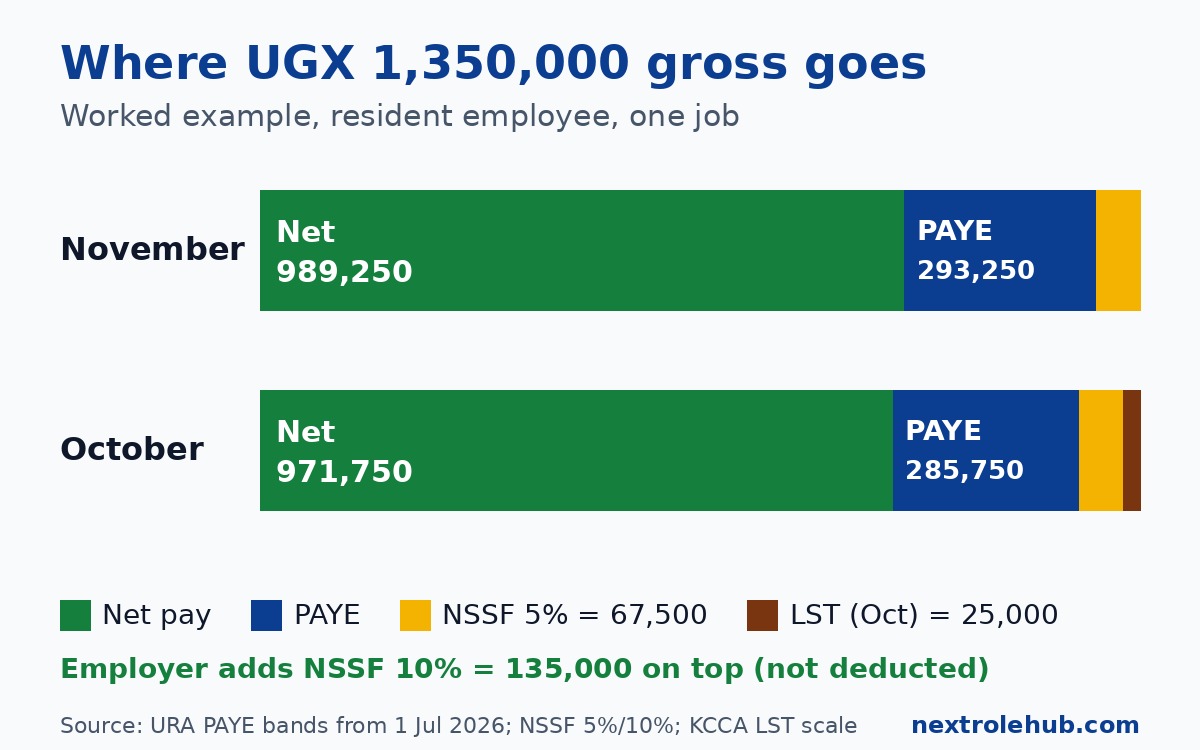
| Line | November (no LST) | October (LST month) |
|---|---|---|
| Basic salary | 1,100,000 | 1,100,000 |
| Transport allowance | 150,000 | 150,000 |
| Housing allowance | 100,000 | 100,000 |
| Gross pay | 1,350,000 | 1,350,000 |
| Less LST allowed before tax | 0 | 25,000 |
| Taxable pay | 1,350,000 | 1,325,000 |
| PAYE | 293,250 | 285,750 |
| NSSF employee (5% of gross) | 67,500 | 67,500 |
| LST | 0 | 25,000 |
| Net pay | 989,250 | 971,750 |
| NSSF employer (10%, paid on top) | 135,000 | 135,000 |
All figures in UGX, calculated by NextRoleHub from URA’s resident PAYE bands, NSSF’s 5% and 10% rates and KCCA’s LST scale, assuming the employer splits LST into four instalments.
The PAYE working, step by step
- November taxable pay is UGX 1,350,000. The amount above 485,000 is 865,000.
- 30% of 865,000 is 259,500. Add the fixed 33,750 and PAYE is UGX 293,250.
- In October, the 25,000 LST instalment comes off first, so taxable pay is 1,325,000. The amount above 485,000 is 840,000, 30% of that is 252,000, and PAYE is UGX 285,750.
- NSSF is 5% of the full 1,350,000 cash wage in both months: UGX 67,500. Grace’s employer adds 135,000, so UGX 202,500 should reach her NSSF account each month.
Notice what happens in October. Grace pays 25,000 in LST, but her PAYE drops by 7,500 because LST is deducted before tax. Her net pay falls by 17,500, not the full 25,000. Her LST band is the top one whichever income figure is used: gross is 1,350,000, and gross after PAYE is about 1,056,750, both above UGX 1 million.
If Grace’s offer letter had said “UGX 1.35 million” and she had budgeted on that, she would be about UGX 360,000 short every month. This is why our guide on how to negotiate salary in Uganda recommends agreeing on the net figure, not just the gross.
Want to test your own salary? Enter your gross pay and see PAYE, NSSF and net pay in one go.
Seven Payslip Errors Worth Catching Early
Most payroll mistakes are honest ones, such as an old rate left in the system or an allowance coded in the wrong place. They are still your money, and small monthly errors add up over a year.
1. PAYE still on the old bands
The old rates started taxing pay above UGX 235,000. If you earn UGX 485,000 or more and your PAYE is UGX 13,750 higher than the formula above gives, payroll may still be on the pre-July 2026 bands. URA asked employers to amend returns filed at the old rates and refund staff, usually through a later payslip; our PAYE refund guide explains how to ask.
2. NSSF taken from you at 15%, or at 10%
Your share is 5%. If the deduction line equals 10% or 15% of your wage, the employer’s share is being charged to you. On a UGX 800,000 wage, the correct employee line is UGX 40,000.
3. NSSF deducted but missing from your statement
This is the most serious one, because the money left your pay. Compare each payslip with your NSSF statement a few weeks after the 15th. The NSSF Act says that where an employer deducts your share but does not pay it, your account is to be credited with the amount, subject to conditions set by the Minister. You still need payslips as proof, so keep every one.
4. LST after October, or above the yearly amount
Add up your July to October LST lines. The total should match one figure from the scale above, never more than UGX 100,000. An LST line in November or later, without an explanation such as a recovery agreed with you, needs a question.
5. PAYE worked out after taking off NSSF
This looks like good news because your tax is lower, but URA treats your own NSSF contribution as taxable. If payroll is underpaying tax, the employer is liable to URA and may later recover the shortfall from you. A larger correction months later is harder on your budget than getting it right now.
6. An allowance missing from gross, or left out of tax
Check that every allowance in your contract appears as an earning line. Then check it is inside taxable pay. A cash housing or transport allowance kept out of PAYE without a legal reason creates the same underpayment risk as error 5.
7. A deduction you never agreed to
The Employment Act allows deductions for taxes and contributions imposed by law, and some others only with your written consent. A “staff welfare” or “uniform” deduction you never signed for is worth querying, as is a loan recovery that has not gone down in three months.
How to Raise a Payslip Error With HR
Do it in writing, keep it short and show your working. Payroll teams fix specific, numbered queries much faster than “my salary looks low”.
- Gather the payslips involved, your contract or latest pay change letter, and your NSSF statement if the issue is NSSF.
- Write down the figure you expected and how you got it, using the PAYE formula or the NSSF rate.
- Email HR or payroll with the month, the line and the difference.
- Give them one pay cycle to explain or correct it.
- If NSSF contributions stay missing, contact NSSF customer service with your payslips. If your employer will not give you accurate pay statements, the Employment Act gives you the right to complain to a labour officer at your district.
Sample message to payroll
Subject: Query on my October 2026 payslip
Hello [Name], my October payslip shows PAYE of UGX [amount] on taxable pay of UGX [amount]. Using URA’s resident bands from 1 July 2026, I calculate UGX [amount]. Could you please confirm which rate table and taxable pay figure payroll used? I have attached the payslip and my working. Thank you, [Your name], [Staff number]
Non-Residents, Second Jobs and Interns
Non-resident employees get no tax-free threshold. URA’s non-resident table starts at 10% on the first UGX 335,000, and that schedule was not changed in 2026. Residence is a tax test, not a nationality one, so a Ugandan who has lived abroad, or a foreign national living here, should confirm status with HR or URA before trusting any calculator.
Second jobs and part-time work are taxed differently. URA says part-time or secondary employment earnings are taxed at a flat 30% of the gross amount, or 40% where your main job pays above UGX 10 million. If that overtaxes you, you can file a return covering all your income and claim the overpayment. On NSSF, each employer pays contributions on the wages it pays you.
Interns and trainees on paid placements should ask HR whether NSSF applies. The NSSF Act’s definition of a contract of service includes apprenticeships and learnerships, but placement terms vary. If your monthly allowance is UGX 335,000 or less and you are resident, there should be no PAYE on it. Browse current internship programmes in Uganda if you are still looking.
Public servants pay PAYE on the same bands, but many are on the Government pension scheme, which NSSF’s mandatory cover excludes. Our guide to government salary scales in Uganda explains how their pay is structured.
Payslip Questions Ugandan Employees Ask
Is NSSF deducted from gross or net salary in Uganda?
NSSF is worked out on your gross cash wage, not on what is left after tax. NSSF’s rule is 5% of the total gross monthly wage from you and 10% from your employer. The NSSF Act defines wages as cash emoluments payable under your contract before deductions, so cash allowances in your contract usually count in the base.
Do I need a TIN before I start my first job?
Most employers ask for one during onboarding so payroll can report your PAYE against your name. URA issues TINs free. With a National ID number and a working phone, the Instant TIN form on ura.go.ug generates it within minutes. Without a NIN the instant route will not work, so check the document list on URA’s Get a TIN page and start early, because the standard application is verified by URA staff.
How do I check that my employer paid my NSSF?
Log in to the NSSFGo app or website and view your statement. Match each month against your payslips. Employers have until the 15th of the following month to pay, so give it a few weeks. If a month is still missing, raise it with HR in writing, then call NSSF on 0800 286 773 with copies of your payslips.
Why did my net pay go up in November?
For most employees, Local Service Tax is collected only from July to October. Once the last instalment is taken in October, the LST line drops off and your net pay rises. Your PAYE also rises slightly, because LST is no longer reducing taxable pay. The two effects together are why the change is smaller than the LST instalment itself.
Can my employer deduct money without my consent?
Only for deductions allowed by law, such as PAYE, NSSF and LST, plus certain others you have agreed to. The Employment Act requires an itemised pay statement showing the purpose of each deduction. If a deduction is unexplained or you never agreed to it, query it in writing. A labour officer can order an employer to repay deductions that were not made properly.
What is “chargeable income” on my payslip?
It is the figure PAYE is calculated on. It starts from your gross employment income, adds taxable benefits in kind such as a company car used privately, and takes off items URA allows, such as LST in the collection months. It is often different from basic salary, so always run your PAYE check on this line rather than on gross.
Do I file a tax return if I only have one job?
URA says you do not need to file a return if your only income is one employment and the tax on it was fully deducted at source. You need a return if you have income from more than one source, for example a second job, business or rental income. Filing is also how you claim back PAYE that was overpaid during the year.
Is employer NSSF part of my salary?
Not your cash salary. The 10% employer contribution goes straight to your NSSF account and is never deducted from you, so it should not reduce your net pay. It is still your money: it builds your NSSF balance, which you can later access under the Fund’s benefit rules. Some offers quote “cost to company”, which includes it, so ask for the gross figure separately.
Your Five-Minute Payday Checklist
Reading PAYE NSSF Uganda payslips gets quick once you have done it twice. Each payday, run through this:
- Earnings lines match your contract, and they add up to gross.
- PAYE matches 33,750 + 30% of taxable pay above 485,000 (for pay between UGX 485,000 and 10 million).
- Your NSSF line is 5% of gross cash wage, and last month’s contribution shows on your statement.
- LST appears only from July to October and totals one figure on the official scale.
- Every other deduction is one you agreed to.
- Gross minus all deductions equals the amount credited to your account.
Save each payslip as a PDF in one folder. If something is off, raise it in writing within the month, while the figures are fresh for you and for payroll.
Comparing offers? Check the net pay first, then apply. New verified vacancies are posted every day.