Job offer checks should begin with what will reach your bank account and the terms you are accepting. An offer may refer to an unseen handbook, leave probation open-ended or describe a role differently from the interview. Resolve those gaps before accepting or arranging a move.
Read the offer together with the employment contract, job description and any policies it incorporates. Salary is only one part of the decision. Your working days, duty station, medical cover and conditions attached to the appointment can change what the offer means for your household.
This guide gives you a clause-by-clause review, the written particulars required under Ugandan employment law, probation and leave rules, and a message you can send HR. It covers employment in Uganda, not the separate requirements for recruitment abroad. A discretionary benefit is not guaranteed income, and a contract cannot simply remove a protected statutory right.
Last checked: 14 November 2026 against the Employment Act, Cap. 226, as amended, the Employment (Amendment) Act, 2026 and NSSF guidance. The consolidated Act identifies its current version as 5 June 2026. This is general information, not individual legal advice; take a disputed clause to a labour officer or Ugandan advocate.
Table of Contents
Job offer: what should you check before accepting?
Before accepting a Ugandan job offer, confirm the legal employer, duties, location, gross salary, deductions, benefits, working hours, probation, leave and notice terms. Read every referenced policy and ask for unclear promises in writing. Check any conditions attached to the appointment, then keep the final agreed documents and your acceptance together.
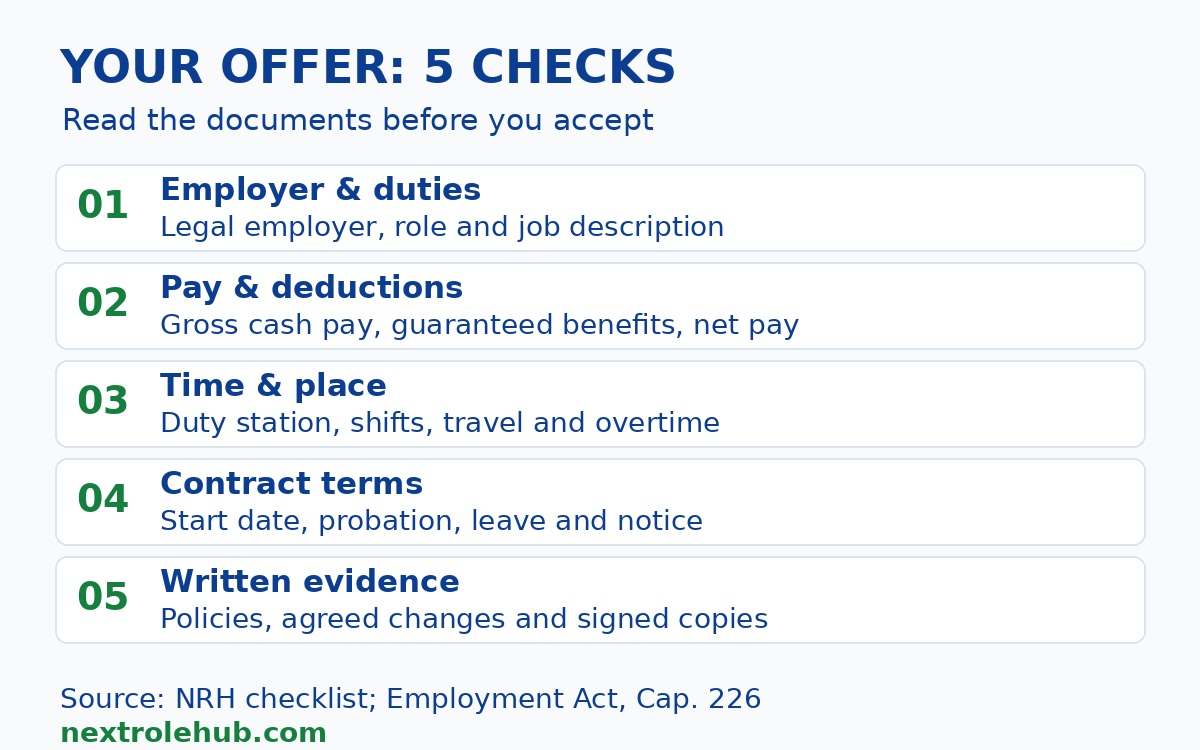
Use two separate questions: does the offer meet the legal minimum, and does it work for you? An offer can satisfy employment law yet still require a commute or relocation you cannot afford. Conversely, a generous headline package does not repair a clause that tries to remove a protected right.
| Part of the offer | Check the document for | Ask before accepting |
|---|---|---|
| Employer and role | Legal employer name, job title, reporting line and duties | Who employs me, and which job description forms part of the agreement? |
| Money | Gross cash pay, payment frequency, deductions and variable earnings | Which amounts are guaranteed, and what is the expected net payment? |
| Time and place | Duty station, hours, shifts, travel and transfer wording | Does the role include weekend work or regular field assignments? |
| Employment terms | Start date, duration, probation, leave and notice | Which conditions must be met before the appointment becomes effective? |
| Referenced documents | Handbook, benefits rules and bonus or commission policy | Can I read the versions that will apply before I accept? |
An offer letter and an employment contract are not always separate
Do not judge the document only by its heading. An appointment letter may contain the employment terms itself, while another employer sends a short offer followed by a detailed contract. Read the actual wording, including anything saying that your acceptance creates an agreement or depends on later approval.
Section 24 of the current Employment Act recognises oral contracts of service unless another law requires writing. That does not make a phone conversation good evidence of a promised allowance. Ask for the complete written terms before committing, even where an oral employment relationship could exist.
Check whether the offer is conditional on references, qualification verification, a medical assessment or another stated requirement. Ask who confirms completion and whether the proposed start date depends on it. Do not describe a conditional appointment as unconditional when making arrangements with your current employer.
The original Employment Act, 2006 on Parliament’s website provides historical context, but it is not the whole current position. The 2026 amendment changed matters including probation and sick pay. This guide uses revised Cap. 226 section numbering; older copies may number the same provisions differently.
What Uganda requires in written employment particulars
Section 58 requires written employment particulars no later than twelve weeks after employment begins. That is a statutory deadline after starting, not a recommendation to accept an unexplained offer now. Request the information before signing so you can assess the job on known terms.
- Names and addresses of both parties, the employment start date and the date continuous service begins.
- Your job title and where you will perform the work.
- Your wages or calculation method, payment intervals, deductions and other pay conditions.
- The applicable overtime rate, normal working hours, shifts and working days.
- Annual leave entitlement and pay during leave, plus sickness or injury terms, including sick pay.
- Any agreed notice requirement longer than the Act provides.
The employer can refer you in writing to another document for these details, provided it is reasonably accessible during working hours and in a form and language you can reasonably understand. Ask for access before accepting; a reference to an unseen policy leaves you unable to evaluate its effect.
Agreed changes to these particulars must also be notified in writing. Keep the original offer, later revisions and policy references together. If HR corrects the salary in an email but the contract still shows the old figure, request a consistent final document rather than relying on two conflicting versions.
Section 25 also provides for attestation by a magistrate or labour officer where an employee cannot read or understand the contract’s language. Do not sign an unexplained document because someone describes it as standard. Ask for the required explanation and process before giving final agreement.
Separate guaranteed pay from deductions and possible benefits
Ask HR to identify basic salary, total gross cash earnings and expected take-home pay separately. A figure described as a package might include employer-paid benefits rather than money you receive. Request a written breakdown and a payroll illustration using your actual circumstances, with assumptions clearly stated.
For employees covered by mandatory NSSF contributions, NSSF’s membership guidance says the employee contributes 5% of total gross monthly wages and the employer adds 10%. The employer’s contribution is not an additional 10% deduction from your salary. Mandatory coverage has eligibility rules and excludes employees under the Government pensions scheme.
PAYE and other lawful deductions affect net pay too. This is not a tax-rate guide: use our PAYE and NSSF payslip explanation to understand the lines, then ask payroll to explain the calculation for this offer. Do not assume your previous employer’s net figure will transfer unchanged.
For bonuses and commission, ask what triggers payment, how performance is measured, when payment is made and whether discretion remains with the employer. A target-based earning opportunity should not be budgeted as fixed monthly salary. Request the actual scheme rather than an interview estimate.
Medical cover needs similar care. Ask when membership starts, who is covered, what limits apply and whether employee contributions are required. For field work, distinguish a reimbursement of approved expenses from a cash allowance. You cannot treat money spent doing the job as disposable household income.
If the package needs improvement, use our salary negotiation scripts for Uganda. Keep the discussion specific: name the term you want changed and request the approved revision before accepting.
Probation rules changed in 2026: check the current wording
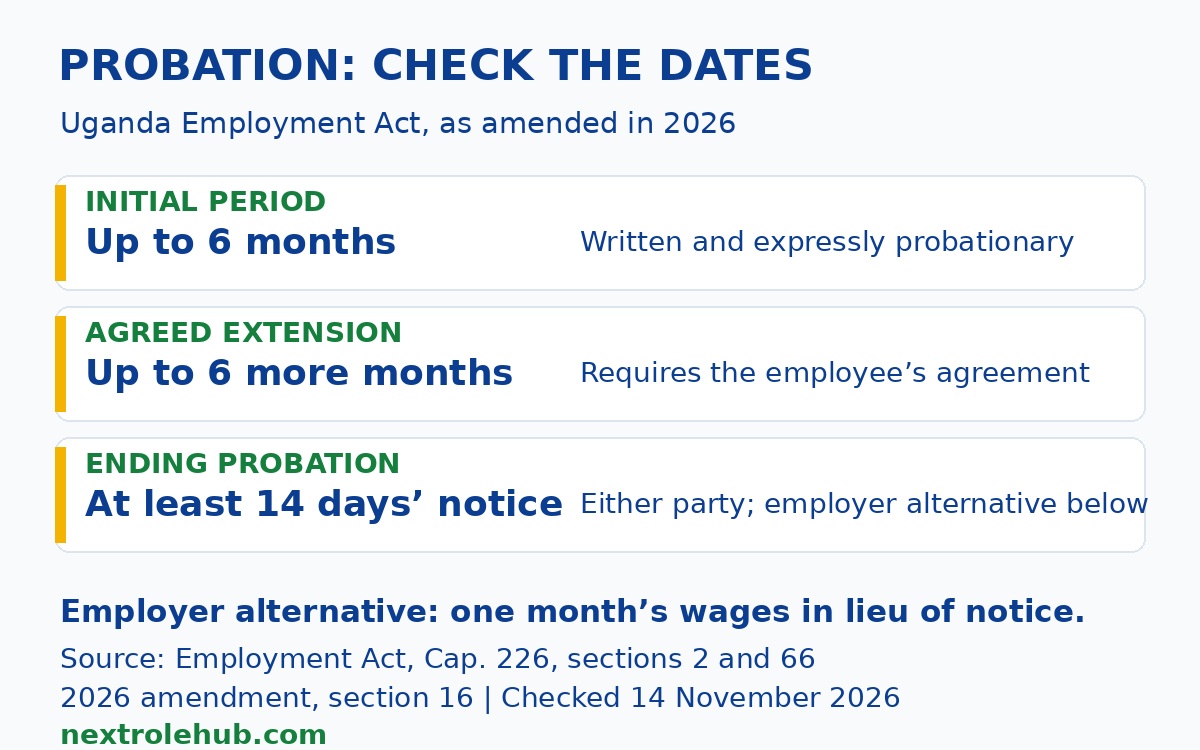
A probationary contract must be written and expressly identify the probationary period. Under the Act’s definition and section 66, initial probation cannot exceed six months. An extension can be for up to a further six months, but requires the employee’s agreement. The same employer cannot put the employee on probation more than once.
Ask for the start and end dates, assessment criteria, review arrangements and decision-maker. If pay or benefits will change after confirmation, ask for the actual entitlement and trigger. Confirmation does not, by itself, establish a salary increase that the employer never agreed to provide.
The 2026 amendment’s section 16 added a confirmation rule: where the employer does not extend probation and continues paying the employee after probation lapses, the employee is deemed confirmed. The statutory conditions matter; expiry of the calendar period alone does not explain every case.
Either party may end a probationary contract with at least fourteen days’ notice. The alternative specified for an employer is payment of one month’s wages instead of notice. Older material mentioning seven days’ wages reflects the former text, not the amended rule. Ask HR to correct an outdated template.
Probation has distinct legal treatment, so avoid assuming every rule for confirmed employment applies identically. If there is already a dispute over confirmation, notice or dismissal, take the documents and payment record to a labour officer or advocate. This offer checklist cannot decide an individual claim.
Check leave eligibility, shifts and overtime together
Read leave in days and working arrangements in actual hours. A promise of generous time off is hard to assess if the contract never identifies the workweek. Ask how public holidays, shift rosters and approval procedures operate for your duty station, especially in customer-facing or field roles.
| Area | Current statutory position to check | Question for HR |
|---|---|---|
| Annual leave | Section 53: seven days with full pay for each continuous four months of service. Applies after at least six months’ continuous service and normally at least sixteen hours weekly. | How is entitlement recorded and leave scheduled? |
| Sick pay | Section 54: after at least one month’s continuous service, qualifying incapacity attracts full wages and contractual benefits for the first two months. The employer may pay half monthly wages for the next four months if sickness continues. | How do I notify absence and provide medical evidence? |
| Maternity leave | Section 55: sixty working days on full wages, with at least four weeks following childbirth or miscarriage. | What notice and supporting documents are requested? |
| Paternity leave | Section 56: four working days yearly on full wages, immediately following delivery or miscarriage by a wife. | How should I notify HR and my supervisor? |
These are summaries of sections 53 to 56 of the amended Act, not an exhaustive leave policy. Sick pay also requires notification as soon as reasonably practicable and a medical certificate if properly requested; section 54 applies to employees normally working at least sixteen hours weekly. Do not replace these conditions with a claim that sick pay begins only after confirmation.
For hours, section 52 starts from a forty-eight-hour working week but includes agreements, limits and shift-work exceptions. It also addresses breaks and overtime. Ask for your exact roster and the written overtime terms instead of relying on a blanket statement that every hour beyond an office timetable is paid identically.
Where you will work on public holidays, ask how the employer applies section 53’s alternative-day and double-rate provisions. Medical insurance is separate from sick-pay entitlement. A policy explaining hospital cover does not answer what wages continue during a qualifying absence.
Read notice clauses against service length, not salary alone
Notice after probation is not simply one month for everyone. Section 57 links minimum periods to service length, and a longer pay period can affect the entitlement. A contract may provide longer notice. Read both employer and employee obligations, and ask HR how any payment instead of notice would be handled.
The Act specifies at least two weeks for service of more than six months but less than one year; at least one month for more than twelve months but less than five years; two months from five to under ten years; and three months for ten years or more. These are statutory threshold descriptions, not a calculation for your own departure date.
The wording leaves exact boundary cases requiring care, including the twelve-month point. For an actual termination or disputed anniversary, ask a labour officer or advocate to apply the Act, your pay period and the contract. Do not shorten a contractual notice period by relying on a general online summary.
Section 3 makes a contractual provision void where it limits the Act to the employee’s detriment. Signing therefore does not validate every restrictive clause. Have an advocate review training repayment, broad deductions or restrictions on future work before agreeing; their effect depends on the wording and applicable law. Resignation procedures and severance calculations are outside this guide.
Send HR one focused clarification request
A short written request creates a clearer record than several phone conversations. Use the sample below as an original starting point, remove questions already answered and replace the bracketed fields. It is a request for clarification, not an acceptance of the offer.
Subject: Clarification of offer for [role]
Hello [name], thank you for offering me the [role] position. Before I confirm my decision, please share the complete contract and referenced policies. Please also confirm the gross cash salary, expected deductions, guaranteed allowances, duty station, working days and probation dates. I would appreciate written details of [specific benefit or clause discussed] and confirmation of any outstanding appointment conditions. Please let me know the agreed response deadline. Kind regards, [name].
After a call, send a factual summary and ask HR to confirm or correct it. If a change is approved, request the revised clause or attachment. Keep negotiations separate from acceptance so a message intended to ask a question does not also say you accept every existing term.
Before accepting, close these avoidable gaps
- Compare the offer, contract and job description for conflicting pay, dates or duty stations.
- Obtain each referenced policy and identify benefits that depend on separate approval.
- Confirm conditions, response deadline and a realistic start date in writing.
- Review travel and relocation costs using your own actual budget, not an invented market average.
- Save the agreed version, attachments, clarification emails and a copy of whatever you sign.
Stop and seek advice if the employer refuses to identify the legal employer, will not explain pay deductions or pressures you to sign a document you cannot understand. An unanswered question is not proof of wrongdoing, but it is still an unresolved risk. Do not silently replace missing terms with what a friend receives elsewhere.
Once you start, compare the first payslip with the agreement and check contributions using our NSSF statement and missing-payment guide. If this is your first appointment after university, our first-job planning guide covers the wider transition without duplicating the contract review here.
Questions about accepting an employment offer in Uganda
Should I accept before HR sends the staff handbook?
Ask for the policies incorporated into your terms before deciding. A handbook may determine benefits, working arrangements or procedures that the offer does not explain. If HR cannot share it immediately, request written answers on the terms affecting your decision and ask for an agreed response extension. Do not assume an unseen document contains the arrangement described at interview.
Does permanent employment mean the job cannot end?
No. Do not treat the word permanent as a guarantee of employment for life. Read the contract duration and lawful termination provisions together. An open-ended appointment differs from a fixed-term contract, but employment can still end under applicable law. If the letter uses permanent in one place and gives an end date elsewhere, request a consistent explanation before accepting.
Can an employer promise a pay rise after probation without stating an amount?
It can discuss a future review, but a review is not the same as an agreed increase. Ask whether the change is guaranteed or discretionary, what performance conditions apply and how approval works. Request the revised salary or calculation method if an increase is actually agreed. Do not budget for an amount that appears only in your own expectations.
What if the employer changes a term after I sign?
Keep the signed version and ask for the proposed change, its effective date and the reason in writing. Section 58 requires written notification of agreed changes to the listed particulars. That rule does not mean every unilateral change is lawful. If you disagree or feel pressured, obtain case-specific advice before signing a variation, particularly where pay or location changes materially.
Does a recruitment agency’s letter identify my employer?
Not necessarily. Clarify whether the agency employs you or only recruits for another organisation. Ask which legal entity signs the contract, pays wages and handles employment queries. A client’s brand on the vacancy is not enough to settle that question. Where recruitment abroad is involved, additional agency and contract rules apply; obtain advice specific to that arrangement rather than using this domestic checklist alone.
Where should I take a clause I believe removes my rights?
Keep the complete contract, offer, referenced policies and relevant correspondence, then contact a district labour officer or a Ugandan advocate. Identify the exact clause and the outcome you need explained. Section 3 protects against contractual terms that undermine the Act to your detriment, but applying it to your circumstances requires more than highlighting an isolated sentence from the agreement.
Accept the documented job, not the interview promise
Use this job offer checklist to resolve the terms that will affect your actual work and income. Read the full agreement, separate guaranteed earnings from possible benefits, check current probation and leave provisions, and keep the final version. Where a clause is disputed, get professional advice before treating a signature as the end of the discussion.
Choose the unresolved point that matters most and send HR a specific written question today. Once the answer is reflected in the documents, make your decision on the job being offered, not the version you hope will appear after you start.