Facing a toxic work environment in Uganda? Use an incident log, a sample grievance letter and official complaint routes before making your next move.
A toxic work environment in Uganda calls for a practical response: get to safety if there is a threat, record specific incidents, and choose a complaint route that fits the conduct. You do not have to resign before seeking help. Nor do you need to prove that the whole organisation is toxic before reporting a particular incident.
The difficult part is deciding what to do when your income depends on the job. A supervisor may control your roster, references or contract renewal. You may work in a small shop without HR, a Kampala office with a formal grievance policy, or a project where your employer is not the client whose name appears at the site.
This guide explains how to separate poor management from conduct that may breach employment law, preserve evidence without taking confidential records, write an internal grievance and approach a district Labour Officer. It includes an original incident-log template and a sample letter. The legal position matters: Uganda’s employment protections changed in June 2026, so older advice about employer size and harassment can be misleading.
Last checked: 9 November 2026 against the gazetted Employment (Amendment) Act, 2026 and MGLSD’s LAMIS complaint guidance. This is general information, not legal advice. Get individual legal advice about deadlines, resignation, dismissal or a settlement.
Table of Contents
Toxic work environment in Uganda: what should you do first?
First identify what happened, who was involved and whether you face immediate danger. Preserve relevant evidence and check the employer’s complaint procedure. Raise a factual grievance where safe, or seek guidance from a Labour Officer. If resignation, dismissal or serious harassment is involved, obtain legal advice before making irreversible decisions.
A demanding deadline or accurate criticism is not automatically harassment. Look at the behaviour and context: repeated humiliation, threats tied to employment, unwanted sexual conduct, discriminatory treatment or deliberate interference with your work. A single serious incident can be reported, and if your safety is at risk, get help immediately rather than waiting for a pattern. Whether it amounts to harassment in law depends on the evidence and the legal test.
| Situation | Useful first response | What not to assume |
|---|---|---|
| Conflicting instructions or unclear targets | Ask for written priorities and a realistic delivery sequence. | Every management disagreement is a legal claim. |
| Public insults, threats or deliberate isolation | Record the incident and seek a safe reporting route. | You must tolerate it because the speaker is senior. |
| Unwanted sexual messages or contact | Preserve evidence and seek the harassment reporting channel or Labour Officer. | A small employer is exempt from prevention duties. |
| Violence or a credible immediate threat | Move somewhere safe and seek police or urgent medical help as needed. | An HR meeting must happen before you can seek safety. |
Do not confront an alleged perpetrator alone if you fear violence or coercion. If the problem is affecting sleep, concentration or health, consider professional medical support. A medical record can document treatment and reported symptoms; it does not by itself establish who committed an employment-law breach.
What Uganda’s employment law now says about harassment
Read the Employment Act, 2006 alongside its revised Chapter 226 text and the 2026 amendment, not as an unchanged law. The Ministry’s laws collection includes the original Act. Older copies and guides can use different section numbering, so identify the version whenever you quote a provision.
The gazetted amendment linked above states that it commenced on 5 June 2026. It inserts section 6A, prohibiting an employer or the employer’s agent from harassing or intimidating an employee at work. It covers abusive conduct and behaviour that disrupts work or creates a hostile working environment. Examples include humiliating public outbursts, insults about competence and threatening communications. Contravening that section is an offence.
The amendment also changes section 6(4) of the revised Act: every employer must put sexual-harassment prevention measures in place and display them visibly. Do not repeat the old claim that only workplaces with more than 25 employees have any prevention obligation. That broader duty now applies regardless of size.
The Employment (Sexual Harassment) Regulations, 2012 give detailed complaint procedures. The ULII version checked records amendments through 31 December 2023, so read its older employer-size wording with the later Act. It describes written acknowledgement, impartial investigation, limited disclosure and protection from retaliation. Sexual harassment includes unwelcome sexual language, material or physical behaviour in the circumstances described by the law, not only demands for sex.
Early May and June 2026 commentary referred to an amendment awaiting commencement. That is historical commentary, not the current position shown by the gazetted Act. If an incident predates the amendment or involves a disputed employment relationship, ask a lawyer or Labour Officer which provisions apply. Do not assume the new offence applies retrospectively.
Keep an incident record without taking confidential files
Write a dated note as soon as you reasonably can. Separate what you directly saw or heard from what someone later told you. Use the exact words only when you remember them; otherwise identify your account as a summary. Mark an approximate time as approximate rather than inventing precision.
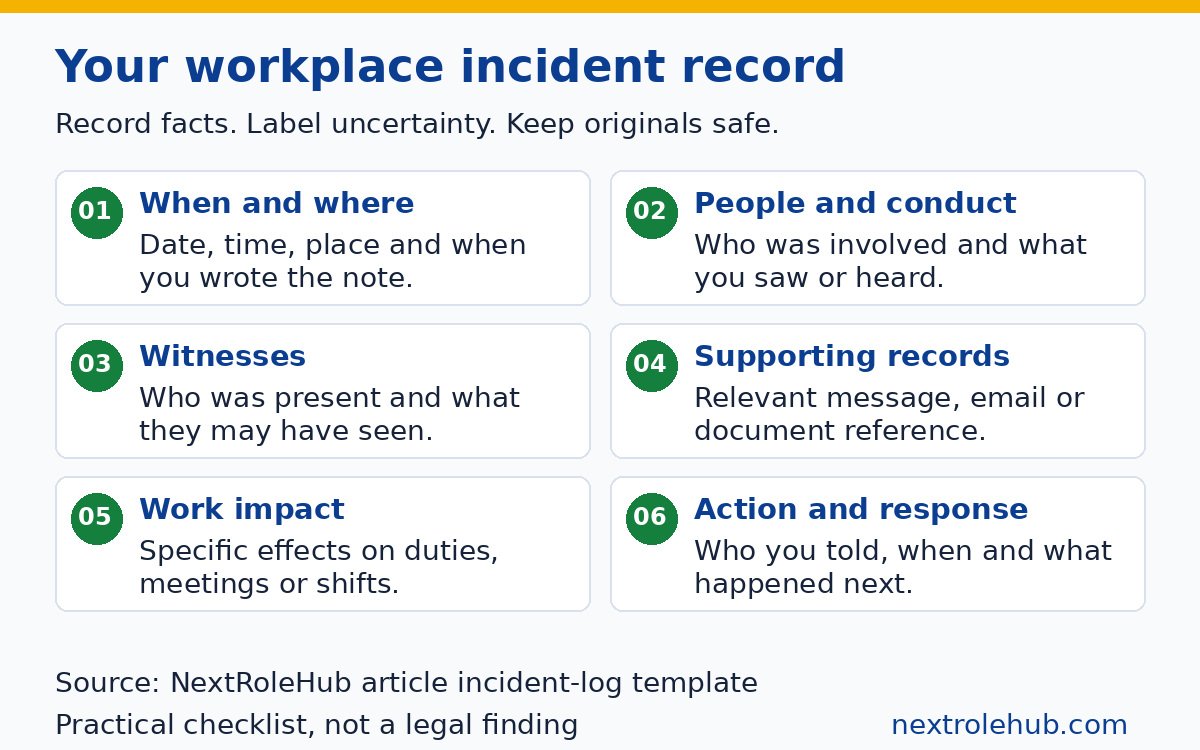
| Field | What to record |
|---|---|
| Date, time and place | When and where the incident happened; when you wrote the note. |
| People and conduct | Names or roles, observable actions and words you can accurately recall. |
| Witnesses | Who was present and what they may have observed. |
| Supporting material | Relevant message, email, meeting invitation or document reference. |
| Work impact | A missed task, disrupted meeting, changed roster or other specific effect. |
| Action and response | Who you told, when, how and what happened next. |
For example, a fictional accounts assistant in Jinja could record that a supervisor shouted an insult during a reconciliation meeting, identify who attended and reference a follow-up email. Writing “management hates me” gives an investigator little to test. Describing the meeting, words and subsequent instructions gives a starting point without claiming a legal finding.
Keep relevant messages in their original context where you are entitled to retain them. A cropped screenshot may omit the sender, date or preceding exchange. Keep an evidence index so you can find the original. Do not alter messages, pressure witnesses to agree with you or present another person’s account as your own.
Do not send customer databases, patient files, beneficiary lists, account details or company secrets to your personal email. Request a lawful preservation or disclosure route instead. Ask a lawyer before covertly recording conversations: recording, privacy and later use of the material raise issues this general guide cannot resolve. Protect your notes with a password and share them only with people handling the matter.
Raise an internal grievance that someone can investigate
Check your contract, staff handbook and displayed harassment contacts. Identify the designated recipient and any appeal route. If your line manager is the subject of the complaint, use the alternative channel provided by the policy or seek external guidance. A grievance should not require you to hand sensitive evidence back to the person accused without considering safety.
- State that you are raising a formal grievance, not merely requesting an informal chat.
- Describe the incidents in date order and attach a short evidence index.
- Explain the work impact and the immediate protection or correction you need.
- Request acknowledgement, the next procedural step and a contact for follow-up.
- Keep proof of submission and note any agreed dates.
Ask for workable remedies: a neutral investigator, clear reporting arrangements, an end to abusive messages or temporary separation that does not penalise you. Request confidentiality, but do not demand a promise that nobody else will hear the allegations. Fair investigation normally requires relevant people to respond.
Under regulations 9 and 11 of the 2012 sexual-harassment rules, the designated recipient acknowledges complaints in writing, and the committee responds within 14 days with recommendations to management. That is not a universal deadline for every grievance, nor a guarantee that the entire dispute will be resolved in 14 days. Ask which procedure applies to your case.
An internal report is not a reason to let legal time limits expire. The sexual-harassment regulations expressly provide a Labour Officer complaint route. If the internal channel is unsafe, absent or compromised, contact the Labour Officer rather than assuming you must obtain management’s permission first.
Sample grievance letter for a Ugandan employee
Adapt this original template to events you can support. The bracketed fields are for your details, not facts to copy. For a sexual-harassment complaint, describe the relevant conduct accurately and use the designated channel where available. You can ask a union representative or lawyer to review the letter before submitting it.
Date: [date]
To: [designated officer, HR manager or appropriate senior officer]
Employer: [legal employer name]
Subject: Formal grievance concerning [brief description]
I work as at [workplace]. I am submitting a formal grievance about the following incidents involving [name and role].
On [date] at [place], [describe what happened and any words you accurately recall]. [Name or role] was present. On [later date, if applicable], [describe the separate incident]. The supporting records are listed in the attached evidence index.
The effect on my work has been [specific impact]. I previously raised this with [person] on [date], and [state the response accurately, or omit this sentence if there was no earlier report].
I request an impartial review and [specific protective or corrective action]. Please acknowledge receipt, confirm the applicable procedure and advise who will handle the complaint. I also request protection from retaliation and careful handling of my personal information, consistent with a fair investigation.
I am available to provide further information through an appropriate confidential channel. Please use [safe contact method] to reach me.
Yours faithfully,
[name, staff number if applicable, and contact details]
Attachments: [numbered evidence index and relevant documents]
Do not add a compensation figure simply to make the letter sound serious. Keep a settlement demand separate from a factual report unless your adviser recommends otherwise. After a meeting, send a short correction if the written minutes misstate what you said. Record disagreement without signing an account you believe is inaccurate.
How to take a complaint to a district Labour Officer
The Ministry’s Labour Directorate identifies workplace complaints and dispute settlement among its services. A district Labour Officer is a practical contact for an employment complaint. Confirm the office serving your workplace through the relevant local government or Ministry rather than using an unverified phone number from a forwarded message.
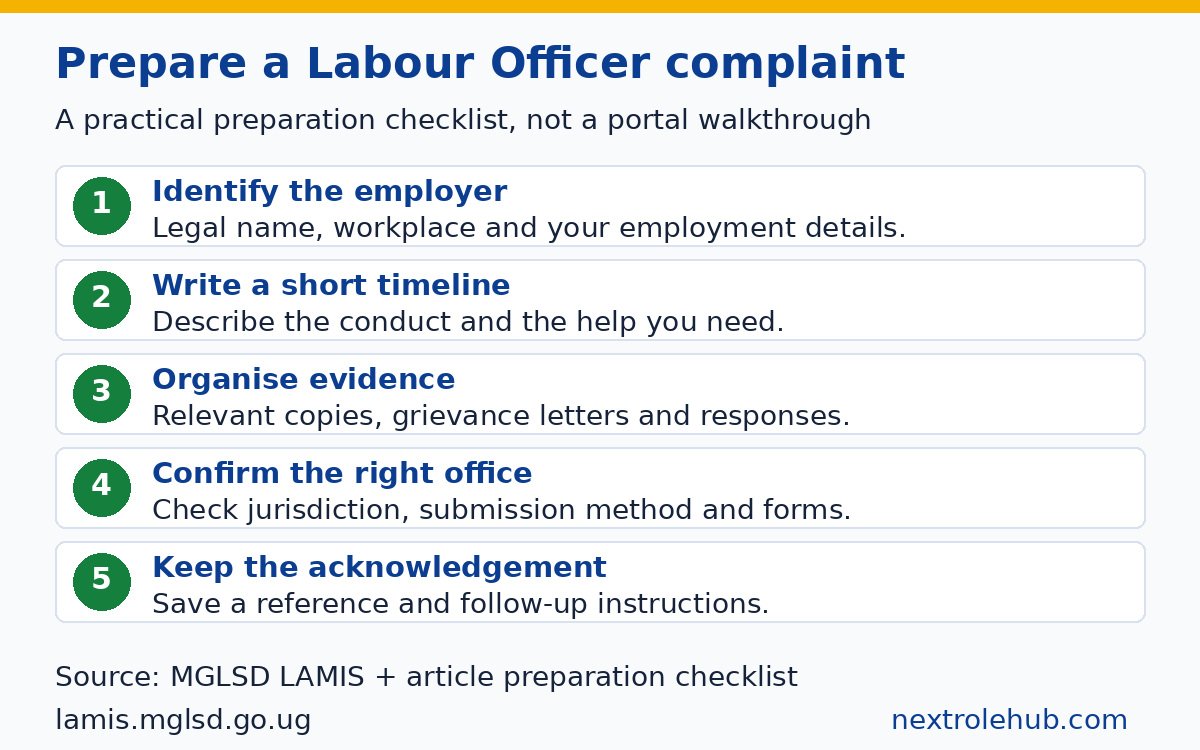
- Prepare your employment details: employer’s legal name, workplace address, job, start date and safe contact information.
- Write a short chronology and explain what help or outcome you seek.
- Organise relevant contract documents, messages, grievance submissions and responses. Bring copies and keep originals safe.
- Contact the Labour Office to confirm jurisdiction, submission method and any required form.
- Request an acknowledgement or case reference and record the follow-up instructions.
MGLSD also offers formal complaint submission through LAMIS, linked near the top. Its public guidance asks complainants to provide detailed information and supporting documents. This confirms an online reporting option, not a tested promise about every screen, response time or automatic assignment to a particular district. Follow the live instructions and retain whatever submission record the system supplies.
If there is no contract in writing, do not assume you have no possible complaint. Explain the working arrangement and ask what evidence the officer needs: pay records, appointment messages or a work identity card may help establish the facts. Whether you are legally an employee, contractor or another category can require individual assessment.
For sexual harassment, regulation 13 describes registration, interviews, obtaining relevant internal findings, the employer’s response and a written decision. It also provides for protective separation without adverse discrimination. Ask about interim protection when you report; do not assume the only option is for you to lose shifts or take unpaid leave.
An officer receiving a complaint is not a guarantee of compensation or a particular outcome. If a decision is issued, request a copy and immediate advice about review or appeal. Regulation 14 contains a 21-day notice-of-appeal provision for sexual-harassment decisions. Do not apply that limit to every employment dispute or wait until it is almost over before getting advice.
Record retaliation as a separate development
Keep a new entry if you are threatened, transferred, denied work or treated differently after reporting. Save the explanation offered and compare it with earlier rosters, duties or performance records where lawfully available. Timing is relevant, but a later management decision is not automatically retaliation simply because it followed a complaint.
Regulation 17 protects people involved in sexual-harassment complaints, including complainants, witnesses and those assisting an investigation. It addresses discriminatory treatment such as dismissal, demotion and reduced benefits. Report suspected retaliation to the person handling the matter or Labour Officer and request appropriate protection. Do not ask colleagues to circulate your allegations publicly as a substitute for a formal report.
If the employer raises genuine performance concerns at the same time, answer them with evidence and keep the two issues distinct. Ask for the targets and reasons in writing. A grievance does not make every instruction invalid, and continuing to carry out safe, lawful duties can protect the accuracy of your work record.
Before resigning, get advice on notice and your claim
Leaving may be necessary, but resignation can affect notice obligations and the legal framing of a dispute. Do not assume that a toxic-workplace label automatically proves constructive dismissal or cancels notice. If you believe the employer’s conduct is forcing you out, speak to a lawyer or Labour Officer before submitting the letter, where safely possible.
Get prompt legal advice if you receive a dismissal letter, are asked to sign a settlement, face serious sexual harassment or violence, or are unsure which time limit applies. Do not sign a full-and-final settlement you do not understand. A request for time to read a document is more useful than accepting an explanation that it is “just a formality”.
Prepare a realistic income plan while options remain open. Update your CV with evidence of your work, not confidential employer material. Keep personal employment records you are entitled to retain. For a separate pay issue, our payslip guide helps identify the documents to query without repeating payroll calculations here.
If you interview elsewhere, use our guide to explaining why you left a job for the recruitment conversation. A concise interview answer is not a substitute for a complete, accurate account to your legal adviser or investigator. You do not need to publish allegations to explain the type of working environment you want next.
Questions employees ask about reporting workplace harm
Can I seek help while I am still employed?
Yes. You do not need to leave your job before reporting workplace conduct or seeking guidance. Explain that the employment relationship is continuing and identify any immediate risks. Ask how to submit evidence safely and maintain a record of the instructions. If you fear retaliation, raise that concern explicitly rather than assuming the recipient will infer it.
What if my workplace has no HR department?
Identify the employer or designated senior contact and ask for the complaint procedure. The current sexual-harassment prevention duty is not limited to large organisations. If the owner is involved, the channel is unsafe or no one will accept the report, contact the Labour Officer. The absence of HR does not itself decide the legal merits of your complaint.
Can I complain about something said in a work WhatsApp group?
Describe the message, sender, date and connection to your work. Preserve enough context to show what happened, without forwarding unrelated personal information. Work-related messages can be relevant evidence, but the content and circumstances determine their significance. Do not assume that every rude message establishes an offence, or that using a personal phone removes its connection to work.
Can someone help me prepare the complaint?
You can seek help from a lawyer, union representative or trusted adviser to organise your account. Keep it in your own words and check every factual statement before submitting it. Ask the receiving office about representation or accompaniment for a particular meeting. Do not give another person passwords or unrestricted access to company systems to collect evidence for you.
What if I cannot remember the exact date of an incident?
Give the best honest estimate and label it clearly. A meeting invitation, shift roster or message may help narrow the period. Explain when you wrote the account and what you remember directly. Do not replace an uncertain date with a precise invented one. Tell the investigator if a later record helps you correct or refine your original account.
Choose one safe, documented next action
Responding to a toxic work environment in Uganda starts with the conduct, not the label. Make a factual record, protect sensitive information and choose a reporting channel you can use safely. The current law addresses harassment more broadly than older guides suggest, but a remedy still depends on the facts and applicable procedure.
Your next action might be requesting the grievance policy, completing the incident log or contacting the Labour Officer. If the decision involves leaving, accepting a settlement or challenging dismissal, get individual advice promptly. Keep the complaint record separate from your job search so neither gets reduced to an emotional message sent in a difficult moment.