Plan your first job after university in Uganda with a route checklist, official eligibility examples and a practical review of time and placement costs.
Getting your first job after university in Uganda starts before an offer arrives: confirm what qualification you can prove, choose suitable entry routes, and organise a search you can afford to sustain. Do not wait for the graduation ceremony if an employer accepts your current completion documents. Equally, do not claim a degree has been awarded when it has not.
The difficult decisions are often practical. Should you accept an unpaid placement, wait for a graduate intake, or apply for a junior role now? What happens when your transcript is delayed? And how do you tell the difference between a government programme announcement and an application window you can actually use?
This guide focuses on that transition from university to a credible first offer, using a 90-day planning framework, official eligibility examples and an application diagnosis table. It is not another list of beginner job titles. For those options, use our guide to jobs without experience in Uganda. Here, the aim is to decide your next move, prepare evidence and avoid spending months on a route that does not fit your circumstances.
Last checked: 9 November 2026 against Public Service Commission ORAMIS guidance, the Ministry of Gender, Labour and Social Development vacancies page and the employer sources linked below. Programme pages without a visible update date are not treated as proof of an open intake.
Table of Contents
First job after university in Uganda: where to start
Start by checking your completion status, selecting roles whose essential requirements you meet, and preparing evidence from projects or placements. Apply through verified employer channels while building relevant work samples. Review your progress at planned intervals rather than waiting indefinitely for one graduate programme or assuming graduation guarantees immediate employment.
There is no official, universal graduation-to-first-job timeline in Uganda. An employer with a fixed intake, a project hiring immediately and a public-service competition follow different processes. Treat the timetable below as a way to manage your actions, not a prediction of when you will be hired.
Before leaving university, settle documents and contacts
Ask your academic office what you can obtain now: a completion letter, provisional results, transcript or award certificate. These documents are not interchangeable. Record what is available, what is pending and who handles queries. Use the qualification description that is true on the application date.
A useful real example is KPMG East Africa graduate recruitment. Its 2026 Uganda requirements said 2026 graduates needed to have completed coursework and their project by August 2026 and hold a university completion letter. The page now says the 2026 applications are closed. This is an eligibility example, not an invitation to apply late or a rule for the next intake.
- Ask an internship or project supervisor for permission to use them as a referee. Confirm the contact details they want shared.
- Keep a clean copy of a project you can discuss, with confidential information removed and permission where needed.
- Ask your department or careers office which employer contacts and placement procedures are current. Do not assume a former partnership still accepts students.
- Set up an email account you will retain after university access ends. Test your phone number, inbox and document backups.
If you are still studying, choose a practical responsibility you can finish properly: maintaining a society budget, preparing a research summary or supporting a supervised placement. Record your own contribution, not the entire team’s output. A supervisor who can verify a modest task is more useful than a prestigious title you cannot explain.
Choose a route by eligibility, not by the employer’s logo
Use the route table to decide what to pursue now and what to monitor. None of these routes guarantees employment. The employer’s live advert decides eligibility, location, documents and selection stages.
| Route | Check before spending time | Useful next action |
|---|---|---|
| Direct junior vacancy | Does the advert accept your qualification and actual experience? | Match each essential requirement to evidence before applying. |
| Graduate trainee intake | Does your completion year and academic record fit this specific cycle? | Track the official intake page; do not reuse last year’s rules. |
| Graduate internship | Does it accept graduates, and can you meet the costs? | Ask about supervision, duties, allowances and the end date. |
| University field attachment | Are you still eligible through your course and faculty? | Confirm academic paperwork with your placement coordinator. |
| Public-service vacancy | Which commission or recruiting body owns the advert? | Use its published application channel and reference number. |
Keep direct vacancies and structured intakes in separate tracker tabs. That prevents a closed annual programme from consuming the time you could spend on a suitable current vacancy. For employer comparisons rather than another route list, see our Uganda internship programmes guide and the bank graduate trainee guide. Recheck the original employer source before acting on any intake detail.
Use 90 days to test your approach, not promise a job
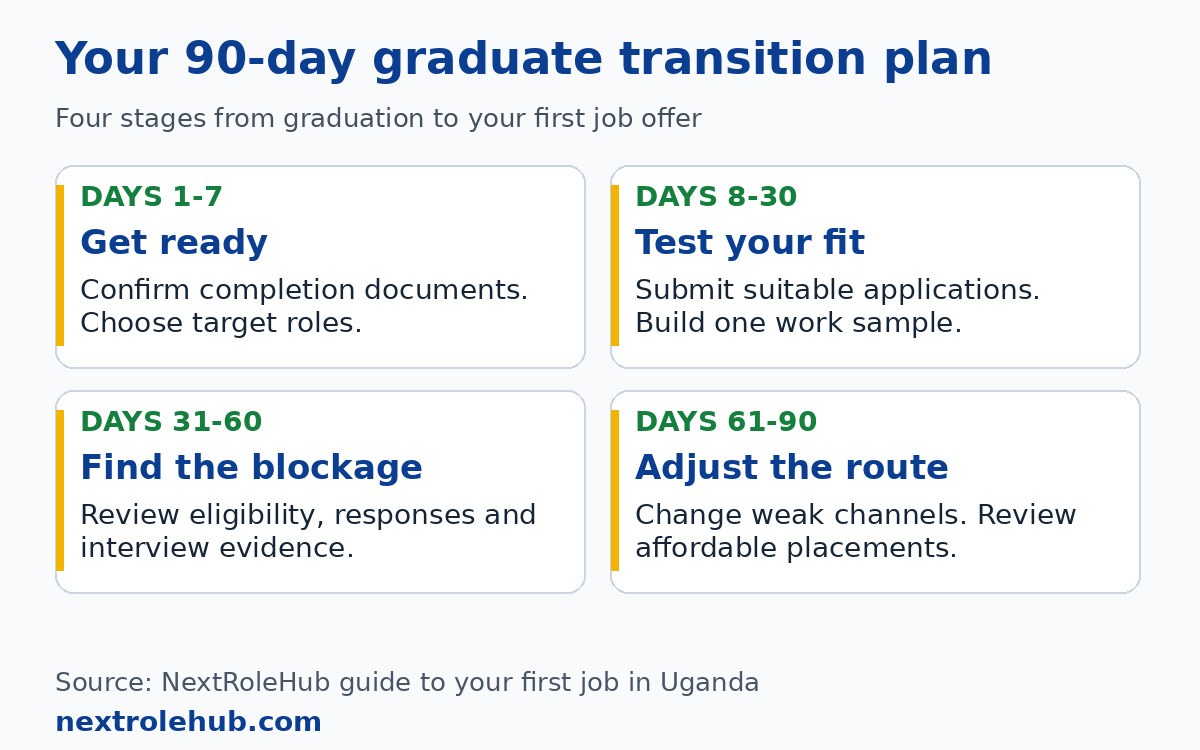
Treat it as a planning framework, not a measured hiring average. Move the dates to fit your examinations, income needs and the adverts available. Keep applying to suitable openings throughout; the phases describe your main review task, not periods when applications should stop.
Days 1-7: get ready
Confirm your completion documents and choose a narrow starting set of role families. For example, a commerce graduate could compare accounts support with customer operations rather than apply indiscriminately across every profession. List employers reachable from your current location and calculate what interviews or relocation would cost before committing.
Create a tracker with employer, exact role, official URL, essential requirements, deadline, submission proof and next action. Read the Uganda CV writing guide for document structure rather than rebuilding your CV from a forwarded screenshot.
Days 8-30: test your fit
Submit applications where you can show a credible match. Before each submission, save the advert and note which evidence answers its requirements. Build one small work sample alongside the search. An operations applicant might create a clearly labelled practice issue log; a communications applicant might prepare a sample event announcement.
Ask a lecturer or former supervisor to review one application against the actual advert. A request for specific feedback is easier to answer than “please help me get work”. Record what you changed so the next application benefits from the review.
Days 31-60: find the blockage
Separate applications still awaiting a decision from rejections and confirmed next stages. Check that uploaded files open, contact details work and required qualifications were actually met. If interviews arrive but offers do not, practise explaining your work and answering the role’s practical questions rather than redesigning the CV again.
Days 61-90: adjust the route
Review which channels produced relevant adverts and which only repeated closed ones. Consider a different duty station if relocation is realistic, or a supervised placement if it adds evidence you lack. Keep your income plan separate from your preferred career route so you can assess each honestly.
At the end of this period, make a written decision: retain the useful channels, repair a specific skill gap, or change the role family. Do not interpret the end of the plan as a personal deadline for success. Recruitment decisions are not under your control; the quality and direction of your next application are.
Build a proof folder that survives an interview
Your proof folder should connect a task you performed with something another person could verify. It is not a collection of certificates unrelated to the work. Keep practice exercises separate from real assignments and label both accurately.
| Target work | Possible evidence | Honest description |
|---|---|---|
| Accounts support | A reconciled practice cashbook with notes explaining corrections | Practice exercise, using fictional entries. |
| Research support | An approved project summary and your data-cleaning notes | Academic work; state your individual contribution. |
| Customer operations | A sample complaint log and escalation procedure | Self-directed sample, not an employer system. |
| Communications | Published student-society notice or approved writing sample | Name the activity and the part you wrote. |
Do not upload customer records, beneficiary names, identity numbers or confidential internship documents to prove competence. Re-create the format with fictional data where appropriate and say that it is a demonstration. Ask permission before sharing work that belongs to a host organisation.
Practise explaining one item without reading it: what needed doing, what you did, what you checked and what changed. If it was a group project, describe where your responsibility ended. A neat spreadsheet loses its value if you cannot explain a formula or correction in it.
This is also where an internship can become useful evidence for a later job. Agree a task with the supervisor, complete it, request feedback and keep an approved summary. A reference may support a future application, but neither the placement nor the reference promises a permanent role.
Government routes: separate policy news from application calls
A report about graduate employment is not an application form. Daily Monitor’s 16 April 2026 report described a proposed framework for graduate entry into government. Do not treat that report as proof that every graduate now has a reserved public-service job or that an unnamed registration scheme is legitimate.
There is specific official evidence you can check. The Ministry of Public Service’s 24 June 2026 announcement records an induction for recruited interns. It does not announce a new application window or explain a general graduate application route.
The MGLSD vacancies page linked near the top gives apprenticeship and graduate volunteer notices with a 30 July 2026 deadline. That deadline has passed. The page is useful evidence of the programme and its application instructions, but it is not proof that late applications or another intake are open. Look for a fresh official notice before registering for a purported new cohort.
For a vacancy handled by PSC, its ORAMIS guidance describes an applicant account, reusable qualifications, document uploads, application tracking and electronic interview invitations. PSC says applications are free and it does not use middlemen. Other recruiting bodies may give different instructions; follow the authority named in the advert.
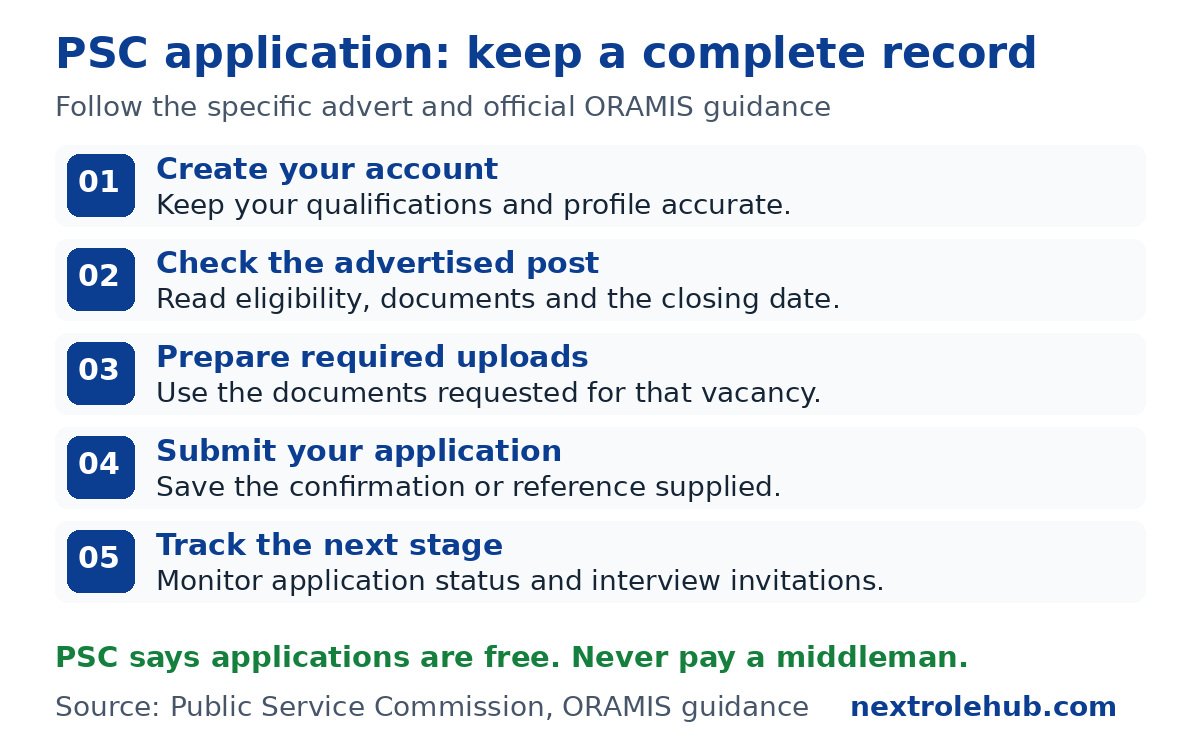
- Create your official applicant account and keep the profile accurate.
- Read the advertised post and check its essential requirements and deadline.
- Prepare the documents that the specific application requests.
- Submit through the stated channel and save any confirmation or reference supplied.
- Monitor application status and invitations rather than relying on a forwarded shortlist.
Check placement costs before accepting unpaid work
An unpaid placement can be genuine and still be unaffordable. A written allowance is not the same as a salary, and training does not remove transport, accommodation or meal costs. Compare the actual terms with what you would have to spend to attend reliably.
For example, Uwezo Uganda’s undated graduate internship page, checked on 9 November 2026, describes placements normally lasting three months, with six months as the maximum. It states that internships have no remuneration, while lunch and a modest local travel allowance are provided. Other costs remain with the intern. The page invites applications but says a suitable opening and fit must be confirmed.
Before accepting any placement, ask for the duties, named supervisor, location, schedule, end date, payment terms and how completion will be recorded. Write your own budget using real fares and costs. If attendance would require borrowing money you cannot repay, seek a closer or paid alternative rather than treating a famous organisation as sufficient compensation.
When applications stall, diagnose the stage
Do not respond to every silence by sending more of the same. Use the stage at which progress stops to choose a practical repair. The table is a diagnosis aid, not a claim that one factor explains every rejection.
| What you can observe | Check first | Change to test |
|---|---|---|
| Few suitable vacancies found | Are searches restricted to a prestigious title or one employer? | Use related junior duties and affordable duty stations. |
| Applications not confirmed | Was the correct channel used, and did submission finish? | Check the portal record or confirmation before assuming receipt. |
| Confirmed rejections before interview | Did you meet essential requirements and provide requested evidence? | Have a reviewer compare one complete application with the advert. |
| Interviews but no offer | Could you explain relevant tasks and answer practical questions? | Rehearse real examples and request feedback where available. |
| Offers you cannot afford to accept | Are pay, transport and relocation terms clear? | Calculate costs before agreeing and clarify terms in writing. |
Use our comparison of Uganda job websites to choose discovery channels, not to avoid checking the employer. For interview-stage preparation, use the Uganda interview preparation guide. Change the part that is failing rather than restarting every part of the search.
Questions graduates ask before their first offer
What should I write when an application asks for my current employment status?
State your actual situation. If you have completed your course and are searching, describe yourself as a recent graduate or job seeker, as appropriate. If you are studying, volunteering or doing temporary work, say so. Do not invent an employer to fill a compulsory field; use the portal’s guidance or contact the recruiting organisation if no truthful option fits.
Can a lecturer be my referee after university?
A lecturer who knows your work can be a useful referee when you have little employment history, subject to the advert’s requirements. Ask permission first and explain the roles you are targeting. Give them enough context to discuss work they actually supervised. Do not list a senior person simply because their title looks impressive if they cannot verify your contribution.
Should I relocate to Kampala before I have an offer?
Do not assume relocation is required for every search. Compare where the work is based, whether selection can start remotely and what accommodation and transport would cost. You can state your current location and genuine willingness to relocate. If an employer offers a role elsewhere, clarify the reporting date and any support before making commitments you cannot afford.
How should I explain temporary work unrelated to my degree?
Describe the work plainly and select responsibilities relevant to the vacancy, such as maintaining records, serving customers or meeting a delivery schedule. Keep the real job title and dates. You can explain that it supported your income while you pursued a graduate route, but do not apologise for legitimate work or pretend it was professional experience in a different discipline.
Should I send my academic documents to everyone who offers a referral?
No. First establish who the person represents and whether an official vacancy or approved referral process exists. Share only what is needed at that stage through the stated channel. A contact can point you to an advert without holding your full academic and identity bundle. Never provide passwords, one-time codes or original certificates to someone promising to secure a job.
Make the next move specific enough to finish
Getting your first job after university in Uganda is easier to organise when you separate eligibility, evidence, money and timing. Today’s useful action might be requesting a completion letter, checking a live advert or reviewing a placement budget. It does not have to be another broad application sent without checking the requirements.
Choose the unfinished step that is blocking you now and complete it. Keep a record of what you submit, learn from the stage where progress stops and use verified employer instructions for every application. Your first offer should be something you understand and can realistically accept, not simply the first message that calls itself an opportunity.