Check your NSSF Uganda statement, trace missing employer payments and identify the right benefit route before planning a withdrawal.
NSSF Uganda savings are accessible through specific benefits, not simply because you resign or need cash. For most employees, the useful questions are whether every working month appears on their statement, which benefit they actually qualify for, and what evidence they need before making a claim.
A payslip can show that money was taken from your salary without proving it reached your member account. Equally, turning 45 does not automatically qualify you for midterm access: contribution history matters too. These are different problems, and they need different next steps.
This guide focuses on your account after payroll: checking your statement, documenting missing remittances, reporting an employer, and preparing for benefits or withdrawals. It also separates retirement savings from Smartlife Flexi, because the withdrawal rules are not interchangeable. You will find a benefit comparison, a missing-month worksheet and a sample message you can adapt without making unsupported accusations.
For deduction calculations and the difference between tax and retirement savings, use our PAYE vs NSSF payslip guide. Here, the aim is to help you verify the savings record and choose the correct official route.
Last checked: 11 November 2026 against NSSF Uganda and the official benefit, member-service and product pages linked below. Several guidance pages show no publication or revision date; confirm case-specific requirements with NSSF before submitting a claim.
Table of Contents
NSSF Uganda benefits: which route fits your situation?
NSSF pays benefits when a member meets the conditions for a particular claim. Age benefit starts at 55, including for members still working. Withdrawal benefit requires reaching 50 and spending a year out of employment. Midterm access has separate age and contribution-history tests, while other benefits address specific circumstances.
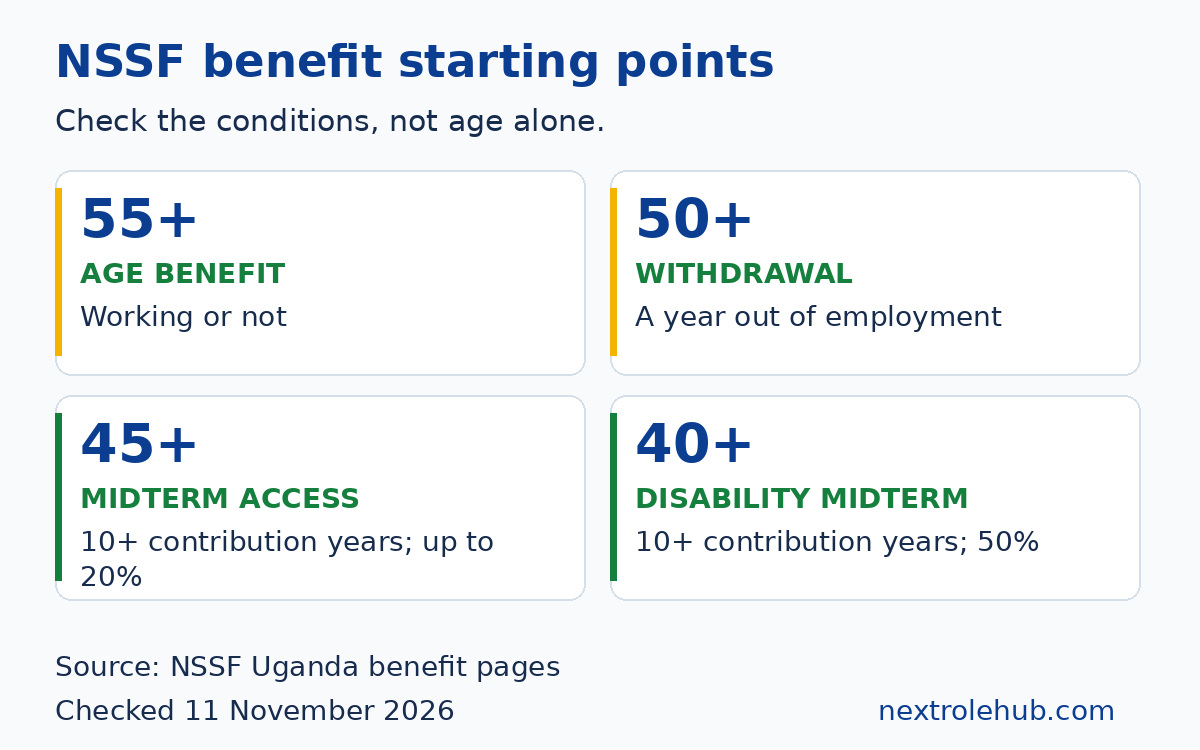
| Route | Official starting condition | What to establish first |
|---|---|---|
| Age benefit | Age 55, whether employed or not | Your date of birth, identification and payment details. |
| Withdrawal benefit | Age 50 and a year out of employment | Your employment exit and time out of work. |
| Midterm access | Age 45+ and at least 10 years of contributions | Your actual contribution record, not just years since registration. |
| Disability midterm route | Member with disability, age 40+, and at least 10 years of contributions | Disability documentation and contribution history. |
| Invalidity benefit | Loss of earning capacity through physical or mental incapacity | Medical evidence and NSSF verification. |
| Survivors benefit | Death of a contributing member leaving eligible relatives | Relationship, death records and applicable estate documents. |
| Emigration benefit | Permanent departure from Uganda | Permanent residence evidence and the employment-exit conditions. |
| Exempted employment | Move into a qualifying exempted employment category | Your appointment and the documents for that category. |
The age and withdrawal conditions appear on NSSF’s benefits guidance. The official benefits claim form also lists exempted-employment claims. Do not assume that every government-related appointment qualifies; ask the Fund to check your actual employment category.
Use this table to identify a route, not to approve your own application. An employment exit letter supports a claim, but it does not remove the age condition. A disability document does not remove the contribution-history requirement for disability midterm access.
How to check your NSSF statement without stopping at the balance
Use NSSFGo to view your e-statement and review transactions, then compare the record with your employment months. A total balance alone cannot tell you whether a particular employer or period is missing. Keep a dated copy or record of what you checked before raising a specific discrepancy with HR or NSSF.
Start from the official NSSFGo portal or the app published by National Social Security Fund Uganda. The publisher’s NSSF GO app description confirms access to the e-statement, current balance and transactions. Screen names can change, so follow the current statement or transaction prompts rather than a screenshot from an old tutorial.
- Sign in through the official service using your own contact details. If access fails, ask NSSF to help recover it rather than sharing a passcode with a third party.
- Confirm that the member profile belongs to you. Check names and the NSSF number against your employment records.
- Review the full period you want to check, including time with previous employers. Do not inspect only the most recent transaction.
- Record months you cannot reconcile, with the employer name and the relevant payslip or employment evidence.
- Keep your record privately. Redact identity and account numbers before asking anyone outside the official process for general advice.
For example, a shop supervisor who changed employers in September should check the final months with the old employer as well as the opening months with the new one. A rising total could hide a gap in the earlier record. That is an illustration of how to review a statement, not a claim that either employer failed to pay.
If a payment appears but you cannot identify the period it covers, ask for clarification rather than allocating it yourself. Keep interest entries separate from employer contributions in your notes. Interest increasing the balance does not prove every expected remittance arrived.
Build a missing-contribution record before chasing an explanation
A useful query identifies the period and the evidence. “My balance is low” leaves too much to investigate. “These employment months do not appear in the statement I checked on this date” gives HR and NSSF something specific to trace.
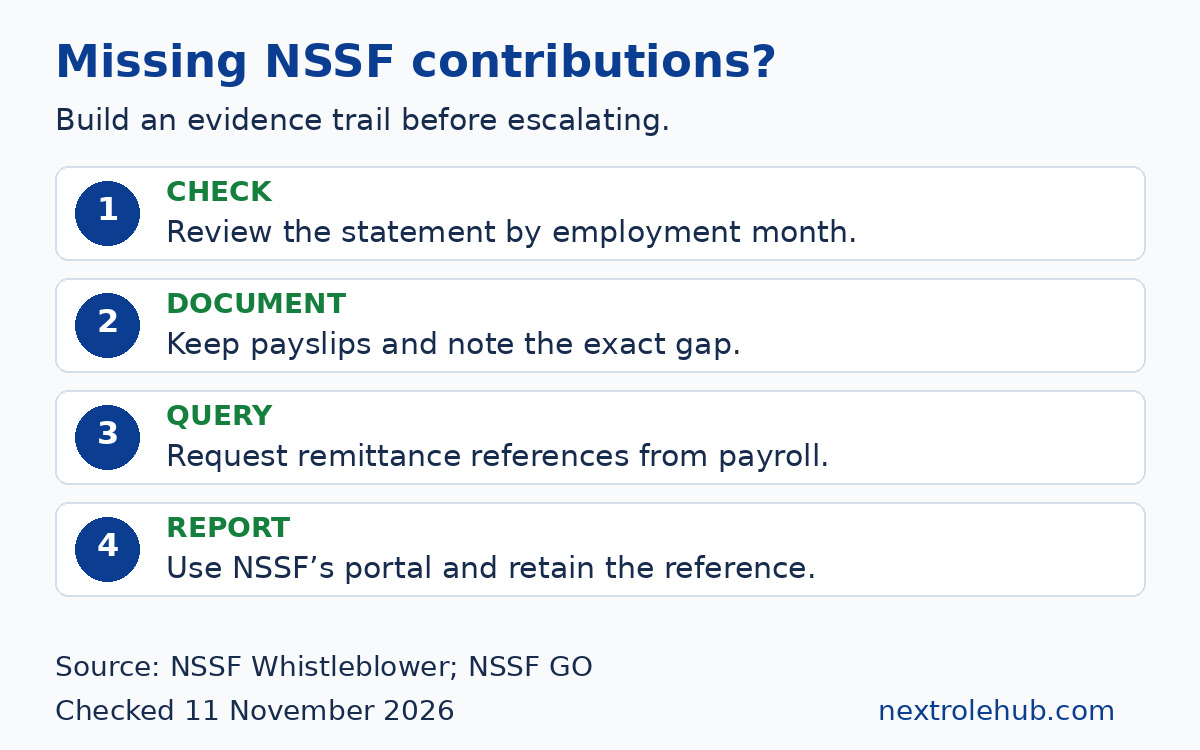
Create a private worksheet like this. The entries below are fields to fill, not verified arrears or a substitute for the Fund’s investigation.
| Field | What to record | Supporting document |
|---|---|---|
| Employment period | Exact month and year you are querying | Contract, appointment letter or employment history. |
| Employer | Legal employer name used during that period | Payslip or employment letter. |
| Statement finding | Missing entry, unclear allocation or unexplained amount | Dated statement record. |
| Payroll evidence | The relevant NSSF line, without recalculating it here | Payslip for that month. |
| Employer response | Payment reference or written explanation supplied | Email or letter from payroll. |
| Next action | Question sent, NSSF referral or case follow-up | Dated correspondence and reference. |
Before calling a month unpaid, check the remittance timing and ask whether an entry has been allocated to another period or member record. A missing entry is a reason to investigate, not proof of theft. Do not let an employer’s vague assurance replace a traceable payment reference either.
A message you can send to payroll
Subject: Request to reconcile NSSF records for [period]
Hello [name], I reviewed my NSSF statement on [date] and could not reconcile the entries for [months] during my employment with [employer]. I have attached the relevant payslips and statement extract. Please confirm the remittance references, the periods covered and the member number used. If a correction is needed, please explain the next step and how I can verify it. Thank you, [name].
That sample is deliberately neutral. Keep the reply with your records, and check the account again after a correction is reported. If your employment has ended, keep a personal copy of the correspondence outside an employer email account you may lose access to.
Report non-remittance through NSSF’s official channel
The NSSF Whistleblower platform accepts reports about employers that fail to pay, remit irregularly, exclude some staff or understate wages. It also covers deductions that are not forwarded to the Fund. You can report without revealing your identity; NSSF describes the information as confidential unless you choose disclosure.
- Collect the employer details and the periods you can support with evidence. Distinguish what you know from what you suspect.
- Open the official reporting service directly. Provide the available facts and documents through its current process.
- Save the reference supplied when you submit the report.
- Use that reference to follow progress through the portal. Keep later information with the same case records.
NSSF says its process can involve reviewing the complaint, investigating, auditing or demanding payment from the employer, and agreeing a settlement or payment plan. Those are enforcement steps, not a promise that your account will be corrected immediately after you submit a report.
The platform does not give one fixed resolution period for every complaint. Avoid planning household spending around an assumed recovery date. Ask for progress using your reference, and record any further documents requested. If a payment plan is agreed, ask how the relevant account entries will be verified.
For direct assistance, NSSF eServices contact information lists toll-free 0800 286 773 and [email protected]. Use official channels for sensitive documents. Do not post your NIN, full statement or complaint evidence in a public social-media thread.
Midterm access: contribution years matter as much as age
Under NSSF’s midterm benefit rules, a member aged at least 45 with ten or more years of contributions can access an amount up to 20% of accrued benefits. A qualifying member with a disability, aged at least 40 with the same contribution-history requirement, can access 50%.
Being registered for ten years is not necessarily the same as making contributions for ten years. If you had long gaps between jobs or missing remittances, ask NSSF to verify your qualifying history. Do this before committing a deposit on land or promising to clear a loan with the expected benefit.
The disability route is not the same as invalidity benefit. Midterm access uses its own age and contribution conditions. Invalidity concerns loss of earning capacity and medical verification. Select the route that matches your circumstances rather than whichever percentage sounds more attractive.
- Check your recorded date of birth and contribution history.
- Read the current midterm document list, including identification, a current photograph and bank-account evidence.
- For the disability route, NSSF lists a supporting letter from the National Council for Persons with Disabilities Uganda.
- Ask the Fund to confirm eligibility and the amount applicable to your record before making spending commitments.
Midterm access is partial access, not permission to withdraw every remaining shilling whenever you wish. It also should not be confused with the age benefit. If you are still employed, continue checking subsequent contributions after any approved claim.
Prepare the documents for your actual benefit claim
Start with the benefit category, then gather its documents. The common core is identification, a current photograph and evidence of the claimant’s bank account. The official form says physical claimants should bring originals so the copies can be compared. Do not send originals to an unofficial intermediary.
Age and withdrawal claims
Age benefit is available at 55 even if you remain employed. Withdrawal benefit adds the requirement of a year out of employment after reaching 50. For withdrawal, the published list includes a termination letter, end-of-contract letter or employer introduction letter. Leaving a job below the qualifying age is not enough on its own.
Health-related and family claims
Invalidity benefit guidance requires evidence of lost earning capacity, supported by medical records and verification by NSSF. A diagnosis alone should not be treated as approval. Ask which medical documents and assessment steps apply to the member’s condition.
For survivors benefit, the Fund identifies a spouse, children or dependent parents as eligible relatives. Its checklist includes the member’s death certificate, claimant identification, payment details and evidence appropriate to the relationship. Estate documents can also be required.
The survivors web page and downloadable claim form show different benefit-value thresholds for some estate documents. Ask NSSF for the current checklist for your claim value before paying for legal paperwork. Do not choose the lower-document route simply because an older form is easier to find.
Permanent emigration
NSSF’s emigration guidance covers permanent relocation, not a holiday or an ordinary short assignment abroad. It requires evidence of residence status, departure and employment exit, among other documents. It also says applicants must have spent at least three months out of employment without contributions before applying.
The listed bank account must be in the country of relocation. Requirements vary with the claimant’s status, so confirm the full checklist before arranging notarisation or embassy documents. A foreign job offer by itself is not the whole evidence package.
Separate voluntary retirement saving from Smartlife Flexi
Self-employed people can apply for voluntary NSSF membership. However, “voluntary” does not mean every balance has the same withdrawal rules. Before depositing, identify the product or account receiving the money, its access conditions and the terms you are accepting.
The voluntary membership FAQs describe voluntary contributions and a minimum of UGX 5,000. The separate Smartlife Flexi product page currently states a UGX 500 minimum deposit. These are different published descriptions; do not copy one minimum across every NSSF product.
Smartlife Flexi’s page describes an initial 12-month withdrawal lock and access after that period, with returns accrued daily and credited monthly. Treat its stated lock period as a planning constraint. Before relying on an exception, ask for the current terms that apply to your specific goal or account.
A trader saving for stock needed next month should not assume a newly opened goal wallet is immediately accessible. Keep money for near-term business costs separate until you understand the product. That is a cash-flow precaution, not a prediction about investment returns.
Older voluntary balances can also have different terms. The Smartlife page describes a migration window linked to November 2024; it is a historical window, not a fresh invitation to transfer now. Ask NSSF which rules apply to your existing balance rather than assuming a product name changed its conditions automatically.
Questions to resolve before changing jobs or making a claim
Does changing employers mean I should open another NSSF account?
First establish whether you already have a member number and whether your existing record is correct. Give the new employer the verified details rather than registering again simply because you changed jobs. If you discover more than one number or an old employer used different details, ask NSSF how to reconcile the records. Do not try to repair identity information by creating another account.
Can I claim my NSSF immediately after resignation?
Resignation is evidence of leaving employment, not an automatic benefit entitlement. Identify the route you qualify for and check all its conditions before budgeting for a payout. Someone leaving work below the withdrawal age may not qualify under that route, while another member may qualify for age benefit or midterm access. Ask NSSF to assess your record instead of treating an exit letter as approval.
Can I report missing contributions without putting my name on the complaint?
NSSF’s reporting platform allows reports without revealing your identity and explains that the information is treated confidentially unless you choose disclosure. Keep the submission reference so you can follow progress. Provide specific, supportable employer and period details. Confidential reporting should not be interpreted as a guarantee that no one could infer who raised an issue from the surrounding circumstances.
What should I do if I no longer control my registered phone number?
Contact NSSF through the official helpline, email or a branch and ask for its current contact-update and account-recovery process. Do not share someone else’s login or ask a stranger to receive a passcode. Keep your identification available for official verification, but send it only through a confirmed channel. Regaining proper access is safer than relying indefinitely on screenshots from another person.
Should I wait until retirement to correct my name or employment record?
No. Raise the discrepancy while the supporting documents and employer contacts are available. Record the exact mismatch, ask which evidence NSSF requires and keep confirmation of the correction. A name difference, an unclear employment period and a missing payment are separate issues, so describe each clearly. Before submitting a benefit claim, check that the identity and payment details are consistent.
Where can I follow up if a claim or complaint is taking longer than expected?
Keep the claim acknowledgement or complaint reference and contact the official service handling that case. The whistleblower portal supports follow-up using its reference; benefits enquiries can go to the Fund’s customer-service address. Ask what stage has been reached and what remains outstanding. Do not substitute an online estimate or an intermediary’s promise for confirmation about your own application.
Choose one account action you can finish today
Start with the part of your NSSF Uganda record you can verify now. Review the statement, document a particular gap, or confirm the benefit checklist that matches your circumstances. Keep account reconciliation separate from deciding how you would spend a future payout.
If you are comparing a new offer, our salary negotiation guide helps you clarify the full package. If you are moving into employment for the first time, the first-job planning guide covers the earlier transition. Neither replaces checking your own savings record after employment begins.
Open the official member service, save the question you need answered and use the right route: payroll for remittance details, NSSF for account verification, and the reporting platform for supported non-compliance concerns. A documented answer is more useful than another year of assuming the balance is correct.