A scholarship recommendation letter needs more than a lecturer’s signature or an employer’s stamp. It needs an eligible referee, evidence that person can genuinely assess, and the submission route required by your award. Start with those checks before asking anyone to write.
Last checked: 22 November 2026 against Chevening’s official reference guidance and the other official sources linked below. Some standing guidance pages show no clear revision date. Closed rounds are labelled; their rules do not announce a new application window.
For a student in Gulu or a working applicant in Kampala, the difficult part may be coordinating people in different offices. Your former supervisor may have moved, your employer may issue only factual service letters, or the scholarship may require a private upload that you cannot complete yourself. A good preparation plan makes those dependencies visible early.
This guide helps you request credible references without writing an endorsement in somebody else’s name. You will find a comparison of official requirements, an adaptable request email, a referee evidence worksheet and a submission check. It focuses on references, not the whole funding application. Use our scholarship application guide for Uganda for the wider document and application process. Each provider’s current instructions take priority over the examples here.
Table of Contents
What should a scholarship recommendation letter do?
A scholarship recommendation letter gives an independent assessment of your readiness for the proposed study or award. It should explain the referee’s relationship with you, discuss work they can verify, and address the provider’s criteria. The referee must supply the judgement and wording; you organise the request and supporting facts.
Useful evidence is specific to the relationship. A dissertation supervisor can discuss how you responded to criticism of your method. A line manager can explain a decision you handled at work. Neither should pretend to have witnessed an activity simply because it appears on your CV. Let each referee distinguish direct observation from information you supplied.
Check the programme rules before choosing a referee
Create a requirement card for each award: referee type, names required, letters required, document format, submission owner and deadline. A requirement to name three people does not necessarily mean three letters must arrive at the first assessment stage. Equally, naming someone never proves their letter was received.
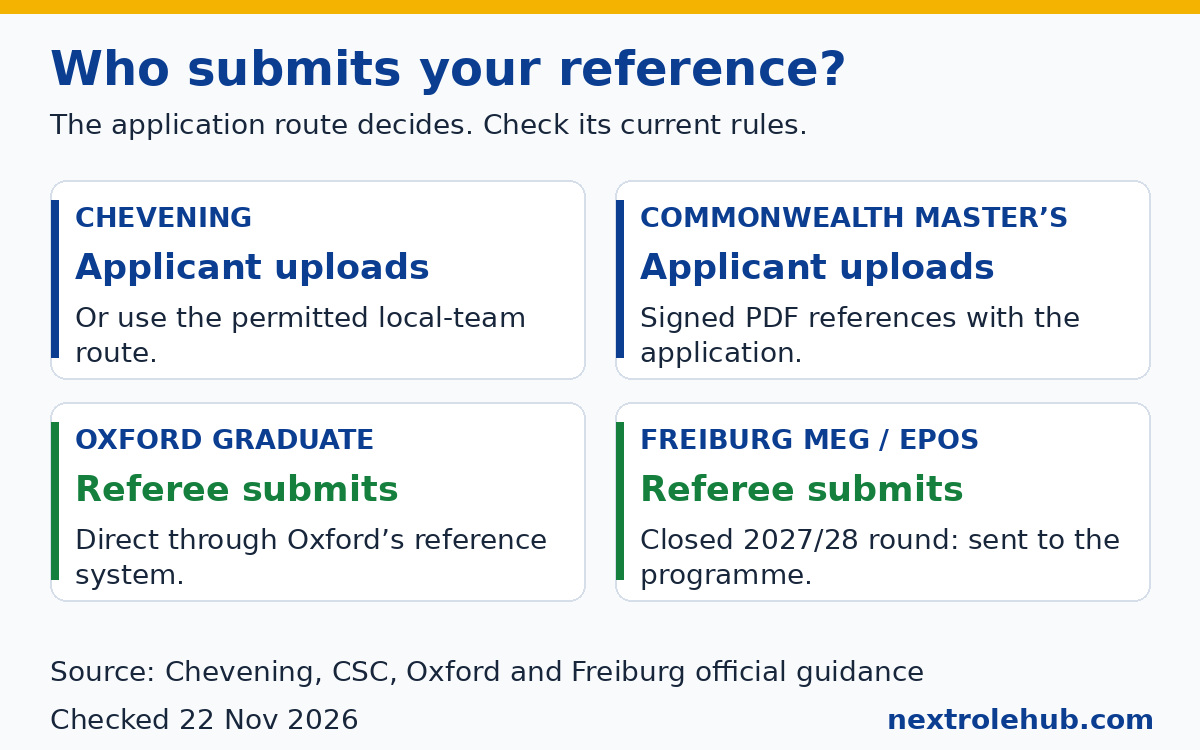
| Official route | People and letters | Submission responsibility |
|---|---|---|
| Chevening | Name two referees. Two academic, two professional or one of each are allowed; friends and relatives are excluded. | Applicant collects and uploads the letters, or follows the permitted local-team route. If invited to interview, upload no later than seven working days beforehand. |
| Commonwealth agency-nominated Master’s | Name three referees; a current employer must be among them if applicable. Include at least two references. | Applicant uploads signed PDF references by the application deadline. The 2027/28 application round is closed. |
| Oxford graduate application | Register three referees. Two received references can make an otherwise complete application ready for assessment; the third may still be requested. | Referees submit directly through Oxford’s reference system by the course deadline. Applicant-uploaded references are not accepted. |
| Freiburg MEG, DAAD EPOS example | One current-employer reference and one academic reference were required for the closed 2027/28 round. | Referees send letters directly to the programme, not through the applicant. Its 15 October 2026 scholarship deadline has passed. |
Sources for the comparison: Commonwealth Master’s programme instructions, Oxford’s referee registration guide and Freiburg’s MEG scholarship requirements, alongside Chevening above. These are different application routes, not interchangeable rules for every scholarship offered by those organisations.
The Freiburg example is especially useful when another website says applicants upload all DAAD references themselves. Course instructions can prescribe a different method and additional referees. Our DAAD guide for Ugandan applicants explains the wider distinction between schemes; check your selected course for the letter requirements.
Choose referees by eligibility and direct knowledge
First remove anyone who does not meet the call’s referee definition. Then consider who can describe relevant work without relying entirely on your account. A suitable lecturer might be your research supervisor or a teacher who marked substantial work. A professional referee might be the manager who reviewed your performance, where the programme permits that role.
For example, a fictional graduate applying for public-health study could approach the supervisor who reviewed their research methods. A fictional district project assistant might ask the manager who assessed their reporting. These are selection examples, not claims about actual applicants or guarantees that either referee type is accepted by every award.
Ask permission before entering contact details. Explain which course you want, what the reference should assess and how much work submission involves. Ask whether the person can provide a sufficiently detailed assessment within the available time. An early refusal lets you find someone else without pressuring an unsuitable referee.
If you graduated years ago, do not silently replace a compulsory academic reference with an employer letter. Send the course office a focused enquiry about acceptable alternatives. If your current employer must be included but disclosure creates a problem, ask the provider about your circumstances before substituting a former manager.
Send a request email that explains the actual task
The example below is an original request template, not a recommendation for someone to sign. Replace every bracketed item with verified information. State whether the referee returns the letter to you or submits it directly; do not leave that decision to a generic email template.
Subject: Could you provide my reference for [course or scholarship]?
Dear [title and surname],
I am [your name], and you supervised my [specific work or course] at [institution or organisation]. I am preparing an application for [exact award and study programme]. Would you be willing to assess my suitability as one of my referees?
The provider asks for [eligible referee type] and wants an assessment of [relevant criteria]. Your feedback on [work you completed together] is why I am approaching you. I can send the work record and a short update on my study plans to help you decide.
The reference must reach [verified destination] by [date, time and time zone], using [official submission method]. My earlier preparation target is [date], if that is practical for you. I have included the official instructions, my current CV and a factual evidence summary.
Please let me know if your availability or your knowledge of my work would make this difficult. I can arrange another eligible referee. Thank you for considering the request.
[Your name and contact details]
If you first contact a lecturer by WhatsApp, use it to reintroduce yourself and ask their preferred channel for the full request. Do not send identity scans or a large document bundle without agreement. Where a portal sends the invitation, confirm the referee’s email address before registering it.
Prepare an evidence pack, not a prewritten endorsement
Give the referee enough context to make their own assessment. Keep the pack selective: the official criteria, relevant study information, an accurate CV and work they can recognise. Your draft personal statement can explain your intended direction, but it must not dictate the referee’s opinion or turn an aspiration into a past achievement.
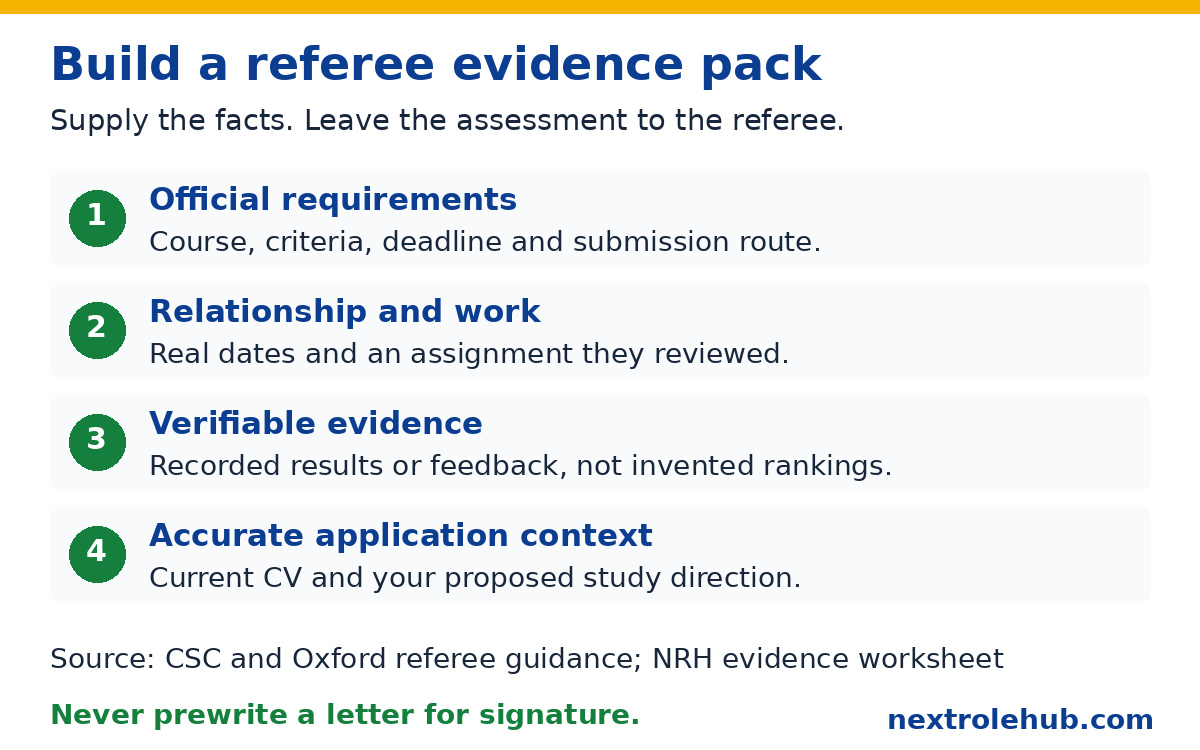
Use this original worksheet to separate an applicant’s claim from what the referee actually knows. The examples are prompts for your records, not achievements to copy into an application.
| Evidence item | What you provide | What the referee decides |
|---|---|---|
| Relationship | Actual course, reporting line or project, with genuine dates. | How closely they knew your work and during which period. |
| Observed work | A relevant assignment, report or project they reviewed. | What it demonstrates about your readiness and ability. |
| Result | The genuine mark, feedback or documented outcome, if available. | Whether they can verify and fairly contextualise it. |
| Development | A correction you addressed or a responsibility you learned. | What changed and whether your response supports their assessment. |
| Study direction | Your proposed course and realistic future use of the training. | How your observed preparation relates to the proposed study. |
Keep unsupported rankings out of the pack. A transcript can establish your recorded mark, but it may not show your rank in the class. Do not ask a lecturer to call you a top-performing student unless they have a defensible basis for that comparison. Where no numerical outcome is recorded, describe the actual work instead of inventing a percentage.
Update your CV so job titles, education dates and project descriptions agree with the application. Our CV writing guide for Uganda can help organise evidence, but a scholarship’s academic CV format overrides a job-CV layout. Remove unrelated personal records from the referee pack.
Never offer a finished letter written as if you were the referee. CSC explicitly requires references to be composed in the referee’s own words. If someone asks you to draft the endorsement, offer the worksheet and official criteria instead. Do not create a signature, alter institutional letterhead or edit a signed assessment yourself.
Keep recommendations, employer certificates and transcripts separate
A recommendation evaluates you. A work certificate records employment facts. A transcript records academic results. Even when the same institution issues more than one document, their purposes differ. A general service letter should not be assumed to satisfy an award that asks for an assessment of your academic potential or leadership.
Freiburg’s closed EPOS round illustrates this distinction: it separately requested employment evidence and two recommendation letters. The employment certificate had to show actual employment dates. Its reference requirements added headed paper, the prescribed signature standard, a date and a stamp, with an explanation where a stamp was unavailable. Those are that programme’s published conditions, not a universal Ugandan checklist.
Check the addressee and language too. Chevening asks for letters addressed to the British embassy or high commission in the applicant’s country and includes rules for notarised English translations. Do not apply that translation rule to every university. Record the exact requirement rather than assuming any English translation or certification will do.
There is no single letter length established by the sources for all scholarships. Oxford’s instructions for referees typically suggest 500 to 1,000 words and normally no more than two pages. That guidance concerns Oxford graduate references. Another award’s form, questions or word limit takes priority for its own application.
Track received references, not promises to write
Start requests when you have identified the actual requirements. As a practical planning suggestion, allow several weeks where possible and agree an earlier target with each referee. This is not an official minimum notice period or a promise about how quickly any university or employer will respond.
- Record permission: the referee has agreed and confirmed the correct contact details.
- Send instructions: share the exact course, assessment criteria, deadline and submission owner.
- Confirm access: for direct submission, check that the invitation reached the referee.
- Check completion: look for a received status or the provider’s accepted confirmation, not merely a sent invitation.
- Save the record: retain your submission receipt or status confirmation and thank the referee.
Use separate tracker columns for “agreed”, “invited”, “submitted” and “received”, recording only the stages your provider actually reports. For applicant uploads, open the completed file and check readability and the required identifying details. For direct references, respect the referee’s submission route; a private copy emailed to you does not prove the institution received it.
Uganda’s Ministry of Education and Sports scholarship notices include calls, shortlists and interview updates. If your award uses national nomination, check the latest relevant notice as well as the funder’s page. A later interview notice does not reopen the application window or automatically change the reference deadline.
Resolve missing letters without creating new problems
If an invitation is missing, check the entered address and ask the referee to inspect spam folders. Use the portal’s official resend or correction process. Oxford publishes different correction instructions before and after submission, so follow the steps for your application stage rather than creating another application to fix a referee address.
If a referee becomes unavailable, approach another eligible person and follow the provider’s replacement procedure. Chevening permits alternative referees at the interview stage but expects you to explain why they differ from those originally named. That does not establish an unrestricted replacement policy for another award.
Do not assume retirement or a personal email address makes a reference invalid everywhere. Oxford allows an explanation when an institutional or professional address is unavailable, with additional verification details. Use the actual provider’s procedure. Never create an institutional-looking email address or claim that a former employee still holds their old role.
If your employer issues factual references only, ask whether the provider accepts a separate eligible supervisor’s assessment. If time is running out, contact the official office promptly with the precise missing requirement. Do not assume it will grant an extension: CSC says required references cannot be accepted after its application deadline.
Questions about difficult referee situations
Can I use the same referee for several scholarships?
You can ask, but the person needs to agree to the additional work and meet each award’s referee requirements. Give them a separate requirement card for each application. A completed letter or questionnaire for one destination does not automatically transfer to another. Oxford specifically says referees must submit a reference for each course application when you apply to more than one course.
Can a religious leader recommend me?
Do not choose someone solely because they hold a respected community position. Check whether the award permits that referee type and whether the person directly supervised relevant activity. Chevening excludes friends and relatives; Oxford excludes personal references from family, friends or neighbours. A social connection alone should not be relabelled as professional supervision to fit an application.
Should a referee include my personal hardship?
Only share information you are comfortable disclosing and that is relevant to the requested assessment. Oxford tells referees not to include personal extenuating circumstances without the applicant’s explicit agreement. If a scholarship separately asks for financial or household evidence, provide it through that designated process. Do not expect a reference to substitute for documents the provider independently requires.
What if I have no paid employment history?
Read the eligibility and referee rules separately. A lack of paid work does not establish which referee types an award accepts, or whether you meet its other conditions. Where academic references are permitted, approach lecturers who assessed substantial work. Do not invent an employer or present volunteering as paid employment. Ask the provider about any compulsory employer field that does not fit your circumstances.
Can I read a reference before it is submitted?
The submission and confidentiality rules control this. Chevening’s route involves collecting letters, while Oxford requires referees to submit directly and lets them indicate confidentiality. Do not insist on reading a confidential reference or enter a referee’s private submission system. You can still ask whether the letter has been sent and check the received status available through your own application account.
Does a positive recommendation guarantee scholarship funding?
No. A reference supports an application; it is not an offer of admission or a scholarship award. Meeting the document requirements does not mean you will be selected. Keep following the official application and results process. Do not pay an intermediary who promises a favourable letter or a guaranteed outcome, and do not make financial commitments based only on a referee’s encouragement.
Make one reference request you can track today
A credible scholarship recommendation letter starts with a clear division of responsibility: you identify the requirement and organise genuine evidence; the referee supplies an independent assessment; the correct person submits it through the required channel. Check completion against what the receiving provider reports, not what you hope has happened.
Today, save the official reference instructions for one suitable course or award, identify eligible referees and send a precise request. If you are preparing an Oxford application, our Clarendon guide for Ugandan applicants explains the separate funding considerations. Keep the letter task manageable, factual and attached to the right application.