A DAAD scholarship Uganda search does not lead to one application form or one closing date. DAAD funds different schemes, including selected postgraduate courses in Germany and selected degrees within Africa. For 2027 study, some scholarship rounds have already closed in 2026. Others still have a published deadline ahead.
Last checked: 13 November 2026 against the official DAAD EPOS call, the participating universities’ scholarship pages and the DAAD Busitema call. Reopen the official page before you submit.
The immediate example is TU Darmstadt’s TropHEE programme, whose scholarship deadline is 30 November 2026. That does not make it suitable for everyone: its published requirements include relevant professional experience and no completed master’s degree. Meanwhile, the Busitema climate-change scholarship deadline was 12 November 2026. That round has passed, even if an older page still calls it open.
This guide helps you choose the right route before preparing documents. It compares the schemes, separates scholarship dates from ordinary admission dates, and explains the EPOS submission sequence. You will also find an evidence checklist for Uganda-based applicants and questions to resolve with the course office.
Table of Contents
DAAD scholarship Uganda: can Ugandans apply for 2027?
Ugandans can apply to DAAD schemes that include their country and match their academic background. EPOS supports selected postgraduate courses in Germany and normally requires relevant work experience. In-Country/In-Region awards support specified African programmes. Each call controls eligibility, funding, documents and deadlines; there is no universal DAAD application date.
Uganda appears in the country list linked for EPOS. The PDF is labelled 2023 and cites OECD/DAC validity for 2024-2025, so it is an older document, not a newly issued 2027 country schedule. Check your country and residence in the live funding search as well, especially if you are applying from outside Uganda.
Country eligibility is only the first gate. A strong academic record cannot replace required professional experience, and admission to a German university does not automatically create a scholarship. Use the exact scheme name when asking an official office about your circumstances.
Choose the study route before collecting forms
Treat the name DAAD as the funder, not as a universal application procedure. The two routes below differ in destination, intended applicant and first submission point. Rules from one should not be carried into the other.
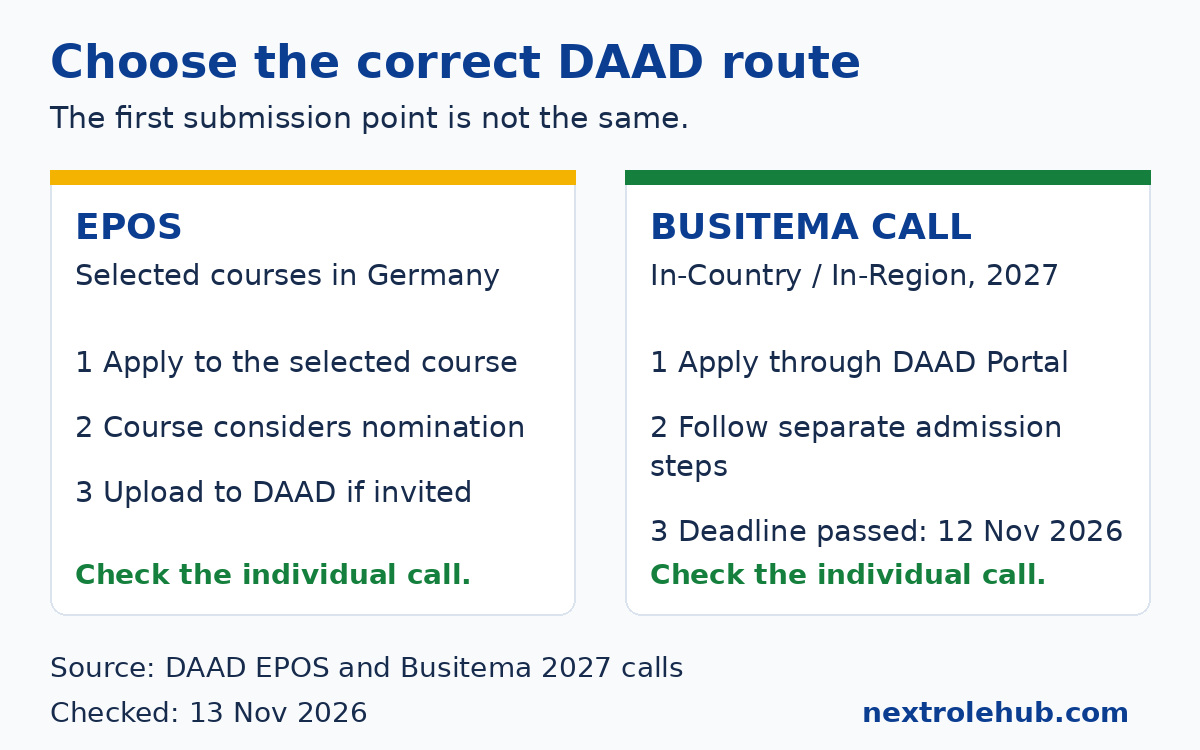
| Route | Study location and purpose | First application check |
|---|---|---|
| EPOS: Development-Related Postgraduate Courses | Selected postgraduate courses in Germany; development-related professional training. | Find your course on the current EPOS list, then follow its own scholarship instructions. |
| In-Country/In-Region, illustrated by Busitema | A specified programme in Uganda or another participating African country; the Busitema call emphasises teaching and research careers. | Read the host-specific DAAD call, including portal and separate university-admission requirements. |
| Other DAAD funding | Depends on the individual award, academic level and project. | Search the DAAD funding database for your country, subject and status. Do not assume EPOS rules apply. |
For example, a water-sector professional considering postgraduate study in Germany should examine relevant EPOS courses and their subject prerequisites. A recent graduate seeking a research pathway in Uganda would examine a suitable In-Country call instead.
The Busitema 2027 call explicitly invited fresh graduates as well as professionals. EPOS has a different experience requirement. Our existing DAAD Busitema guide covers that individual programme in detail; its 12 November 2026 application deadline has passed.
2027 intake deadlines: what has closed and what remains
A scholarship calendar needs two separate labels: the year you apply and the year you start studying. A programme beginning in 2027 can require your funding application in 2026. A later self-funded admission deadline does not reopen the scholarship competition.
| Programme and official source | Scholarship deadline | Position at 13 November 2026 |
|---|---|---|
| TropHEE, TU Darmstadt | 30 November 2026 for winter 2027/28 | Published deadline ahead. The page does not state a closing hour or time zone. |
| Environmental Governance, University of Freiburg | 15 October 2026 for winter 2027/28 | Deadline passed. Do not use the page’s general May admission date as a scholarship date. |
| Climate Change and Disaster Management, Busitema | 12 November 2026 for the 2027 call | Deadline passed. No extension was verified in the sources checked. |
These are examples, not the full DAAD calendar. The official EPOS 2027/28 course list, marked June 2026, directs applicants to course websites for dates. It also marks Development Management as having its next intake in 2028. Do not assume that every listed course starts in 2027.
For TropHEE, the university says the application must be received by the deadline. Because no hour is stated, ask the course office if timing is unclear and submit well beforehand. Do not assume a 23:59 cut-off; the page does not give one.
Busitema’s university notice dated 4 November 2026 confirms the same November deadline and a separate admission process. Its older wording that applications are open does not override the calendar. An extension needs a new official notice, not an active-looking button or a forwarded message.
EPOS eligibility: check your degree and work evidence
The DAAD EPOS requirements describe applicants with an appropriate bachelor’s degree, above-average results in the upper third and at least two years of related professional experience after the first degree. Degrees should normally be no more than six years old. The selected university also sets its own academic conditions.
- Match the subject prerequisites to your transcript, not only to your current job title.
- Establish which work periods occurred after completing your first degree and are relevant to the course.
- Check the course’s language rule, accepted evidence and document deadline.
- Review previous study and residence conditions before spending money on the application.
DAAD excludes applicants who have lived in Germany for longer than 15 months at the application deadline under the published EPOS rule. If your residence history or degree timing is unusual, send the official contact a factual chronology. Do not assume an exception or quietly change a date to appear eligible.
Course-specific restrictions matter. TropHEE’s scholarship page requires applicants not to have completed a master’s degree and asks for professional experience primarily in water, preferably outside a university. That restriction is not a universal statement that all DAAD schemes reject people with a master’s.
Freiburg provides a different example: its closed 2027/28 EPOS round excludes internships and voluntary work from the required professional experience, and generally does not treat university teaching or research as relevant employment for that scholarship. Read the course rule before counting activities simply because they appear on your CV.
What EPOS covers, and what not to assume
The current EPOS funding announcement lists €992 per month for graduate-level scholarship holders. Funding lasts 12 to 42 months depending on the programme. The published package also includes payments towards health, accident and personal-liability insurance, plus a travel allowance unless that travel is covered elsewhere.
Rent support and allowances for accompanying family members are conditional benefits, not automatic additions. Confirm what your award includes before making commitments. This guide does not convert the stipend into UGX: a conversion would need a dated exchange rate and would not describe your actual living costs in Germany.
| Funding question | Evidence to check |
|---|---|
| What monthly payment applies? | The current scheme announcement and your final award letter, not another course’s promotional poster. |
| Are tuition and compulsory charges covered? | The course fee page and the precise scholarship terms; list any unresolved charges separately. |
| Are dependants supported? | The stated eligibility and approval conditions for family allowances. |
| When does payment begin? | The award’s start date and payment instructions; ask what you must fund before the first transfer. |
Do not attach EPOS’s German-study stipend to a scholarship in Uganda. The Busitema call has its own benefit schedule and distinguishes In-Country from In-Region support. Its published terms also say extra family benefits are unavailable. Comparing the routes requires their separate award conditions, not a single “DAAD amount”.
Keep a preparation budget for expenses you may need to pay yourself, such as requested certification, tests or travel connected with the application. Ask the responsible institution which costs actually apply before paying a provider.
How the EPOS application sequence works
EPOS starts with the selected course, not an unsolicited bundle sent to DAAD. The general call says applications sent directly to DAAD will not be forwarded to universities. Follow the submission method on the course’s current page, whether that is a university system or another stated channel.
- Select eligible courses from the current EPOS list and read their admission and scholarship pages together.
- If choosing more than one course, rank no more than three and keep the same order in every application.
- Prepare the general DAAD documents plus every additional item the course requires.
- Submit the complete file directly to each selected course using its prescribed method.
- If nominated, follow DAAD’s invitation to upload the complete documents to its portal.
- Wait for the formal funding decision and check any outstanding admission conditions.
TropHEE’s current page requires email submission only, with the documents in the DAAD-checklist order combined into one PDF. It also requires hand-signed, currently dated forms. Open the official page for the course office’s complete contact details rather than copying a partially hidden address from a search extract.
After a positive DAAD response, TropHEE still requires the university’s online application. That sequence differs from Busitema’s call, which required the DAAD portal submission plus a separate host-admission application. Never use a successful applicant’s experience at another institution as your submission instructions.
Save the exact file you sent, its submission time and any confirmation. A saved form, a draft email or an uploaded file without the required final submission is not reliable evidence of completion. Monitor the email account you used, including its spam folder, for official follow-up.
Build a document file the reviewer can verify
Your evidence file should make the reviewer’s checks easy, not ask them to reconstruct your employment history. Start with your university records and employment dates, then reconcile the CV, forms and motivation letter. The checklist below combines the general EPOS requirements with practical preparation advice.
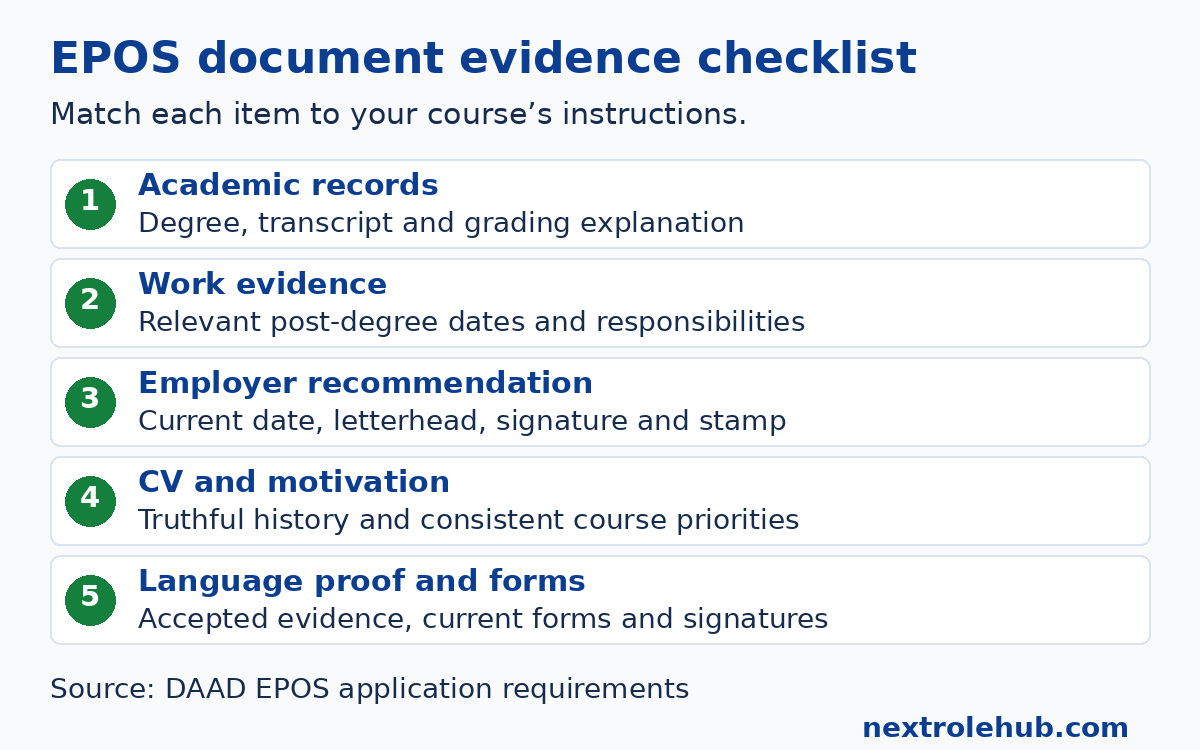
| Document | Preparation check for a Uganda-based applicant |
|---|---|
| Degree certificate and complete transcript | Use the issuing university’s records. Include the grading explanation requested; do not invent a German-equivalent grade. |
| Work certificates | Ask employers to confirm the actual work period and relevant responsibilities. Ensure post-degree experience is identifiable. |
| Current employer recommendation | Check the general EPOS requirements for current date, official letterhead, signature and stamp, plus course-specific instructions. |
| CV | Use the required Europass format for EPOS, reverse chronological order and an explanation for gaps. |
| Motivation letter | Connect actual work to the chosen training and future development contribution. Keep course priorities consistent. |
| Language evidence and forms | Use the specific course’s accepted proof and current forms. Check signatures, translations and certification rules. |
Request academic documents from your university’s responsible office early enough for your own deadline. If a name differs across records, ask the receiving course what explanation or supporting evidence it accepts before submitting.
For employment evidence, distinguish a contract from proof of completed work. Freiburg’s closed round, for example, required certificates stating retrospective employment dates rather than relying on a contract or payslip. Your current course may specify different evidence, so use that example as a warning to read, not as a universal replacement rule.
For writing help, our graduate CV layout guide explains how to present genuine education and practical evidence. Those job-application templates do not replace Europass or a scholarship’s prescribed format. Keep academic projects labelled as academic work.
A useful motivation outline starts with a specific problem you know through real work, explains the training you lack, and identifies how the course addresses that gap. Finish with a realistic use for the learning. Do not promise a national transformation you cannot substantiate, or copy the university’s description as your personal motivation.
DAAD’s general applicant guidance also addresses AI-assisted writing: applicants must preserve authenticity and disclose AI-created passages as instructed. Check that guidance before using a writing tool for your own application. An adviser may help with clarity, but your responsibilities, results and proposed work must remain truthful.
Mistakes that send a complete file to the wrong place
- Confusing scheme names: Busitema portal instructions do not describe the initial EPOS submission.
- Using a later admission deadline: a self-funded place does not restore an expired scholarship round.
- Counting experience without checking the rule: an internship or university role may not qualify for the selected course.
- Changing priorities: the course order must stay consistent across EPOS forms and the shared motivation explanation.
- Assuming an English waiver: Ugandan nationality alone does not establish the course’s accepted language evidence.
- Trusting an agent’s funding promise: submit through the official route and keep control of your account and documents.
Before sending a clarification request, identify the exact uncertainty. Attach or describe only the information needed: course title, intended intake, qualification, work dates or the document rule you cannot interpret. A focused enquiry gives the office something it can answer; a request to guarantee a scholarship does not.
Questions Ugandan DAAD applicants ask
Does every DAAD scholarship require IELTS?
No universal IELTS rule applies across DAAD. English-taught EPOS courses set their own evidence requirements. TropHEE’s current scholarship page lists IELTS, TOEFL or medium-of-instruction evidence, while other courses have different conditions. Confirm the accepted document and any required score with your chosen programme. Studying in English in Uganda is not, by itself, proof that every course will waive a test.
Can I apply if my degree is older than six years?
Do not decide from a general internet answer. EPOS normally limits degree age, while DAAD’s general guidance describes circumstances that may justify delays, including certain caring responsibilities or illness. The specific announcement remains controlling. Explain your dates and any relevant evidence to the official contact, and obtain clarification before assuming you qualify. Never conceal the original award date.
Does a second-class upper degree automatically qualify me?
Not by itself. The Busitema call specifies at least Second Class/Upper Division, whereas EPOS describes results in the upper third and each university has additional admission conditions. These are not interchangeable descriptions. Provide your genuine transcript and grading information. The responsible course must decide how your qualification meets its requirements; a self-made grade conversion cannot establish eligibility.
Can I study at Busitema and use EPOS funding?
Not under the EPOS route described here. EPOS funds the selected courses in Germany listed for that scheme. Busitema’s climate-change award belongs to the separate In-Country/In-Region programme and follows its own funding and application rules. Its verified 2027-call deadline was 12 November 2026. Check for a new official call rather than attempting to attach another scheme’s funding to admission.
Can I apply for another master’s if I already have one?
Check the individual course and scholarship, not just the qualification level. TropHEE’s published scholarship prerequisites exclude applicants who have already completed a master’s. Freiburg’s closed round instead asked such applicants to justify further postgraduate funding. The Busitema call separately excludes people who have already received a DAAD master’s scholarship from further DAAD master’s funding. Different restrictions answer different questions.
What should I do if the scholarship deadline has passed?
Look for an official extension or a different, genuinely open programme that fits your background. Do not assume a portal still accepting logins means the round is open. If no extension is published, use the closed call only for preparation and wait for a confirmed new announcement. Our scholarships hub can help you identify other opportunities, but each provider’s current call decides availability.
Choose one course you can justify, then verify the route
Your DAAD scholarship Uganda plan should begin with scheme fit, not a generic deadline poster. Identify the destination and programme, test your academic and professional evidence, and record the exact funding deadline. Keep admission, nomination and final scholarship approval separate throughout the process.
If TropHEE fits your background, read its current scholarship page and resolve missing evidence before the published 30 November 2026 deadline. If it does not fit, do not force your work history into its requirements. Compare other scholarships for Ugandans instead.
For a different European route, read our Erasmus Mundus application guide. The Clarendon funding guide explains Oxford’s separate process. Neither follows DAAD’s rules. Keep one source-backed record per opportunity so you know what to submit, where it goes and which date actually matters.