A scholarship application in Uganda can involve more than one form: university admission, a funding application and sometimes a national nomination. Start by finding the current official call and working out which submissions it requires. A complete file sent to only one of the required destinations can still leave you outside consideration.
That distinction matters when a student in Gulu has an admission letter but no funding, or a graduate in Kampala finds an overseas scholarship with a separate Ministry selection process. The documents may overlap, but the decisions are different. Neither an admission offer nor a nomination is the same as a final scholarship award.
This guide follows the whole process, from checking eligibility to saving proof of submission and reading an offer. It includes a document-by-document worksheet and a funding-gap check you can use for different awards. It does not repeat individual programme calendars. NextRoleHub does not award scholarships, collect applications or guarantee selection: apply through the provider’s official channel, not through us.
Last checked: 18 November 2026 against the Ministry of Education and Sports scholarship hub and the official provider guidance linked below. Historical calls are labelled as examples, not open opportunities. Some standing guidance pages do not display a clear revision date; the current award notice takes priority.
Table of Contents
How does a scholarship application in Uganda work?
Find a current official scholarship call, confirm that you meet its eligibility rules, and identify every required application channel. Prepare the requested evidence, complete admission or nomination steps where applicable, and submit before each deadline. Save confirmation, monitor official updates, and read the funding conditions before accepting an award.
- Find the provider’s current call and identify the academic year it covers.
- Check nationality or residence, study level, subject and any experience conditions.
- Record separate admission, nomination and funding deadlines.
- Prepare each document in the exact form requested.
- Submit through every required channel and save the receipt.
- Track results and resolve conditions before committing money or leaving employment.
There is no universal Uganda scholarship form, minimum grade or document bundle. A school-level award, an undergraduate tuition discount and a research scholarship solve different problems. Use the workflow below as a preparation tool, not as a replacement for the individual call.
Verify the call before spending money on documents
Search results and forwarded posters are leads. Open the university, embassy, funder or Ministry page and locate the actual notice. Check whether it invites applications, announces a shortlist, changes an interview date or publishes awardees. Those notices serve different stages of selection.
The Ministry scholarship hub contains applications alongside nominations, interview schedules and a postponement notice. A later interview update may matter more to an existing applicant than the original advert. It does not, by itself, reopen applications. Read the latest relevant notice and the original conditions together.
Record the scholarship’s full name, official URL, study year, application deadline and contact route. If the closing hour or time zone is absent, mark it as unresolved and ask the official office. Do not assume that every international portal closes at midnight in Kampala.
For example, the Embassy of Japan’s MEXT page marks its listed 2026 application rounds closed. The University of Kisubi Centenary call gave an 18 July 2026 deadline for the August 2026 intake. Both are past examples here. A page remaining accessible in November does not establish a new intake.
For opportunity discovery, use our scholarships hub, then recheck the provider’s page. Do not rely on a countdown alone, particularly when the date printed in an advert has already passed.
Keep admission, nomination and scholarship approval separate
Before writing an essay, draw the route your application must follow. Some awards depend on an existing admission offer. Others let you seek funding before an offer is issued. National nomination can add a separate selection stage. The official instructions must establish the order.
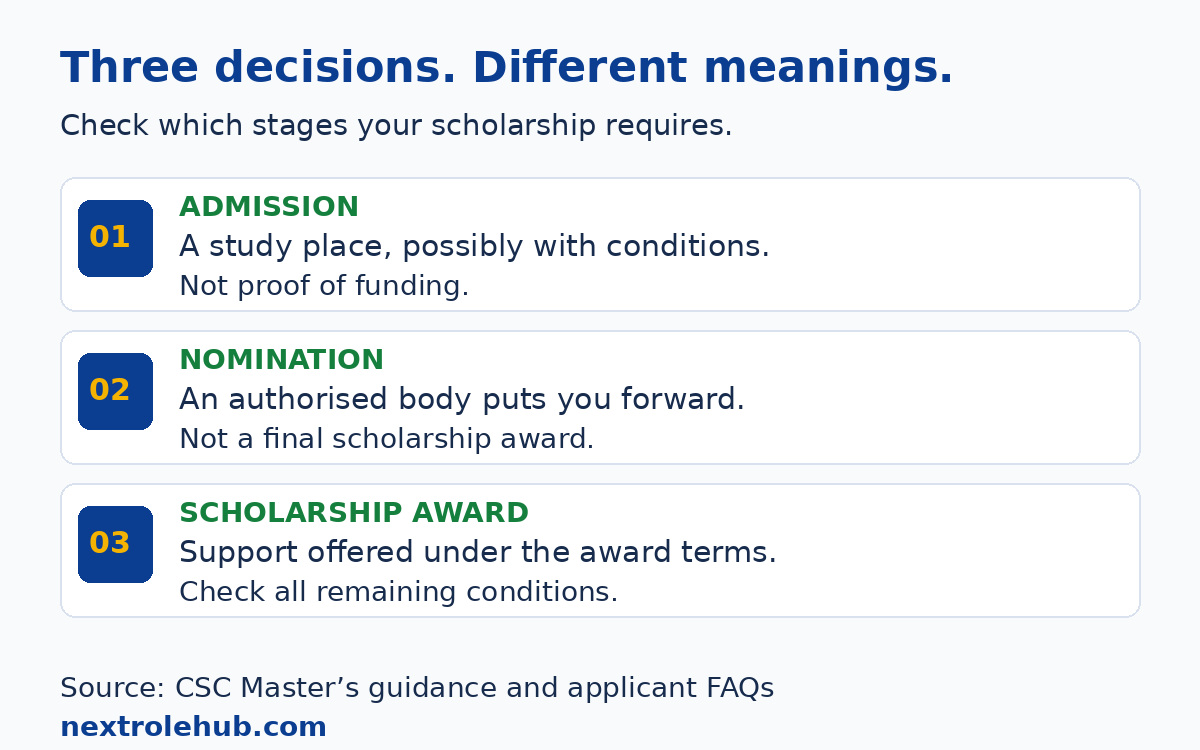
| Decision | What it establishes | What it does not establish |
|---|---|---|
| Admission | The institution offers you a study place, possibly with conditions. | That tuition or living expenses are funded. |
| Nomination | An authorised body puts your application forward. | That the final funder has selected you. |
| Scholarship award | The provider offers the support stated in its award terms. | That all visa, admission or acceptance conditions are already complete. |
The agency-nominated Commonwealth Master’s route requires both a CSC application and an application to a participating nominator. The provider says nomination does not guarantee selection. Its 2027/28 application round is now closed, so this explains the route rather than inviting a late application.
The CSC applicant FAQs say an admission offer is not required at the scholarship-application stage for the listed Master’s route, while a nominating agency can impose additional conditions. The programme page also urges applicants to pursue university admission in advance. Taken together: do not wait for funding to start the admission process, but do not invent a universal offer-letter requirement either.
For scheme-specific instructions, read our DAAD guide for Uganda-based applicants or Erasmus Mundus application guide. This article covers the shared preparation workflow, not their course choices, benefit rates or intake calendars.
Build a scholarship document worksheet, not one attachment bundle
Create a private folder for each award and list its exact evidence requirements. The worksheet below combines requirements found in official guidance with editorial preparation checks. Not every row applies to every scholarship. A document marked optional in a checklist becomes mandatory only when your actual call requires it.
| Evidence | What to prepare | Check before submission |
|---|---|---|
| Identity | The ID document accepted by the call. | Names and dates match; scan is complete and readable. |
| Academic history | Requested certificates and all relevant transcript pages. | Pending qualifications are labelled accurately; translations or certification meet the rule. |
| Admission | An offer or acceptance document if required. | Correct institution, course, intake and outstanding conditions. |
| Financial circumstances | Requested income, household or other support evidence. | Statements agree with supporting records; other funding is disclosed. |
| References | The required type and number, prepared by the referees. | Correct submission route, signature or identification, and deadline. |
| Written case | Statement, CV, proposal or letter specified by the award. | Answers the actual prompt within its limit. |
| Forms and consent | Current forms, declarations and signatures. | No required section, consent or attachment is missing. |
Use the issuing institution for academic records. Inspect the complete transcript rather than saving only a screenshot of your final classification. CSC guidance requires full higher-education transcripts and explains that missing pages can make an application ineligible. That is a specific provider rule with a useful general lesson: completeness is not the same as a good final grade.
Where names differ between records, seek the receiving office’s instructions. Do not edit an official scan to make names or dates agree. Ask what supporting explanation it accepts and keep the written answer with your application file. Certification and translation requirements also come from the receiving provider; a readable scan alone may not satisfy them.
The TEST for Uganda 2026/27 guidance shows how detailed financial-need evidence can become. It requests supporting records for household circumstances and other funding, not just a statement that money is difficult. Its 14 August 2026 application deadline has passed. Use it to understand the evidence burden, not as a currently open call.
If a parent earns informally, do not invent a salary slip. TEST’s past guidance describes an affidavit route for parents unable to evidence earnings through payslips. Another provider may accept different evidence. Ask the current provider what applies before paying for documents that may not be needed.
Keep requested identity and household records private. Upload them only through the verified application route. If using a shared computer in a trading centre or university lab, sign out and remove local copies after saving your own secure version. Never send a password or login code to someone offering to complete the form.
Write the funding case and organise genuine references
A scholarship statement needs to answer the selection prompt, not retell your CV. Separate academic preparation, financial circumstances and future use of the training when the form asks for them separately. A strong academic example cannot stand in for missing financial evidence on a needs-based award.
For a practice planning exercise, imagine an applicant who helped organise records during a school attachment and now wants education training. The useful evidence is the task actually performed, what it revealed about the applicant’s learning needs, and how the proposed course addresses those needs. Do not add invented pupils served, exam improvements or leadership titles to make the account sound larger.
Build an evidence outline before drafting: the actual activity, your personal contribution, the learning gap and the relevant course feature. Then explain a realistic use for that learning. Avoid promises to solve a national problem alone. The outline is editorial advice, not an official scoring formula or a sample claim to submit as your history.
Our graduate CV layouts can help organise genuine education and project evidence. The cover-letter guide helps with concise evidence-based writing, but a job letter is not automatically a scholarship personal statement. A prescribed academic CV, proposal or essay format overrides either guide.
Ask referees for permission and send the award name, relevant criteria, your current CV and the deadline. Choose someone who can discuss work or study they actually supervised. A senior title is not useful if the person cannot explain how they know you.
Check who submits the reference. Under the current CSC instructions, applicants collect the required references and upload them with the application. Other awards may send referees private links. Never assume a lecturer’s promise, an email sent to you or a listed referee name proves the receiving system has the required document.
Do not write praise in a referee’s name or alter a signed letter. CSC requires references in the referee’s own words. Check each scholarship’s rules on writing assistance and AI before using tools for your statement; your achievements and judgement must remain your own.
Check the funding gap and the obligations attached
Read the award’s coverage item by item. Tuition support does not automatically include accommodation, food, research expenses or travel. Even a broad award can require you to pay some costs before reimbursement. If the provider does not publish an amount or payment date, record it as unconfirmed rather than supplying an internet estimate.
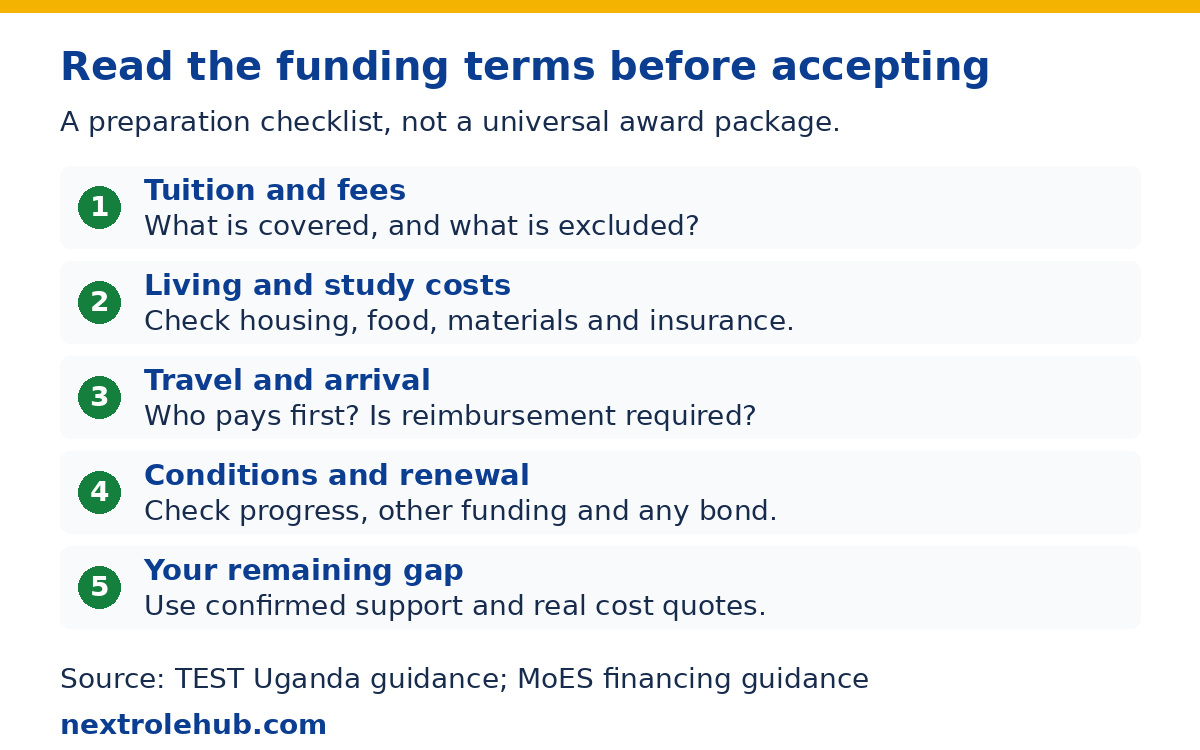
- Tuition and compulsory charges: identify what is covered and any excluded fees.
- Living and study costs: check accommodation, meals, materials, research and insurance.
- Travel and arrival: establish who pays, when payment occurs and whether reimbursement applies.
- Conditions: read academic-progress, renewal, other-funding and return-service obligations.
- Remaining gap: use your actual quotes and confirmed support, not assumed stipend amounts.
TEST’s past guidance described both full and partial awards according to need. It also required annual renewal and a five-year commitment to remain in Uganda after study, with provisions concerning further study abroad. Those are terms of that scheme, not conditions attached to every scholarship. Read a bond before signing it, including how to seek clarification.
Keep scholarships separate from repayable finance. The Ministry’s Higher Education Students Financing Scheme guidance describes student loans as repayable and explains that the loan is a cost-sharing arrangement. Calling a loan a scholarship can leave a family misunderstanding both the remaining living costs and future repayment obligations.
Be precise about fees too. CSC says its online scholarship application is free. Kisubi’s past call, by contrast, specified an institutional application-form fee. Neither proves that every payment request is genuine or that every education application is free. Verify the current notice and official institutional payment instructions; never pay a private intermediary for a guaranteed award.
Submit through the right channel and keep a usable record
Read the submission instructions again after assembling the documents. A portal, an email address and physical delivery are not interchangeable. The closed MEXT rounds on Japan’s embassy page required physical submission and rejected email applications. Their copy requirements differed by category. Do not apply those past rules to a future round without checking its new notice.
Open every final attachment. Check page order, readability, signatures, file type and size limits. Keep separate originals even when the provider requests a combined file. A blurry compressed certificate is not a successful upload simply because the portal accepted the file.
For an online form, review the entries as well as attachments. Confirm that the course title, dates and names agree throughout. Use the provider’s final submission step and save its confirmation or reference. An account, a saved draft and a submitted application are different states.
Set your own preparation target ahead of the official deadline. Work backwards from slow dependencies such as academic records, referee availability and required certification. This is a planning method, not a promise about how quickly any Ugandan office will issue documents. Ask each office about its current process.
After submission, check the application dashboard, email and the provider’s notice page. Save interview changes and any requests for further evidence. An application confirmation is not a shortlist, and a shortlist is not an award. Avoid resigning, booking non-refundable travel or paying accommodation deposits on the strength of a nomination alone.
Questions that change how you prepare an application
Can I apply for a scholarship without a passport?
Check the accepted identity evidence for the exact application stage. CSC’s current Master’s instructions accept a qualifying national ID or passport, but that does not establish the rule for another funder or for later travel. If you lack a document the call requires, contact its official office about acceptable alternatives. Do not assume an application-stage alternative satisfies a visa requirement.
Do I need IELTS if I studied in English in Uganda?
Not automatically for every scholarship, and previous English-medium study does not guarantee every university will waive a test. The CSC FAQs distinguish its scholarship application from the university’s language requirements. Check both sets of conditions before booking a test or requesting a medium-of-instruction letter. Use the evidence accepted by your particular course, including any stated validity period.
Can I apply before my final degree results are released?
Only where the call permits your current academic status and completion timetable. CSC guidance allows some applicants still completing a first degree to provide transcripts to date, subject to completion and eligibility conditions. Another scheme may require an awarded qualification before its deadline. State what is completed and what is pending; do not substitute an expected result for a confirmed award.
Can I hold two scholarships at the same time?
Read both providers’ terms and disclose existing support. Some awards restrict overlapping funding, while needs-based schemes may reassess the amount you need. TEST’s past guidance required disclosure of grants and loans; CSC restricts concurrent awards covering the same costs. Do not assume that two separate offers mean you may accept both unchanged. Seek written guidance before committing.
Can a cybercafe assistant submit the form for me?
You can seek practical help with scanning or typing, but keep control of the account and review every entry before submission. Do not allow a helper to invent circumstances or keep your password. Sign out on shared devices, remove downloaded personal files and retain your own submission copy. The provider will assess the information under your name, not your helper’s intentions.
What if I discover a mistake after submitting?
Use the correction instructions on the official portal or contact the responsible office promptly. Explain the exact error, quote your application reference and ask what correction process is available. Do not submit another application unless the rules permit it. CSC warns that submitted applications cannot be edited, which is why final review matters; other providers may follow a different process.
Prepare one complete application before starting the next
A scholarship application in Uganda is easier to manage when every requirement has a source, an owner and a completion check. Start with the current official notice. Separate admission from nomination and funding, and build the document worksheet around that specific award rather than a generic folder of certificates.
Your next step is practical: choose one suitable opportunity, save its instructions and mark each requirement complete, missing or awaiting clarification. Resolve the gaps before polishing the essay. Then submit through the verified route and keep the confirmation so that a strong application is also a complete one.