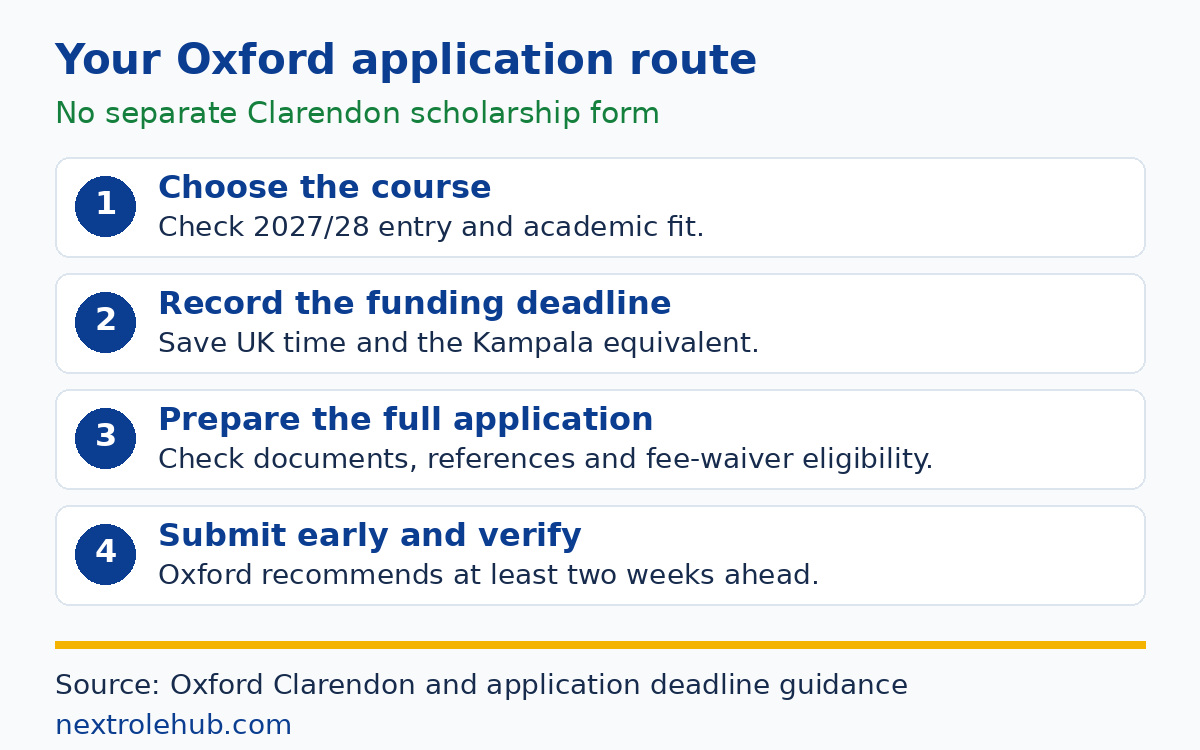
Clarendon scholarship Uganda applicants do not need a separate scholarship form. The work is in choosing the right Oxford graduate course and submitting a complete academic application before its funding deadline. A late application can leave you competing for admission without the scholarship consideration you were counting on.
For 2027 entry, do not copy a single closing date from a scholarship poster. Oxford sets deadlines by course, and some pages show an early round, a scholarship round and a later admissions round. Those dates do different jobs. Your calendar needs the one that preserves funding eligibility, together with its UK submission time.
This guide explains who can be considered, what Clarendon covers, how to check your own deadline and how to prepare documents from Uganda. It also separates the scholarship from two other decisions: an application fee waiver and an English-language test waiver. Neither is automatic just because you are Ugandan. Use the course-check worksheet below before spending money on tests, translations or application support.
Last checked: 11 November 2026 against Oxford’s official Clarendon applicant guidance. Course examples below are for 2027/28 entry; recheck your chosen course before submitting.
Table of Contents
Clarendon scholarship Uganda: can Ugandans apply?
Yes. Ugandan applicants can be considered for Clarendon when applying for a new eligible Oxford master’s or DPhil by the relevant December or January course deadline. Consideration is automatic, not an award guarantee. Scholarships cover course fees and provide living support; selection depends on academic merit and potential, not nationality.
Oxford’s eligibility rules place no restriction on nationality, ordinary residence or subject. Full-time and part-time graduate study can qualify. You still need to satisfy the entry requirements of the particular degree; general scholarship eligibility does not override a course’s academic requirements.
Clarendon is for a new course. An Oxford master’s student applying for a DPhil or another master’s can be considered. Someone continuing the same degree next year cannot. Oxford also excludes applicants holding deferred graduate offers from Clarendon consideration. If your situation involves a deferral, check it before relying on funding.
Academic strength matters beyond a minimum admissions threshold. Oxford describes first-class honours or equivalent as typical among successful scholars, while acknowledging that exceptional master’s performance can compensate for a more moderate first degree. Do not translate a Ugandan transcript into a made-up UK classification: Oxford says departments assess international qualifications and applicants need not convert their own grades.
What Clarendon pays, and what you must still check
The core award covers course fees in full and provides support for non-fee costs. Full-time and part-time support work differently, so use the correct column when planning your studies. The scholarship offer, rather than a social-media description of “fully funded”, determines your individual entitlement.
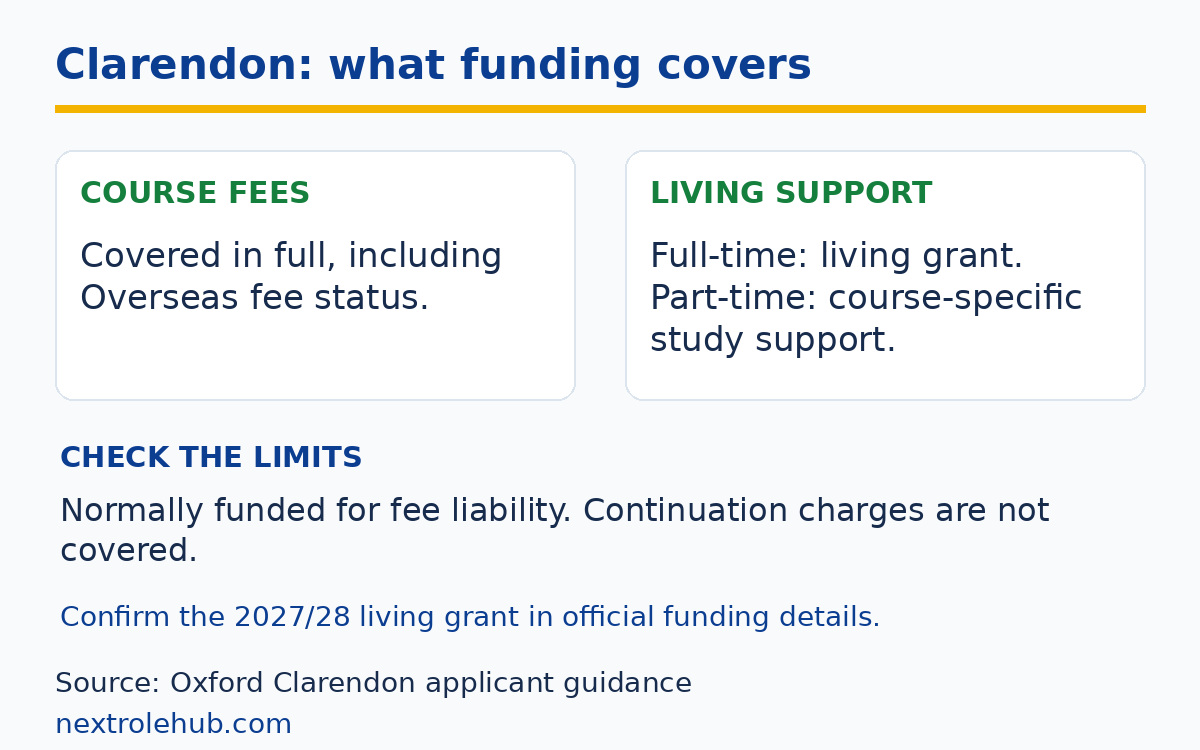
| Funding item | Full-time study | Part-time study |
|---|---|---|
| Course fees | Covered in full, including Overseas fee status | Covered under the applicable course-fee rules |
| Non-fee support | Annual living grant of at least the UKRI minimum doctoral stipend rate | Study support grant, with value dependent on the course |
| Usual funded period | Normally the period of fee liability | Normally the applicable fee-liability period or modular-fee arrangement |
| Continuation charges | Not covered by Clarendon | Not covered by Clarendon |
Source: Clarendon funding and duration conditions. The page still quotes at least £20,780 for 2025/26. That is a historical figure, not a confirmed 2027/28 stipend. A 2027/28 cash amount was not stated on the applicant page checked for this guide; do not build a current budget from the older amount.
For part-time courses, Oxford describes grants that can be a sixth, a third or half of the UKRI minimum, depending on the course. The offer letter gives the amount. Modular courses have additional rules about compulsory fees and the modules needed to complete the award; optional extra modules are not automatically funded.
Keep a separate list of costs you need clarified: travel from Entebbe, visa-related charges, any required language test and support for dependants. The general Clarendon page does not establish that each of these receives a separate payment. Ask Oxford rather than treating a full-fee scholarship as a promise that every expense is reimbursed.
Find the scholarship deadline for your exact course
Start with Oxford’s graduate course finder, then open the page for your intended degree and study mode. Confirm the entry year before reading the dates. A page for a previous admissions cycle is not evidence for your 2027 application.
- Write down the exact course title and whether it is full-time or part-time. Similar titles can lead to different requirements.
- Read the Application deadlines section, including the explanation underneath each date. Identify the final deadline for Oxford scholarship consideration.
- Open Entry requirements and Completing your application. Record the documents, referee requirements and any course-specific instructions.
- Record both the UK deadline and Kampala time. For the January examples below, noon UK time is 3:00 pm in Uganda on the same day.
- Save the official course URL beside your notes and set an earlier personal submission target. Oxford recommends submitting the form and supporting documents at least two weeks ahead.
These two examples show why a universal “Clarendon closes in January” reminder is not enough. They are not a list of recommended courses and do not establish deadlines for other degrees.
| Official 2027/28 course page | Relevant deadline | Kampala equivalent |
|---|---|---|
| MSc in Advanced Computer Science | 6 January 2027, 12:00 midday UK time; final application deadline | 6 January 2027, 3:00 pm EAT |
| MSc in Mathematical Modelling and Scientific Computing | 27 January 2027, 12:00 midday UK time; final scholarship-consideration deadline | 27 January 2027, 3:00 pm EAT |
The Mathematical Modelling page also lists 13 November 2026 for an earlier decision round and 2 March 2027 as the final admissions deadline. Its March date does not replace the January funding deadline. Oxford’s deadlines guide confirms that applications to a March or later course deadline are ineligible for Oxford scholarship consideration under the normal course-deadline route.
Make a one-page course record: title, official URL, entry year, scholarship deadline, Kampala time, personal submission target, required uploads, referee status and unresolved questions. This is more useful than a folder of scholarship screenshots because every task points back to a current official requirement.
Uganda residents: check the application fee waiver first
There is no separate Clarendon application charge, but the graduate course application normally has a fee. Oxford’s international applicant guidance lists £20 for research-course applications and £75 for taught-course applications. Check your course classification rather than assuming every master’s degree belongs to the same fee group.
Uganda appears on Oxford’s eligible-country list for the low-income-country application fee waiver. To qualify under that route, your country of ordinary residence must be eligible, you must be unable to apply without the waiver, and you must meet the course entry requirements. Ugandan citizenship alone is not the whole test.
- Start a Standard application in Oxford’s online form.
- Enter your ordinary residence truthfully and answer the additional waiver questions.
- Check that your answers meet all the published conditions. Eligible applicants are not sent to the payment screens when submitting.
- If the payment step or your circumstances are unclear, use Oxford’s official guidance and contact route before the deadline. Do not assume a fee waiver extends the course deadline.
Consider a Ugandan graduate ordinarily resident in Kampala and another ordinarily resident abroad. Their nationality may be the same, but their fee-waiver assessment can differ. This residence rule concerns the application charge, not Clarendon’s nationality eligibility. Do not confuse a waiver refusal with a scholarship rejection, or a waiver approval with a funding award.
Build one complete academic application, not a second scholarship pack
Clarendon draws on your graduate application. Spend your preparation time making that file accurate and academically persuasive. Oxford does not ask for an additional Clarendon essay or a separate bundle of scholarship documents. The requirements of your chosen course decide what belongs in the application.
Collect evidence before polishing the statement
Request your official transcript from your university and check the name, award and grading information. If a transcript is not in English, Oxford requires the original plus a certified English translation. Follow the upload instructions; do not send irreplaceable originals somewhere merely because an unofficial adviser asks for them.
Create a document checklist from the course page, not from another applicant’s experience. A statement of purpose, research proposal, written work and CV are not interchangeable. Where a CV is required, use our Uganda CV writing guide for clear evidence and dates, then follow Oxford’s academic instructions over job-application conventions.
Manage references as a submission dependency
The course examples above require you to register three referees. Oxford’s general deadlines guidance says a complete on-time application needs all mandatory documents and at least two submitted reference letters. That does not remove a course’s requirements or mean you should ignore the third reference. Read the individual instructions and aim to have every requested reference submitted early.
Choose people who can assess your academic work in the way the course requires. Give them the course link, deadline and a concise reminder of work they supervised. References must be submitted directly by referees, not uploaded by you in their place. Check submission status rather than assuming an invitation email means the letter has arrived.
Show academic fit with evidence you can defend
For a research course, connect your proposed question to methods, prior study and the department’s expertise. For a taught course, explain which academic preparation makes you ready for its demands. “I want to help Uganda” needs a specific problem and a credible study direction; it is not evidence of readiness by itself.
For example, a mathematics graduate interested in modelling could identify a question arising from previous coursework, explain the methods already studied and show the training still needed. This is preparation advice, not a model applicant’s biography or a promise of selection. Keep every result, publication and responsibility truthful.
Treat language evidence separately from funding
Oxford’s English-language guidance allows you to apply before supplying English test scores. Your application can still be assessed, but an eventual offer may require satisfactory evidence before you take up the place. Check whether your course requires Standard or Higher proficiency and use the current accepted-test rules before booking.
A test waiver may be possible for a qualifying recent degree taught and assessed entirely in English. Oxford specifies conditions including full-time study, a recognised institution, at least nine months of study and completion within two years of the new course’s start. An English-medium letter alone does not guarantee approval. Check the full conditions rather than assuming Uganda’s use of English settles the question.
What happens after you submit
Your department assesses the application for admission and identifies potential Clarendon nominees. Academic divisions then consider nominations. Oxford’s published Clarendon selection timeline describes divisional meetings in February or March, with most initial scholarship offers sent by the end of April.
Successful candidates are contacted by email. The initial scholarship offer is sometimes called a CB1; a later funding breakdown, or CB2, explains the assembled funding package. Accepting a scholarship does not remove conditions attached to your course offer. Read both sets of correspondence and respond within the stated deadlines.
Oxford says unsuccessful Clarendon applicants are not individually contacted. Its guidance says that if you have heard nothing by mid-June, you should assume you have not received an award, although a few late nominations can occur. Do not reject alternative funding merely because you have received an Oxford admission offer.
For a wider funding search, Oxford’s scholarship guidance explains that some schemes need extra applications. Locally, our scholarships for Ugandans hub lists separate opportunities. If you are comparing routes, the Erasmus Mundus applicant guide covers a different funding system; its procedures do not apply to Clarendon.
Avoid the mistakes that lose funding consideration
- Using a generic deadline. A course can remain open after its scholarship round closes. Save the funding date, not just the final admission date.
- Treating a saved form as submitted. Confirm the submission and check the required documents and references are received.
- Recycling a scholarship essay. Clarendon uses your course application; an unrelated leadership story can use space needed for academic evidence.
- Buying an application guarantee. Oxford says applicants must complete their own applications and that it has no arrangements with agencies. Nobody outside Oxford can promise a Clarendon award.
- Spending before checking waivers. Review the application-fee and language-test waiver rules independently, then budget for costs that remain.
If a point is unclear, ask a narrow question with the exact course title: whether your qualification meets the requirement, which reference type is acceptable, or which date preserves scholarship consideration. A precise query is easier for the relevant department to answer than “Can I get Clarendon?”
Questions Ugandan Clarendon applicants ask
Can a final-year undergraduate apply for 2027 entry?
Yes, Oxford allows applications during the final year when you plan to move directly into the graduate course. Assessment uses the grades available so far. You must still meet any eventual offer conditions and provide the final documents required. If your results will not be available before the course starts, consult the department rather than assuming you can begin late.
Is there a guaranteed number of Clarendon scholarships for Uganda?
The official applicant guidance checked for this article does not publish a reserved Ugandan allocation. Do not mistake eligibility for a country entitlement. Your application is assessed for academic strength and potential through Oxford’s departmental and divisional processes. A claim that an agent controls a Ugandan quota should not influence where you submit documents or money.
Can someone with a second-class degree win Clarendon?
There is no responsible yes-or-no answer based only on that label. Oxford describes outstanding academic results as essential and notes that exceptional master’s performance can compensate for a moderate first degree. Your chosen course has its own minimum requirements. Ask the department about your qualification where needed; neither admission nor funding follows automatically from meeting a minimum.
Does choosing a particular college improve my funding chances?
Do not select a college on the assumption that it guarantees funding. Oxford’s general scholarship guidance says most college awards do not require applicants to name that college as their preference, and scholarship arrangements can involve a college move. Check any separate award’s conditions individually. For Clarendon, concentrate on a strong course application by the funding deadline.
May I apply to several Oxford courses to seek funding?
Oxford allows a maximum of three graduate course applications in one admissions cycle, with no more than two taught courses. Its guidance warns that withdrawing an application does not let you substitute a different course outside those limits. Choose carefully, check each deadline and prepare a distinct academic case for each course rather than submitting interchangeable statements.
Can I use this guide as my Clarendon application?
No. NextRoleHub explains the process but does not submit applications, nominate scholars or collect scholarship payments. Begin on your chosen Oxford course page and use its official application route. Keep your login details private and complete the form yourself. Guidance can help you organise evidence; the application, written work and factual claims must remain your own.
Start with one verified course record
Your Clarendon scholarship Uganda plan should begin with a course you can justify academically, not a funding poster. Save its official 2027/28 page, record the correct scholarship deadline in Kampala time and work backwards through documents, references and any unresolved entry conditions.
Today, complete the course record and contact your referees. Then check whether you qualify for the application fee waiver before paying. If Oxford is not the right fit, compare other routes through our DAAD Busitema scholarship guide, checking its separate deadline, or the scholarships hub. Different awards require different applications; use each official source as the final authority.