Pretoria Mastercard scholarship applicants for 2027 should treat the published application round as closed. The University of Pretoria lists 31 August 2026 for undergraduate scholarship applications and 30 September 2026 for postgraduate applications. Both dates have passed. Do not send a late application because a search result still says “applications are open”.
For a Uganda-based applicant, the useful work now is understanding the route, checking whether your intended degree qualifies and organising evidence for a future officially announced call. If you already applied, keep your admission and scholarship records together and monitor the email address you used. A university offer is not a scholarship award.
This guide explains the published 2027 rules, the funding package and its exclusions, the documents requested in the official forms, and the questions that need clarification before another application. It also highlights two details easy to miss: undergraduate Law has a regional restriction, and the general page’s reference to Honours is broader than the first-year master’s wording in the postgraduate form.
Last checked: 19 November 2026 against the University of Pretoria application page and its linked 2027 forms. No reopening or later intake date was verified in the official sources reviewed.
Table of Contents
Is the Pretoria Mastercard scholarship still open for 2027?
No, not under the published 2027 deadlines checked for this guide. Undergraduate scholarship applications closed on 31 August 2026, and postgraduate applications closed on 30 September 2026. The official forms reject late submissions. An unchanged “open” banner does not establish an extension; only new official instructions can do that.
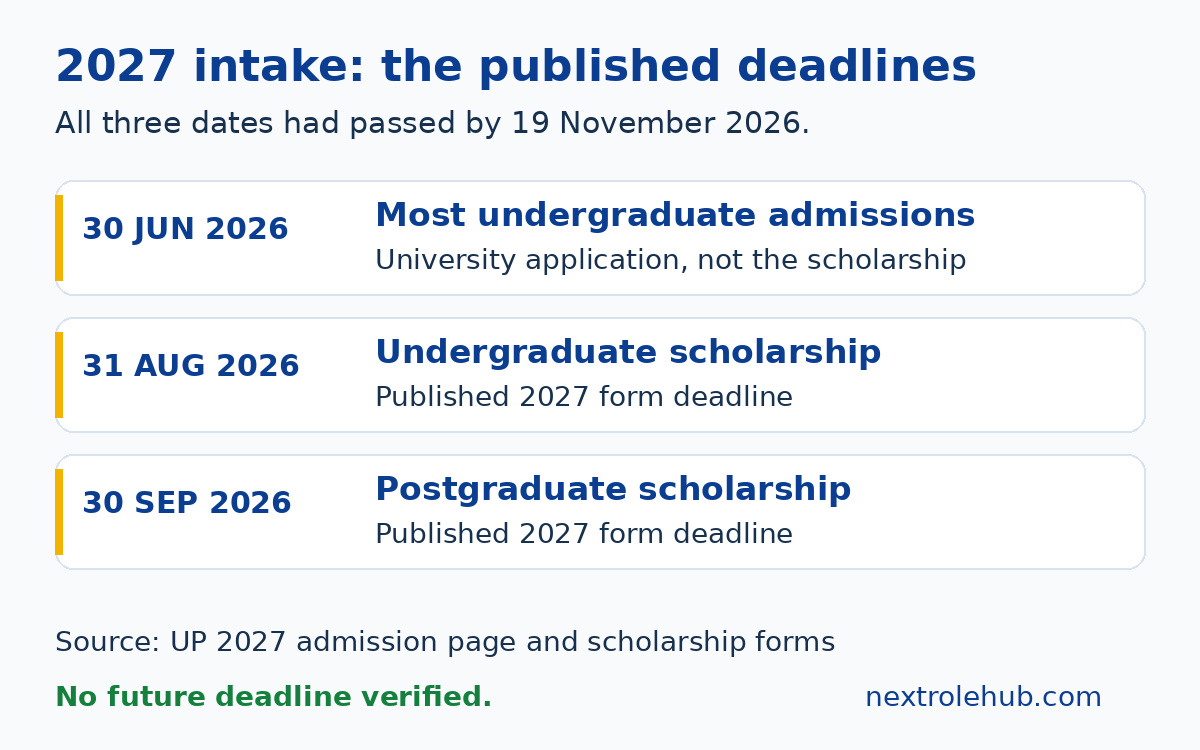
Keep university admission dates separate from scholarship dates. UP’s 2027 undergraduate admissions page gives 30 June 2026 for most undergraduate programmes and 31 May 2026 for Veterinary Science. Those are admission dates, not an invitation to use August or September as the first date to apply to the university.
| 2027 application stage | Published deadline | Meaning on 19 November 2026 |
|---|---|---|
| Most undergraduate university admissions | 30 June 2026 | Passed; course admission came before scholarship selection. |
| Undergraduate scholarship application | 31 August 2026 | Passed; the undergraduate form says no late submissions. |
| Postgraduate scholarship application | 30 September 2026 | Passed; the postgraduate form says no late submissions. |
| Future scholarship round | Not verified | Do not infer a new deadline from the previous timetable. |
Sources: UP’s admission page above and the 2027 undergraduate scholarship form and 2027 postgraduate scholarship form. The postgraduate form also instructs candidates to apply for faculty admission by 30 June 2026; individual postgraduate course requirements still need checking.
An older official application page still gives a general 31 October closing date and discusses the 2023 intake. That historical wording does not override the specifically labelled 2027 forms. Do not treat it as evidence of an extension or a later application window.
If you missed this round, do not pay someone to “reopen” it. Save the official programme page and look for a new dated announcement. For other routes, use our DAAD scholarship guide for Ugandans to understand the different schemes, then verify each course’s current call.
Can applicants from Uganda qualify?
Ugandan citizenship can fit the programme’s African-applicant requirement, but nationality alone is not enough. UP targets academically strong young Africans facing serious financial and social barriers. The official guidance includes refugees, internally displaced people and people with disabilities, alongside leadership and a demonstrated commitment to community service.
Both 2027 forms specify an academic average of at least 70%. Do not convert UACE results, a Ugandan GPA or a degree classification into a self-declared South African percentage. Send your actual results and grading information; ask UP how your qualification will be assessed when the equivalence is unclear.
- Undergraduate applicants: first-year, full-time degree study beginning in 2027, without an undergraduate qualification already completed.
- Postgraduate applicants: the 2027 form specifies first-year, full-time master’s study, without a master’s qualification already completed.
- Financial need: the forms exclude applicants who can afford tertiary study and request supporting household evidence.
- Admission: only applicants admitted to UP are considered; keep your student number and admission letter.
- Study mode: the forms exclude extended and non-degree study. Both require an application for university residence.
These are screening requirements, not a prediction of selection. A strong transcript cannot replace financial-need evidence or turn an excluded course into an eligible one. Use the exact form for your study level and disclose previous university study honestly.
Which degrees and faculties are included?
This scholarship guide concerns one host: the University of Pretoria in South Africa. It is not a shared application for every Mastercard Foundation partner university. Another university’s age limit, degree list or submission method cannot establish your eligibility at UP.
| Faculty listed in the 2027 forms | Undergraduate route | Postgraduate route |
|---|---|---|
| Economic and Management Sciences | Listed | Listed |
| Natural and Agricultural Sciences | Listed | Listed |
| Engineering, Built Environment and Information Technology | Listed | Listed |
| Humanities | Listed | Listed, excluding Psychology degrees |
| Law | Restricted to applicants from SADC | Listed without that undergraduate restriction in the form |
| Education | Listed | Listed |
The two official forms linked above are the source for this comparison. A faculty appearing here does not mean every degree, study mode or international qualification automatically qualifies. Some course links printed inside the forms point to older yearbooks. Use them to identify the faculty, then confirm the current degree and admission conditions with UP.
The undergraduate Law restriction matters in Uganda. Uganda does not appear on SADC’s official member-state list. A Ugandan applicant should not assume that the undergraduate Law option is available through this call. Do not extend that restriction to postgraduate Law without checking its separate form and obtaining clarification where needed.
Honours needs a specific enquiry. The programme webpage mentions Undergraduate, Honours and Masters, but the linked 2027 postgraduate form describes first-year master’s students. Ask [email protected] which form and conditions apply to your exact Honours degree rather than treating the broader page as proof of eligibility.
The forms also tell applicants to check professional recognition at home, particularly for Law. Admission and scholarship approval do not themselves establish a right to practise a regulated profession in Uganda. Resolve that question with the relevant Ugandan professional authority before accepting a course.
What the funding covers, and what it does not
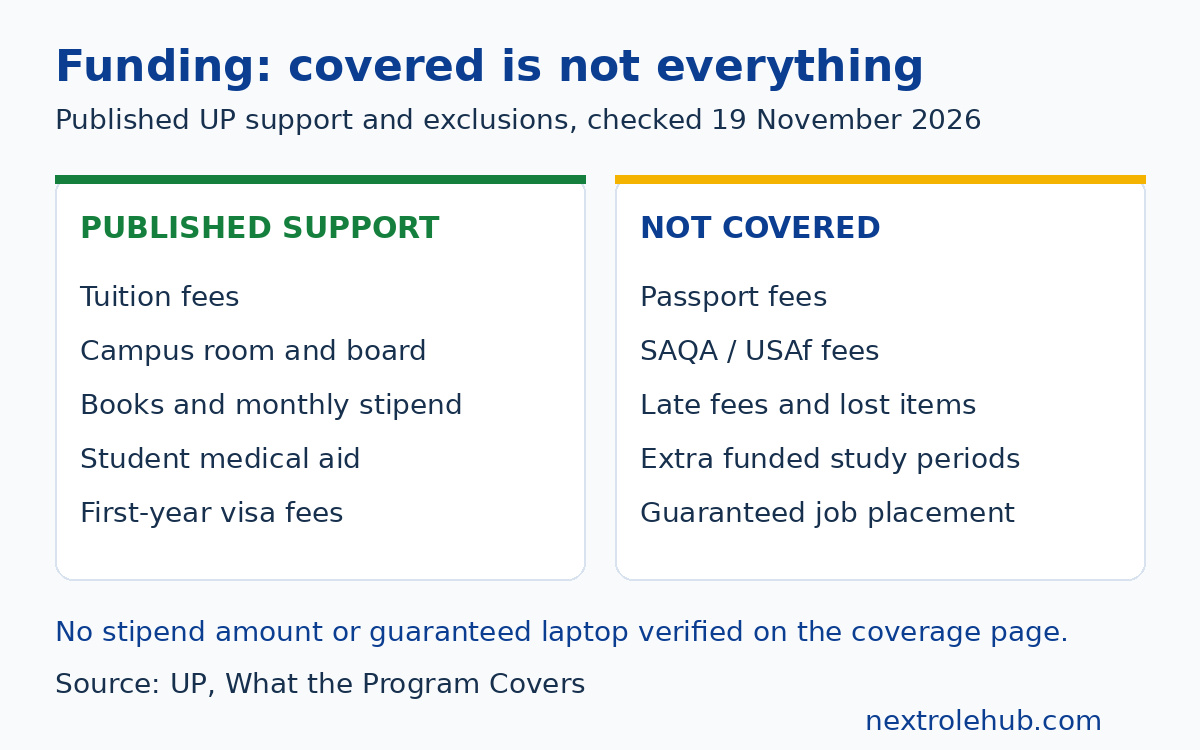
UP describes a package that combines study costs with academic and personal support. Its official coverage page lists tuition, campus room and board, a monthly stipend, books and school supplies, student health insurance, first-year start-up funds and visa fees. It does not publish a stipend amount on that page.
| Support area | Published position | Planning caution |
|---|---|---|
| Study and living | Tuition, campus room and board, books, stipend and annual support | No current cash allowance is stated on the coverage page. |
| Arrival | First-year start-up funds and visa fees | Check timing and reimbursement conditions in the award terms. |
| Health | Student medical aid | Not a guarantee that every medical or dental expense is paid. |
| Development | Leadership learning, counselling, mentoring and a one-time Africa-based summer internship with flight and stipend | Not a guaranteed job or internship placement. |
| Excluded administration | SAQA, USAf and passport fees | Keep these separate from scholarship-paid costs. |
The coverage page excludes funding beyond the standard eight undergraduate semesters or two graduate years, including summer school. It also excludes late fees, lost items and individual professional-development spending such as conferences. Read the bursary agreement for your actual funded period rather than assuming every extra semester will be covered.
Do not budget for a guaranteed laptop. The public coverage list reviewed does not promise a new laptop to every scholar; it mentions lost laptops among items not paid for. Likewise, no verified rand or UGX stipend amount is available from that page. Ask the programme office for the applicable terms instead of copying another university’s allowance.
The programme design page explains the wider support: academic help, entrepreneurship skills, community engagement and alumni connections. Those opportunities sit alongside scholar responsibilities, including academic progress, programme participation and returning to the home country or region after study.
How the official application sequence works
Use this sequence to understand the closed 2027 call, not as permission to submit now. A future call may change the forms, dates or submission route. Recheck all three before using any document you saved from this cycle.
- Check the intended degree against the current scholarship form and the faculty’s admission rules. Resolve country, prior-degree and qualification questions first.
- Apply to UP through its official admissions route. Keep the student number and monitor the university portal for requests or decisions.
- Apply for UP residence as required by the scholarship form. Do not mistake a residence application for confirmed accommodation.
- After provisional acceptance, complete the relevant scholarship form and gather the supporting evidence.
- For the 2027 call, the forms required the application and supporting documents in English as one combined PDF, emailed to [email protected] by the applicable deadline.
- Keep the exact submitted PDF and sent-email record. If contacted for interview or further information, respond through the stated official channel.
The forms contain awkward wording about a “subletting document” in the submission instruction. Do not invent a separate requirement from that phrase. Ask the programme office what it means for your circumstances, while following the clearly stated supporting-document checklist. Record the response with your application notes.
There is another point to clarify if relevant: the instructions ask applicants to disclose relatives working at UP, while the declaration says the applicant has no family relations employed there. Anyone affected should obtain written guidance before signing. Never sign a statement you know is false just to complete a form.
Build an evidence file from the actual form
The following preparation checklist summarises the official 2027 forms. Some documents apply only to particular household circumstances. Check the complete form, not just this table, and do not manufacture a certificate or affidavit for a situation that does not apply to you.
| Evidence group | What the 2027 forms request | Useful preparation check |
|---|---|---|
| Admission and academics | Provisional admission evidence; high-school results for undergraduate applicants or previous-degree transcript for postgraduate applicants | Match the intended degree and student number to the application. |
| Identity and household | Applicant and relevant family identity records; birth certificates and sibling details where specified | Check names and explain genuine differences through the accepted route. |
| Income | Recent gross-income evidence; payslips, statements, allowances or maintenance evidence as applicable | The forms ask for evidence covering or issued within the relevant three-month period. |
| Conditional family evidence | Affidavits, death certificates, divorce or guardianship documents where applicable | Follow the exact situation-specific list in the form. |
| Additional circumstances | Refugee documentation, disability evidence and tertiary-enrolment evidence for siblings where applicable | Share only the required records through the official submission route. |
For international qualifications, the undergraduate form points to Universities South Africa (USAf), while the postgraduate form points to the South African Qualifications Authority (SAQA). These are different routes. Ask which assessment applies to your qualification before paying; the scholarship excludes those verification costs and passport expenses.
For a parent earning informally in Uganda, the absence of a payslip is not a reason to invent salaried employment. The forms provide for affidavits where proof of income is unavailable or someone is unemployed. Explain the real source of support and follow the requested evidence rules. Keep gross income distinct from the net-income fields elsewhere in the form.
Before combining scans, arrange them against a private checklist with columns for requirement, person concerned, document location and outstanding action. Open the finished PDF on a phone and check every page for legibility, orientation and missing edges. This is preparation advice, not an additional UP document requirement.
Keep passports, household finances and disability records out of public WhatsApp groups or an adviser’s shared folder. NextRoleHub does not collect scholarship applications. Use the university’s official route and keep control of the email account used for admission and funding correspondence.
Answer the essays with evidence, not slogans
The 2027 forms ask short essays about study and career plans, community contribution, overcoming a challenge and why the applicant should be considered. They set a maximum of 300 words for each short essay. Work from the actual prompts rather than pasting one long personal statement into every answer.
An applicant who helped organise reading sessions in Gulu could explain the problem noticed, their own responsibility, what they actually did and what they learned. That is a hypothetical planning example, not a scholar’s biography. The persuasive part is the verifiable contribution, not describing yourself as a future continental leader.
For the career answer, connect your existing preparation to the chosen course and a realistic next use for the training. For the obstacle answer, describe your response and learning without turning family hardship into a dramatic story you cannot substantiate. Obtain permission before including another person’s sensitive details.
Make a private evidence sheet of dates, activities and people who can verify them. Our Uganda CV writing guide can help you organise truthful responsibilities and results, but its job-application format does not replace the scholarship’s own form or essay limits.
What applicants should do after submitting
The official process includes review and an interview before admission into the scholarship programme. No interview calendar or results-release date was published on the application page reviewed. Do not interpret silence as a scholarship offer or rely on a social-media claim that everyone will hear on a particular day.
Keep your student number, degree title, scholarship submission date and final PDF together. Check the email account you used, including spam, and continue monitoring the admission portal. If an official message requests missing information, verify the sender and follow that message’s instructions rather than sending documents to a new address supplied by an unofficial intermediary.
UP says applicants who receive no response should regard the application as unsuccessful, but the page does not set a specific date for that conclusion. If you need to decide about another offer, make a focused enquiry with your student number and application details. Do not reject another funded place on the assumption that UP funding is guaranteed.
Questions Uganda-based applicants still need answered
Does the 70% rule mean I should calculate my own equivalence?
No. The published threshold does not provide a conversion table for every Ugandan qualification. Submit the genuine academic record and any grading explanation requested by UP. If your results use points, letter grades or a different GPA scale, ask the university how it assesses them. Do not rewrite your transcript or declare an equivalence that the receiving institution has not accepted.
Can I combine the award with another bursary?
The 2027 forms say recipients may not hold other bursaries, except UP achievement awards. They also ask about successful bursary or loan applications. Disclose your actual funding position and ask about any unusual arrangement before accepting competing awards. Do not assume that a small outside grant is automatically exempt simply because it would help cover an expense.
Does Ugandan nationality guarantee an English-test waiver?
The scholarship pages and forms reviewed do not establish a universal English-test waiver for Ugandans. The admission conditions for your exact degree determine the language evidence required. Ask the faculty what it accepts before booking a test or relying on an English-medium letter. A scholarship’s general African eligibility does not replace programme-specific admission requirements.
Will funding also cover my spouse or children?
The public coverage page reviewed does not promise separate allowances for accompanying dependants. Do not add family travel, accommodation or living costs to the package without written confirmation. Ask the programme office which expenses are covered by your individual agreement and whether any family arrangements affect residence or study obligations. Keep unconfirmed costs outside your expected scholarship budget.
Can I use the 2027 form for the next intake?
Treat it as preparation material only. A new intake can change eligible degrees, documents, dates and declarations. No next-round deadline was verified for this guide. When a fresh official call appears, download its current form and compare the requirements again. Reusing a saved PDF without checking its year can leave you answering the wrong questions or following an expired route.
Check the next call before spending on an application
The Pretoria Mastercard scholarship can be relevant to academically strong Ugandans facing financial barriers, but the published 2027 round has closed. Your next action depends on whether you submitted on time: existing applicants should protect their records and watch official correspondence; new applicants should wait for a confirmed new call or compare other suitable funding routes.
For comparison, read our Erasmus Mundus guide for Ugandans and Clarendon scholarship guide. Their submission systems and selection rules are different from UP’s. Use each guide to find the relevant official requirements, not to transfer one scholarship’s rules to another.
Browse the scholarships hub for other leads, then verify the provider’s current deadline before preparing a file. For Pretoria-specific questions, return to the university’s application page and [email protected]. A dated official answer is more useful than an agent’s promise of a guaranteed place.