Your salary expectation interview answer should clarify gross monthly pay before you name a range. Use scripts for calls, forms and follow-ups.
A useful salary expectation interview answer gives the employer a clear basis for discussion without committing you to a package you do not understand. Ask what the role pays, clarify whether the figure is gross monthly pay, then give a researched range if a number is required. Avoid answering “anything” simply because you want the job.
The awkward moment can arrive before you have met the hiring manager. A recruiter calls while you are travelling to work, or an application form demands a single figure. You may know what must reach your account each month but not what gross salary would produce it. Those are different questions, and mixing them can leave you agreeing to less than you intended.
This guide focuses on that first answer: what to say in a screening call, what to enter in a form, and how to handle follow-up questions. It includes original scripts and a preparation worksheet, not a table of supposed market salaries. Most employers do not publish complete pay packages, and this article does not estimate a universal salary for graduates or experienced applicants in Uganda.
Last checked: 12 November 2026 against Uganda Revenue Authority employment income guidance, NSSF membership guidance and the Standard Gauge Railway Project employment form. The SGR form has no visible publication date; it is a form example, not evidence of an open vacancy.
Table of Contents
What makes a good salary expectation interview answer?
State a researched gross monthly range, connect it to the responsibilities, and explain which package details still need confirmation. If the job scope is unclear, ask for the employer’s budget first. Your answer should open a practical discussion, not promise acceptance before you have seen the terms.
This is different from bargaining over a written offer. A screening conversation establishes whether your expectations and the employer’s budget are close enough to continue. Once an offer arrives, use our guide to negotiating salary in Uganda for the separate discussion about changing the terms.
Harvard’s career-service guidance on evaluating offers recognises that compensation can come up during an application or first interview. It recommends researching the role and location, asking about the budget, and giving a considered range if pressed. That is general career advice, not a statement of Ugandan employment law.
Prepare a range you can explain without bluffing
Begin with the exact vacancy, not a job title alone. An accounts assistant who maintains records under supervision is not doing the same work as an accountant responsible for reporting and audit preparation. A district-based project role may also involve travel or accommodation costs that an office role does not.
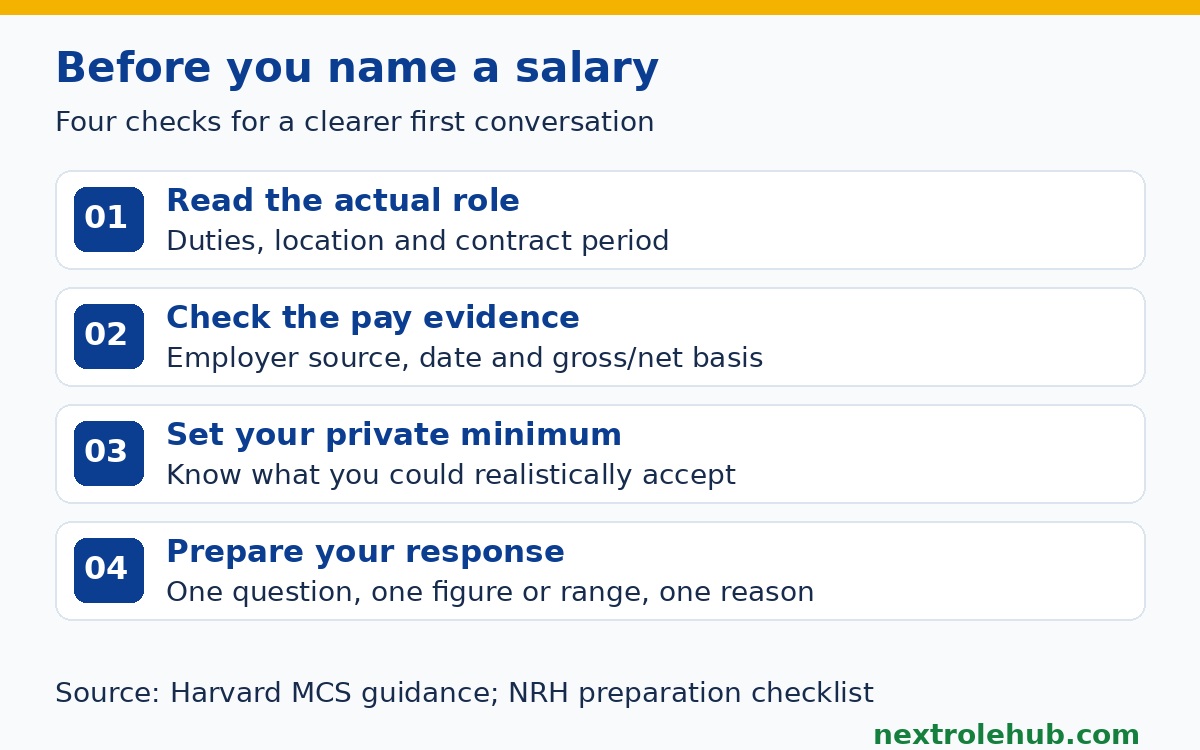
- Save the employer’s advert and note the duties, location, contract period and any published pay scale.
- Find dated, comparable employer adverts or official scales. Record whether figures are gross, net, monthly or annual. An expired advert can be historical evidence, not a current vacancy.
- Ask a recruiter or professional contact about comparable roles without requesting their confidential payslip. Treat an informal opinion as a lead, not verified pay data.
- Work out the minimum package you could actually accept, then choose an evidence-supported target. Keep your private budget separate from your explanation to the employer.
If you cannot find comparable pay evidence, say less, not more. Ask for the approved range and clarify the responsibilities. Do not announce “the industry standard” because a social-media post quoted a number without an employer, date or pay basis.
Make the lower end of any range a figure you could genuinely consider under the stated conditions. A very wide range does not solve uncertainty; it leaves the recruiter unsure what you mean. There is no universal percentage width that makes a range correct.
Separate gross pay, take-home pay and the whole package
Before naming a figure, ask: “Are we discussing gross monthly cash pay before deductions, or the amount paid into my account?” Also confirm whether allowances are included. Basic salary, gross cash pay and total employer cost are not interchangeable labels.
URA lists salary, commission, bonuses and various allowances as employment income, while also describing exemptions and special treatment for some items. Calling money a transport allowance does not by itself make it tax-free. Ask payroll how the actual package would be treated rather than guessing from the label.
For employees covered by mandatory NSSF contributions, the Fund’s published guidance specifies an employee contribution of 5% of total gross monthly wage and an employer contribution of 10%. The employer share is not an extra deduction from your salary. Coverage and the relevant scheme must still be confirmed for your employment.
| Term in the conversation | What to clarify before agreeing |
|---|---|
| Basic salary | Is this only the fixed base, with cash allowances paid separately? |
| Gross monthly cash pay | Which regular cash earnings are included before deductions? |
| Net or take-home pay | Which tax, contribution and other deductions were used to arrive at it? |
| Total package or employer cost | Does the headline include employer contributions, insurance or conditional payments? |
Use the PAYE and NSSF payslip guide to understand the separate lines. A payroll estimate should state its assumptions. Your tax position, benefits and other deductions can change the result, so do not treat a rough calculation as a guaranteed bank credit.
Choose a script for the conversation you are actually having
These are original practice scripts, not quotations from successful candidates or promises about employer behaviour. Replace bracketed details with information you can support. Do not insert an invented salary range just to make the answer sound complete.
When a recruiter asks before explaining the role
Sample answer
Could you first share the approved pay range and confirm the main responsibilities? I would like to compare the same gross monthly figure rather than give you an amount for a role I have not yet understood.
Ask once, then listen. If the recruiter provides a range, confirm the pay basis before responding. If they cannot disclose it and still require your expectation, use a prepared figure you can defend or explain what information you need to give one responsibly.
When you have a researched range
Sample answer
For the duties described, I would be looking at UGX [lower amount] to UGX [upper amount] gross per month. My basis is [the relevant pay evidence] and my experience in [specific responsibility]. I would need to confirm the allowances and contract terms before assessing the full package.
Name one relevant strength, not your entire CV. For a customer-service applicant, that might be handling escalated complaints or reconciling records, if true. A claimed improvement in sales or processing time needs evidence; a specific duty is enough when you do not have a reliable number.
When you are a fresh graduate
Sample answer
I have not held a salaried role yet. I would like to understand the approved graduate or entry-level package, including the gross monthly amount and any allowances. My [real project or placement] is relevant to the duties, and I am assessing whether the terms would work for me.
Being new does not mean agreeing to unspecified pay. Check the duty station, attendance requirements and whether the arrangement is employment or a placement. Our guide to a first job after university in Uganda explains how to assess routes and placement costs without assuming every opportunity leads to a permanent job.
When the advert names a scale or fixed package
Sample answer
I saw the scale stated in the advert. Could you confirm the gross starting amount for this appointment and which allowances apply? If the position uses a fixed entry package, I would assess that package rather than assume an individually negotiated starting salary.
Do not claim that every government, NGO or graduate post has identical rules. The specific advert and employer policy decide what is available. A scale label alone does not tell you the net amount, all allowances or your exact placement within a band.
What to enter when an application asks for expected salary
Read the field label and instructions before typing. The SGR Project’s published employment form, for example, separates current salary from a new expectation marked gross and uses UGX. It demonstrates why copying your bank credit into an expectation field may answer the wrong question. It does not establish the requirements of other employers.
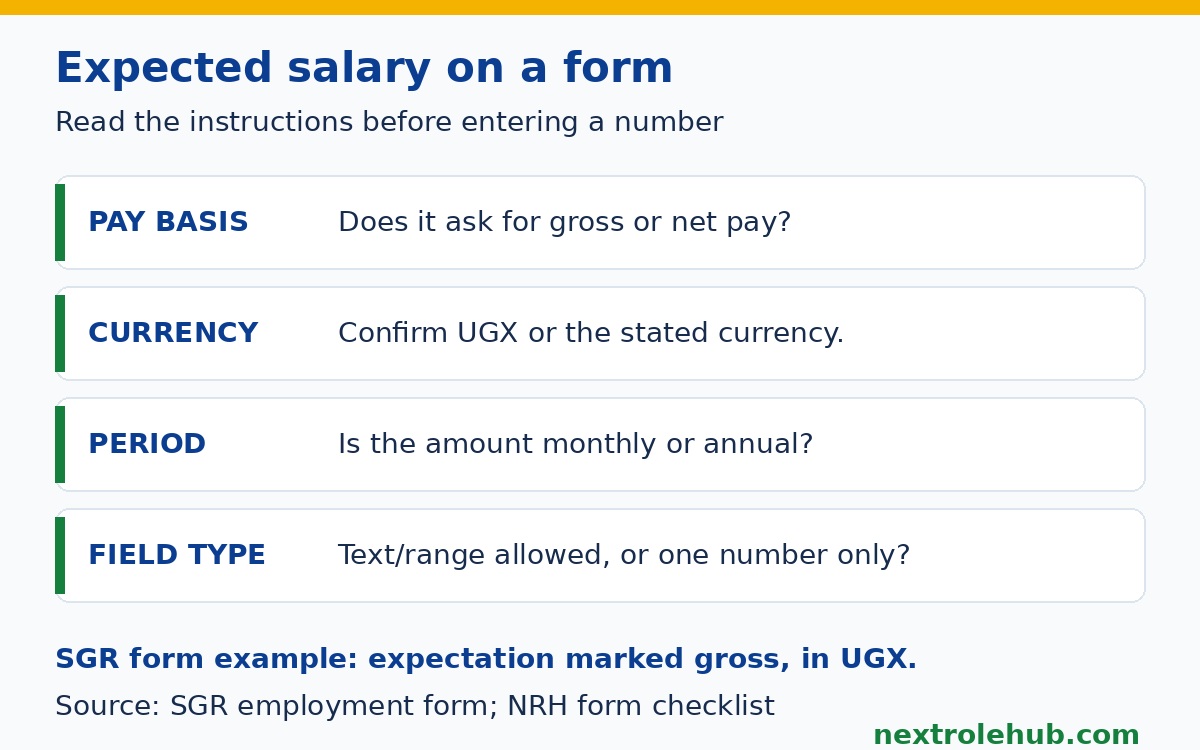
- For a text field that permits it, state a researched gross monthly range and any essential qualification about the package.
- For a compulsory number-only field, use one considered figure on the requested basis. Do not enter a range, currency symbol or “negotiable” if the field rejects text.
- Check currency and period. An annual amount entered into a monthly field can make an otherwise sensible expectation look wildly different.
- Save your submission or confirmation so your later interview answer remains consistent.
If the form requires current pay and you have never earned a salary, use a truthful option or explanatory text where supported. If no accurate entry is possible, contact the recruiting organisation through its official channel. Do not invent an employer or salary, or use an arbitrary zero simply to bypass a required field.
A portal may allow “negotiable”, but an instruction demanding a figure takes priority. Follow the actual form rather than advice that every salary question can be left blank. If the employer publishes a range, compare your experience with the role’s requirements before choosing your entry.
Handle pressure without contradicting your application
A follow-up is a chance to remove an ambiguity. Do not automatically interpret it as hostility or start defending personal expenses. Keep the discussion about the job, the pay basis and what you have learned.
“That is above our budget.”
Sample answer
Thank you for clarifying. What gross monthly amount is approved, and what does it include? I can then tell you whether it is workable. I would rather identify a genuine gap now than agree to a figure I could not accept.
You can be flexible without immediately cutting your expectation. First establish whether the difference is real: one person may be discussing basic pay and the other a package including allowances. If the comparable figures remain too far apart, a polite refusal can save both sides more interviews.
“Why did your expectation change?”
Sample answer
My application was based on the duties available at that point. I now understand that the role also includes [new responsibility]. That changes the scope I am assessing. Could we review the expectation against this fuller description?
Use that explanation only if you actually learned something material. If you made an input error, say so plainly and correct it. Do not invent an expanded role or competing offer to justify a sudden increase.
“What do you earn now?”
Sample answer
I would prefer to discuss the compensation for this role and the responsibilities it carries. Could you explain the proposed range and what salary information your recruitment process requires? I will keep any information I provide accurate.
That is a conversational option, not a claim that an employer must accept the refusal. A form or employer may request salary history, and you must decide how to respond truthfully within that process. Do not alter payslips or claim an allowance you never received.
Use this worksheet before practising aloud
Write the answers privately before your next call. The worksheet turns vague research into a usable response and exposes any missing information. It is a preparation tool, not a salary survey or a formula for what an employer should pay.
| Preparation prompt | Your note |
|---|---|
| What exactly am I pricing? | Role, main duties, location, hours and contract period. |
| What evidence supports my request? | Employer source, date, comparable duties and gross/net basis. |
| What must I clarify? | Cash allowances, deductions, variable pay and written terms. |
| What can I honestly contribute? | One relevant responsibility, work sample or supported result. |
| What will I say? | A short opening, the number or question, and one reason. |
Read your answer aloud, then remove the apology and unnecessary backstory. Listen for words that suggest certainty you do not have, such as “guaranteed”, “everyone earns” or “the standard rate”. Practise a second version for a number-only application so you are not deciding under pressure.
Keep the rest of your interview preparation separate. The Uganda interview questions and sample answers guide covers broader competency and job-fit questions. This salary answer should not become a speech that prevents the panel from assessing your skills.
Salary answer questions applicants ask
Should I put salary expectations in my cover letter?
Include them if the advert asks for them, using the requested currency and period. Otherwise, use the limited space to explain your fit for the job. If a separate application field collects salary information, complete that field as instructed rather than adding an inconsistent second figure to the letter. Keep a copy of both documents.
Can I ask about salary during a first interview?
Yes, you can seek clarification, particularly when the employer raises pay or you need to assess whether continuing is practical. Keep the question brief and linked to the package. Asking what is budgeted is not the same as demanding a change to an offer that does not yet exist. Read the situation and the interview instructions.
What if the advertised pay range is very broad?
Ask whether the entire band is available for a new appointment and what determines placement within it. The maximum may not be the expected starting point. Compare the stated responsibilities with your relevant evidence, then choose an expectation you can explain. Do not assume years of service alone automatically place you at the top.
Should I include a performance bonus in my expected salary?
Keep guaranteed cash separate from uncertain earnings when deciding what you can afford. Ask whether the bonus is guaranteed or conditional, which targets apply and when payment is due. If you quote a package inclusive of variable pay, make that explicit. A possible bonus should not silently replace the fixed salary you need.
What if the interviewer quotes a daily rate instead of a monthly salary?
Ask what the rate covers before converting it. Confirm whether it is employment or a service contract, how many days are paid, whether travel days count and which expenses are reimbursed. A daily amount cannot safely be compared with monthly employment pay by assuming a full month of paid work or identical benefits.
Does giving an expectation mean I have accepted the job?
Treat your expectation as part of the discussion and clearly state any assumptions. Do not write that you accept an offer if you are only confirming interest. The effect of a particular exchange depends on its wording and circumstances; this guide is not legal advice. Ask for the actual terms in writing and review them before committing.
Before the next call, settle your number and your question
Your salary expectation interview answer needs a clear pay basis and an honest reason. Prepare the range you can support, know what would make the package workable, and write down the missing detail you will ask about. If the evidence is thin, ask for the employer’s budget rather than dressing up a guess as market research.
Save your submitted expectation beside the advert. Then practise saying it without rushing or adding an unplanned discount. Once the employer sends written terms, move from interview preparation to checking the actual offer, including what you would receive and what you would be agreeing to do.