Interview dressing Uganda advice starts with the invitation, not the price of a suit. For most office interviews, choose pressed trousers, a skirt or a professional dress, a plain shirt or blouse, and clean closed shoes. Add a jacket when the meeting is formal or the employer has not clarified its expectations.
The harder decision is how far to go. A bank interview, a hotel practical assessment and a field visit do not call for identical clothes. Nor does an NGO label tell you whether you are meeting a headquarters panel or joining an outdoor exercise. This guide separates those situations so you can choose an outfit without buying a wardrobe you do not need.
You will find a six-sector comparison, a low-spend outfit plan, a movement test and a video-interview check. The recommendations are practical starting points, not a claim that every Ugandan employer has published the same dress code. Where there is an official rule, we identify who it applies to. Where there is no public rule, your recruiter’s instructions come first.
Last checked: 11 November 2026 against the Uganda Public Service Standing Orders, 2021, section F-j, and the National Careers Service video-interview guidance. The Standing Orders are a 2021 edition, not a new 2026 interview policy.
Table of Contents
What should you wear to a job interview in Uganda?
Wear an outfit that suits the interview activity: formal separates or a suit for a formal office panel, neat business casual where the employer confirms it, and task-appropriate clothing for practical work. Prioritise clean fabric, comfortable fit and suitable footwear. Specific instructions from the recruiter override general advice about the sector.
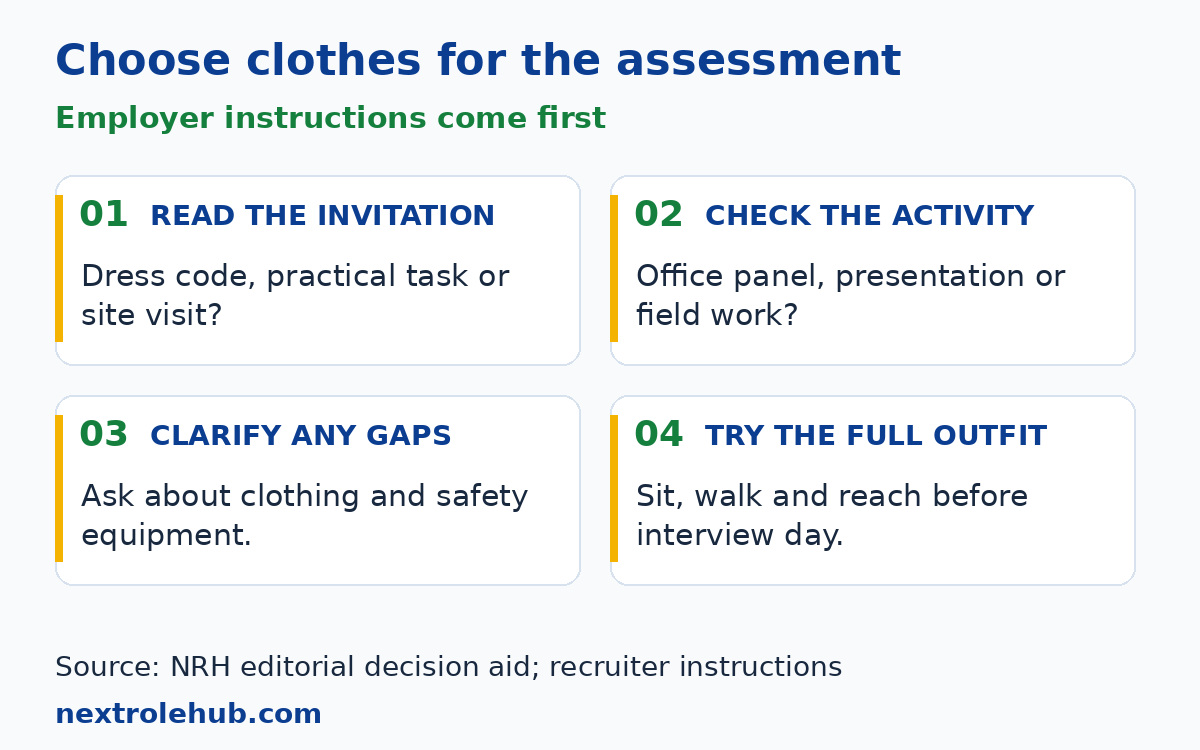
- Read the invitation for a dress code, practical exercise, site visit or safety requirement.
- Check the exact role and meeting location. A branch panel and an agent field demonstration are different settings.
- Look at recent official workplace photographs, not only gala dinners or staff sports days. Treat photographs as clues, not policy.
- If anything remains unclear, ask the recruitment contact a focused question before spending money.
A useful message is: “Thank you for the interview invitation. Will the assessment be office-based only, or does it include a practical or site visit? Please let me know if any particular clothing or footwear is required.” This asks for the information that changes your outfit, rather than asking someone to approve your personal style.
Interview dressing Uganda: six sectors compared
Use the table as a decision aid, not a list of verified employer policies. Start with the proposed outfit, then adjust it to the invitation, seniority and assessment activity. For an office interview with no guidance, a jacket is an option you can carry rather than wear throughout the journey.
| Interview setting | Practical starting outfit | What to confirm |
|---|---|---|
| Bank or financial services | Pressed dark trousers or skirt, plain shirt or blouse, jacket and clean closed shoes; a restrained tie where appropriate. | Branch or head-office panel, client presentation, or field assessment? Ask about any specified dress code. |
| NGO or UN organisation | Formal separates or a simple professional dress for an office panel; add a jacket for a formal meeting. | Do not assume “NGO” means casual. Check whether there is a presentation, community visit or outdoor task. |
| Government panel | Conservative formal clothing; a suit or jacket with coordinated separates and closed shoes is a sensible default. | Follow the interview notice. Public-officer workplace rules are context, not proof of an applicant scoring rule. |
| Tech or startup | Plain shirt, blouse or knit top with tailored trousers or chinos and clean shoes; jacket if the meeting is formal. | An engineering role at a bank may differ from a startup role. Confirm “smart casual” rather than guessing. |
| Hospitality | Pressed shirt or blouse with neat dark separates and comfortable closed shoes. | Is it a management interview, reception role, kitchen trial or service demonstration? Check uniform and hygiene instructions. |
| Field, agriculture or technical role | Neat clothes that allow movement, with footwear suited to the stated activity. | Will you enter a farm, workshop or construction site? Confirm required protective equipment and who provides it. |
For example, an agency-banking applicant may prepare formal clothing for a Kampala office panel but need different footwear for a confirmed outdoor demonstration. That is a hypothetical planning example, not a particular bank’s recruitment policy. Our guide to bank jobs in Uganda explains the different role families; use the actual invitation to settle the clothing decision.
For NGO and UN interviews, do not spend your preparation time guessing a universal UN outfit. UNICEF’s assessment guidance describes several formats, including presentations, technical exercises and informal conversations. It does not establish one dress code for all UN recruitment. Clothing should allow you to complete the format you have been invited to attend.
What the public-service dress rules actually cover
The official Uganda Public Service Standing Orders provide a firmer reference for public-sector workplace formality than a social-media dressing poster. Section F-j addresses public officers on duty. It describes formal dress appropriate to the profession, makes provision for uniformed services and recognises profession-specific requirements. It is not written as a universal interview-candidate checklist.
The section specifies formal items for male officers, including a shirt, jacket, tie and closed dark shoes. It also permits women’s trouser suits with jackets, according to their professions. That is a useful correction to blanket claims that women cannot wear trousers in public-service settings. Read the provision in context rather than turning a fragment into a rule for every applicant.
The Ministry of Public Service download page identifies this as the 2021 edition and shows a page update of 2 October 2023. Your interview notice remains the direct source for what candidates must do on the day.
For a government panel with no clothing instructions, formal separates or a suit are a cautious recommendation. Do not claim that a tie guarantees marks or that a particular colour is compulsory without a written instruction. For how to address several interviewers, use our panel interview tips; this clothing guide does not repeat the document-verification checklist.
Build an interview outfit without buying everything
Start by laying out what you already own. The lowest-spend plan is often to borrow a jacket that fits, prepare an existing plain top and repair or clean shoes. Do not treat a new suit as an entry fee to an interview. Buy only the missing item that prevents the outfit from working.
| What you already have | Build around it | Before paying |
|---|---|---|
| Plain shirt or blouse and dark trousers | Press them, check fit and use clean closed shoes; borrow a suitable jacket if needed. | Try the borrowed jacket with the full outfit, not in isolation. |
| Simple professional dress or skirt | Add a plain layer or jacket if the meeting is formal; choose shoes you can walk in. | Sit down and check coverage, closures and freedom of movement. |
| Only one usable formal item | Borrow compatible separates before shopping for a complete set. | Check the invitation so you buy for the actual assessment. |
| A specific missing shirt | Compare size, fabric, returns and delivery on a clear product listing. | A low headline price is not the final delivered cost. |
Compare current product listings carefully before paying. Confirm the selected size, fabric, returns policy and delivery charge; a retailer’s starting price is not a quote for your chosen variant. For a complete outfit budget, obtain actual prices for every item you need, including shoes, alterations and delivery, rather than relying on an estimated total.
For an interview tomorrow, fit and availability matter more than an online discount. Inspect a borrowed or second-hand item for stains, damaged seams and missing buttons. If a repair is needed, get the actual quote and completion time. Keep travel money separate from clothing money rather than spending everything on a jacket and struggling to reach the venue.
Check the fit while sitting, walking and presenting
Try the complete outfit before interview morning. The UK government’s JobHelp clothing guidance recommends checking fit while moving, keeping presentation professional and limiting distracting jewellery or fragrance. The following checklist turns that general advice into a practical rehearsal; it is not an employer’s marking sheet.
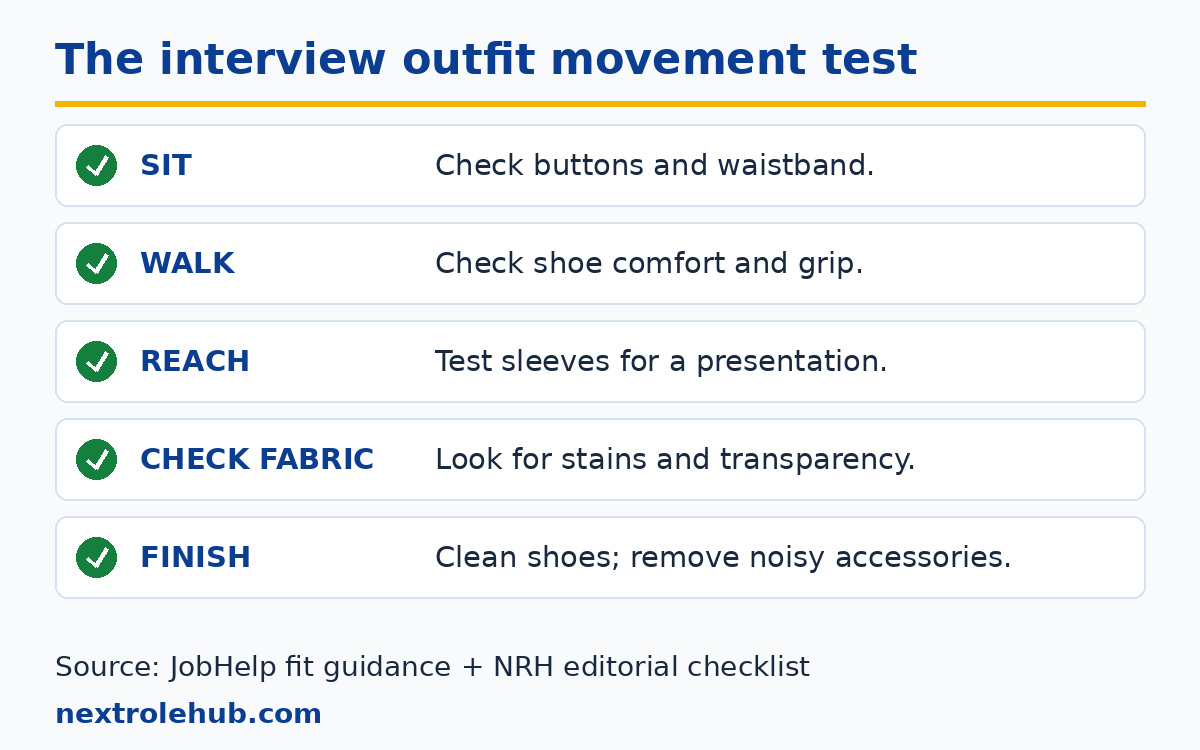
- Sit: check the shirt or blouse buttons and waistband. You should not need to keep pulling fabric into place.
- Walk: use the shoes on a safe surface and check for rubbing or slipping. Flats and low shoes are practical choices; heels are not necessary.
- Reach: practise pointing at a presentation or writing on a board without restricted sleeves.
- Check fabric: use daylight to spot stains, transparency, loose threads and visible underlayers.
- Finish: clean the shoes, check closures and remove accessories that catch, rattle or distract.
Choose the clothes that fit your body now. A borrowed jacket that prevents you from moving is not an improvement over neat separates. Test collars and ties while seated, and check that a scarf or head covering stays comfortable when you turn to speak to different panel members.
You do not need makeup, new jewellery or an expensive hairstyle to complete this checklist. Keep hair and any facial hair clean and manageable in the way you normally wear them. Avoid making a drastic styling change immediately before the interview if it leaves you uncomfortable or takes money away from essential travel.
Keep your outfit presentable on a Kampala commute
Plan for the journey you will actually make. If you are taking a taxi or boda through Kampala, a jacket can travel separately in a clean bag. Put it on near the venue rather than arriving overheated because you wore every layer from home. Protect light-coloured clothes from a dirty seat or wet outer layer where possible.
Check the weather forecast before leaving; this guide does not predict rain on your interview day. An umbrella or suitable outer layer can protect clothes if rain is expected. Carry a small clean cloth for shoe dust and allow time to check your appearance somewhere appropriate before reporting to reception.
Do not wear unstable shoes simply because they look formal. If you change footwear after travelling, choose somewhere safe and appropriate to do it. For a confirmed site assessment, follow the safety instructions rather than substituting polished office shoes for required protective footwear. Ask beforehand if you do not have the specified equipment.
What to wear for a video interview
For a video interview, choose a plain professional top that remains distinct from your background and test it on the camera you will use. Dress your lower half appropriately too, in case you stand. Follow the same employer instructions as an in-person meeting and remove jewellery that makes noise near the microphone.
The National Careers Service advises plain smart clothing, an uncluttered background, an eye-level camera and a practice recording. These are technical presentation recommendations, not Uganda-specific employer regulations. Use the recording to check what the interviewer will see, rather than judging the outfit only in a mirror.
- Record yourself wearing the actual outfit while answering a question. Check that a patterned fabric is not distracting on screen.
- Face a window or suitable light so your face is visible. If a white shirt looks washed out, adjust the lighting or test a different plain top.
- Sit at the distance you will use for the interview and check the collar, jacket and background together.
- Test sleeves and accessories while typing or using a mouse. Remove anything that makes repeated microphone noise.
- Charge the device and test the interview connection. If the phone is your interview device, silence alerts without disabling the connection.
For a Kampala applicant interviewing with a team abroad, prepare for the light conditions at the scheduled time, not just the afternoon when you rehearsed. If using a shared room, agree on a quiet period with other occupants. Clothes cannot compensate for a camera facing a bright window behind you or constant interruptions.
Interview clothing questions candidates ask
Can I wear jeans if the employer says smart casual?
Ask for clarification if the invitation gives no examples. Smart casual does not mean the same outfit in every organisation. Neat chinos or tailored trousers are a less ambiguous choice than jeans when you have them. If the employer expressly permits denim, choose an intact, clean pair and suitable shoes. Do not turn a general internet recommendation into a ban that contradicts the invitation.
Should I buy a suit for my first graduate interview?
Only after checking what the assessment requires and what you can borrow. A suit can be useful for repeated formal interviews, but it is not automatically your best immediate purchase. Try the clothes you own first, then identify a specific gap. If borrowing, test the entire outfit while seated. An uncomfortable suit bought in a hurry can create more problems than it solves.
Can I wear religious clothing or a head covering?
Build the outfit around clothing you normally wear for religious reasons rather than assuming you must remove it. Check that it is comfortable for the activity and works with any specified safety equipment. If the interview involves a workshop, kitchen or site visit, ask the recruitment contact about the practical requirements in advance. This is preparation advice, not a legal opinion about a particular employer.
What if I need different shoes because of a disability or medical condition?
Use footwear that is safe and suitable for you. Contact the recruiter early about any adjustment needed for access, standing, walking or a practical assessment. Describe the relevant requirement without sharing more medical detail than you are comfortable providing. A generic closed-shoe recommendation is not a reason to wear footwear that hurts you. Confirm any site-safety arrangements directly with the employer.
Do braids or natural hair need changing for an interview?
There is no basis in this guide for telling every applicant to change their natural hair or remove braids. Prepare a neat, comfortable style you can manage through the journey and interview. If a specific role includes hygiene or machinery-safety instructions, ask how to secure hair appropriately. Separate those activity requirements from unverified claims about what all Ugandan recruiters supposedly prefer.
What should I do if my outfit gets wet or stained on the way?
Deal with the practical problem before trying to hide it. If possible, clean the affected area, remove a wet outer layer and check whether a spare or borrowed item is available. If a delay will affect your arrival, contact the recruitment person promptly. Give a brief factual explanation when needed, then focus on the interview rather than apologising repeatedly for something you could not fully control.
Choose the outfit, then return to your answers
Good interview dressing in Uganda is a decision about the role, activity and clothes available to you, not a competition over labels. Read the invitation, choose the appropriate level of formality and test the outfit while moving. Prepare the shoes and any extra layer before the morning rush.
Once the outfit is settled, put your time into evidence and answers. Use our Uganda interview preparation guide for the wider plan and practise with our interview questions and sample answers. Clothing should make the meeting easier to manage; your task in the room is to show what you can do.