Oil and gas salary Uganda figures are often undisclosed. Compare real role requirements, guaranteed pay and site terms before accepting an offer.
Oil and gas salary Uganda searches can leave you with impressive numbers but little proof. No official body publishes a sector-wide pay ladder, and the official EACOP adverts quoted below describe qualifications and responsibilities without stating salaries. That makes a written package breakdown more useful than an unsupported entry-to-senior pay table.
You may be comparing a graduate placement in Kampala with a contractor assignment near Hoima, or deciding whether an experienced maintenance role is worth leaving your current employer. A job title alone cannot settle that decision. You need to know who employs you, what work you will carry out, how long the contract lasts and which payments are guaranteed.
This guide explains how to assess pay from entry level to senior technical work, using official role examples and a reusable offer-comparison worksheet. It does not invent EACOP, CNOOC or contractor salary bands. For employer names, application routes and project background, use our oil and gas jobs in Uganda guide. Here, the focus is the compensation decision after you identify a suitable role.
Last checked: 9 November 2026 against EACOP careers, its official role descriptions, URA employment-income guidance and NSSF membership rules.
Table of Contents
What oil and gas salary Uganda figures are verified?
Employers in the sector rarely publish dated salary bands, and the official EACOP adverts quoted here do not disclose pay. That is why this guide does not give an employer salary range. Undisclosed pay means you must request the approved range; it does not mean the work is unpaid.
Some search results offer broad petroleum-engineer estimates or quote dollar salaries across unrelated jobs. Those are not proof of what a named employer will offer you in Uganda. A survey can provide context only when its date, sample, location and definition of pay are clear. It cannot establish a confidential company grade.
The table separates information an employer actually publishes from questions you still need to ask. The October role descriptions are reference examples, and they may have closed by the time you read this. Check the employer portal for current status.
| Official source reviewed | What it establishes | What remains undisclosed |
|---|---|---|
| EACOP GIS Graduate Trainee, 2 October 2026 | Graduate eligibility, GIS tasks and software expectations | Monthly salary or allowance; gross/net basis; benefits |
| EACOP Pipeline and Maintenance Engineer, 26 October 2026 | Relevant engineering background, 7 to 10 years of experience and inspection knowledge | Base salary, allowances and the value of the total package |
| EACOP careers page, checked 9 November 2026 | Official recruitment channels and a no-recruitment-fees warning | A sector salary scale or a published pay ladder |
Keep this distinction when discussing offers with friends. A former employee’s bank credit may include overtime or arrears. A contractor’s invoice may include costs an employee never has to pay. Neither amount becomes a dependable monthly salary benchmark without the underlying terms.
Entry-level, technical and senior roles: what changes?
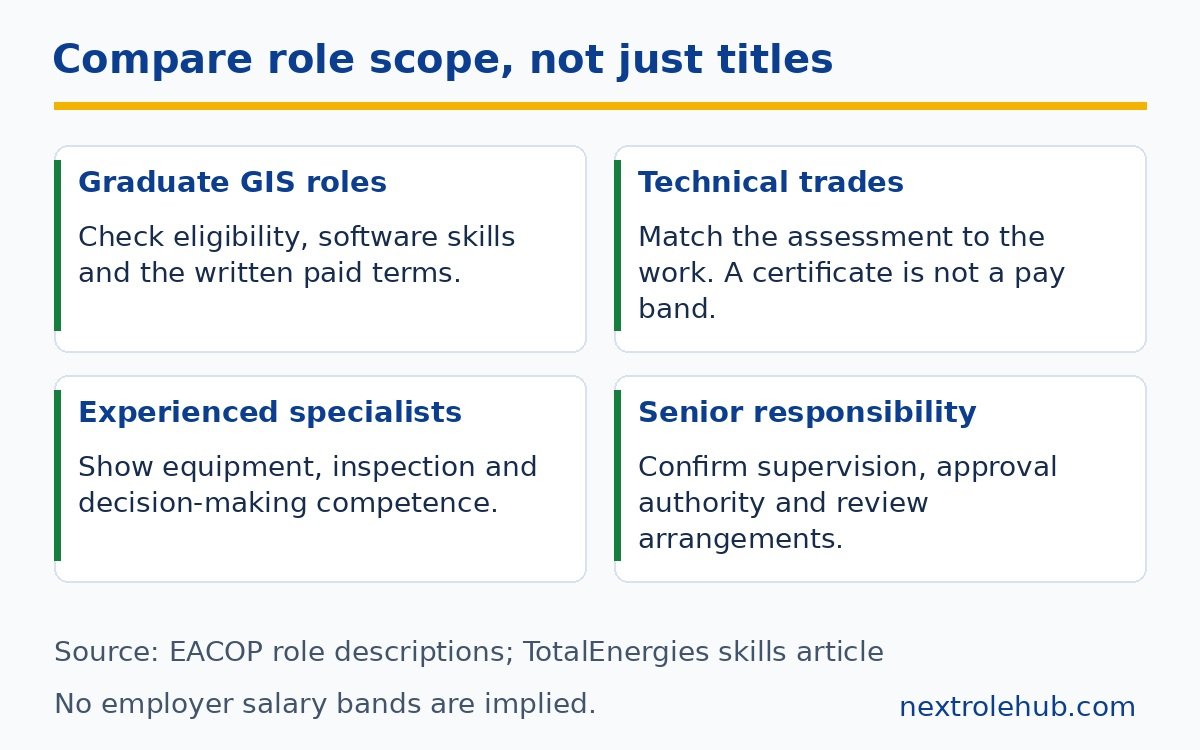
Career level should describe responsibility, not just the number of years since graduation. The examples below help you judge the work behind a proposed package. They are a comparison framework, not an official grading system or a promise that pay rises automatically at each stage.
Graduate roles: compare learning and the paid terms
The EACOP GIS Graduate Trainee description published on 2 October 2026 asks for a relevant bachelor’s degree, at least a Second Class Upper Division and graduation within the previous one to two years. It also names GIS software knowledge and geospatial-data tasks. These are requirements for that particular advert, not universal rules for every oil-sector graduate programme.
For a trainee offer, establish whether the payment is described as salary or a training allowance. Ask how often it is paid, what payroll deductions apply and whether transport to assigned field activities is arranged. Get the programme duration and learning arrangements in writing. A possible future permanent job should not be counted as guaranteed compensation.
Technicians and skilled trades: separate competence from title
A technician may work on equipment maintenance, installation, inspection or testing. A welder may need evidence of competence for the process and standard specified by the employer. When assessing an offer, compare the actual equipment, supervision and site responsibilities rather than assuming every technician has the same commercial value.
TotalEnergies EP Uganda’s craftsmanship article describes coded-welding training and occupational health, safety and environment training. It was published on 22 October 2021, with page metadata showing a modification on 11 December 2025. It is historical evidence of the skills involved, not a current intake notice, a salary survey or a guarantee of employment.
Before paying for another certificate, identify the gap between your existing competence and the exact advert. Ask a prospective employer which assessment is required and whether it supports renewal or further training. A course fee is a cost you incur; it is not evidence that a future employer owes a particular salary.
Experienced specialists: demonstrate the work you can own
For an experienced engineer, inspector or planner, the discussion should move beyond a list of qualifications. Explain which systems you have maintained, the records you controlled and the decisions you were authorised to make. Use truthful evidence from your work, with confidential client information removed.
The EACOP Pipeline and Maintenance Engineer description gives a concrete example. It asks for 7 to 10 years of experience and at least two years in non-destructive-testing inspection techniques. It refers to corrosion, inspection planning, maintenance and inspection software, and relevant engineering standards. Those requirements explain the scope; they do not reveal a pay band.
Senior and supervisory work: price the accountability
A senior title deserves closer examination if you will supervise contractors, review technical findings or make decisions affecting equipment integrity. Request a clear reporting line and limits of authority. Find out whether you are coordinating work or formally approving it, because these are different responsibilities.
If the proposed job combines technical delivery with staff supervision, record both before the salary discussion. Ask how performance is assessed and who approves a pay review. Do not accept an undefined expansion of duties simply because the project name sounds prestigious.
The package terms that make two offers different
Ask for the employment contract and compensation schedule, not only the headline figure in an email. The following are items to check; they are not benefits that EACOP, CNOOC or any contractor is assumed to provide.
- Legal employer: confirm the organisation signing the contract and paying you. A client project name is not necessarily your employer.
- Pay period and currency: distinguish monthly salary, daily rate and an assignment fee. For foreign-currency terms, ask how conversion and bank charges are handled.
- Fixed and conditional payments: separate guaranteed cash from overtime, field allowances, completion bonuses or payments requiring approval.
- Work pattern: obtain the roster, shift hours, treatment of rest days and whether off-site periods are paid. Do not assume a rotation used in one advert applies elsewhere.
- Living and travel arrangements: check site accommodation, meals, mobilisation, transport home and any costs you must meet yourself.
- Duration and ending terms: record the contract period, notice arrangements and any written completion or renewal conditions. A planned extension is not a signed extension.
A camp room may reduce your expenses while on assignment, but it is not money you can send home. Equally, a housing allowance paid through payroll is not automatically tax-free. Keep cash, non-cash support and work-cost reimbursements in separate columns.
A shorter project contract may still suit you, particularly if it develops useful technical experience. Compare it with your actual alternative, including the cost of changing jobs. Do not assume a higher monthly headline will compensate for every month between assignments.
Build an offer comparison without inventing market pay
Use this worksheet for two real written offers. Fill it with the employer’s figures and wording, not a salary website’s estimate. Leaving an unknown field blank is better than putting a hopeful number into your household budget.
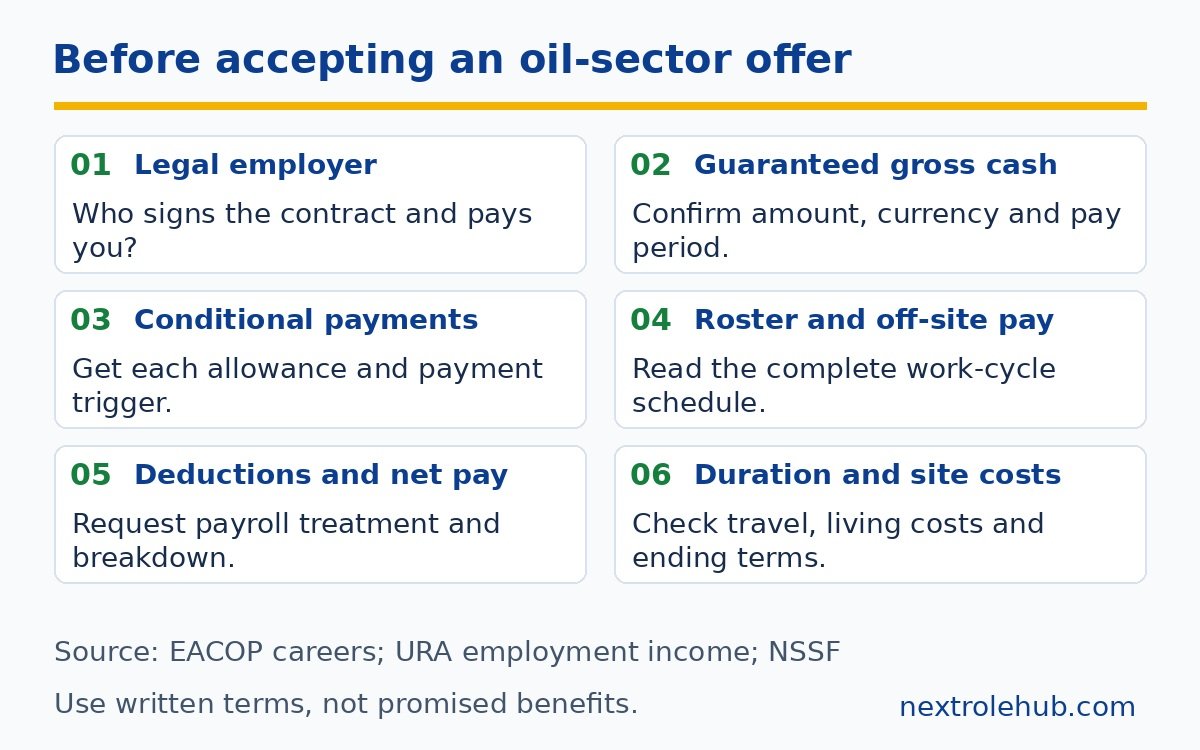
| Item to compare | Offer A | Offer B |
|---|---|---|
| Legal employer and work location | Copy from contract | Copy from contract |
| Guaranteed gross cash and pay period | Enter confirmed amount | Enter confirmed amount |
| Conditional cash and payment trigger | List separately | List separately |
| Payroll deductions and estimated net | Request payroll breakdown | Request payroll breakdown |
| Roster and paid off-site time | Attach written schedule | Attach written schedule |
| Accommodation, meals and transport | State what is provided | State what is provided |
| Personal costs of taking the assignment | Use your actual budget | Use your actual budget |
| Contract duration and review terms | Record written terms | Record written terms |
A practical comparison for a Kampala-based applicant
Imagine you already have a Kampala job and receive a field-assignment offer. The field offer advertises a larger amount, but it does not explain whether travel days and time away from site are paid. Your existing role has a predictable monthly salary. You cannot yet call the field offer the better financial choice.
First ask the field employer for a sample payment schedule covering a complete work cycle. Next check which transport and accommodation costs it covers. Finally, compare the cash you can reliably budget across the same period. This example uses no invented salary amounts because the missing contract terms, not arithmetic, are the problem.
Keep variable pay outside the amount you rely on for rent, school fees or loan repayments until you understand the qualifying conditions. If a completion payment depends on staying until handover, ask what happens if the work package ends early. Request the clause instead of relying on a recruiter’s summary.
Use evidence labels beside every number
Mark each figure as confirmed in the contract, explained by payroll or still awaiting confirmation. If the employer revises the offer, update the worksheet from the revised document. This prevents an old email, a verbal promise and a final contract from becoming one imaginary package.
The same discipline helps when you already work in the sector. Save your pay-change letters and compare duties at each review. A discussion about increased inspection responsibility is stronger when you can show the additional scope rather than quoting an unrelated engineer’s alleged salary.
Gross pay, PAYE and NSSF: keep the comparison honest
Gross pay is the amount before employee deductions; net pay is what remains after the applicable deductions. Employer cost can include items that never enter your bank account. Ask payroll to identify all three, especially if the offer uses the phrase total cost to company.
URA’s employment-income guidance includes wages, overtime, bonuses and many allowances within employment income. It also distinguishes specific reliefs and work-related reimbursements. A line labelled field allowance or housing support does not settle its tax treatment by itself. Ask payroll how the payment will be classified.
NSSF’s membership guidance states a 5% employee contribution from the total gross monthly wage and a separate 10% employer contribution. The employer contribution is not an additional 10% deduction from your salary. Confirm how mandatory coverage applies to your employment rather than assuming the word contractor removes every obligation.
URA also states that an employee’s own retirement-fund contribution remains taxable. Do not subtract NSSF before PAYE simply because it is money you do not receive in cash. Benefits, residence status, Local Service Tax and other facts may change the payroll result, so request an employer calculation for your specific offer.
For tax bands and worked take-home examples, see our Uganda take-home pay guide. Use our payslip guide for PAYE and NSSF when checking your first payment. A general illustration should never be described as your employer’s guaranteed net salary.
Ask about salary without pretending to know a secret scale
If an application requests expected pay before sharing its budget, clarify the package basis first. You can state your own requirement, but do not present it as an official EACOP salary or a verified sector average. Your expectation and the employer’s approved range are separate pieces of information.
A useful question: “Could you share the approved gross range for this position and confirm which allowances are guaranteed? I would also like to understand the roster and payment during off-site periods before giving a final expectation.”
For a technical role, follow with evidence specific to its duties. Describe your relevant equipment exposure, inspection competence or supervisory responsibility. Do not claim certification you do not hold, or suggest that working for a recognisable client automatically entitles you to a fixed premium.
If the employer cannot move on base salary, identify the contractual issue that matters most to you. It might be clear mobilisation arrangements, documented training support or a defined review process. Ask for the revised clause or compensation schedule before you accept. Our salary negotiation guide covers the wider conversation; the additional issue here is project and site terms.
A salary review date is not the same as a promised increase. Ask who makes the decision, what performance evidence will be used and whether any adjustment is guaranteed. If the answer is discretionary, record it that way in your comparison.
Pay assumptions that can cost you money
- Using a senior specialist’s figure for a graduate role. Match responsibility and employment terms before treating any amount as comparable.
- Calling an advert a salary source when it contains no pay. Qualifications establish eligibility, not compensation.
- Converting an overseas oil salary into UGX. Different tax, work location and contract terms make a currency conversion a weak benchmark.
- Budgeting on every possible allowance. Check the trigger, approval and whether it is paid during leave or off-site periods.
- Counting employer NSSF as cash. It is a separate retirement contribution, not extra bank pay.
- Paying a recruiter to access a supposed high-pay grade. EACOP states that it does not charge recruitment fees. Verify channels through its careers page.
Keep copies of the advert, offer and final contract together. If they disagree about salary, assignment length or work location, ask for a corrected document before signing. A polished offer letter does not resolve an unexplained contradiction.
Questions about oil and gas pay in Uganda
Does an advert with no salary mean an unpaid position?
No. An omitted salary means the public description does not tell you the amount. Ask the employer whether the position is paid, the approved gross range and when the package will be disclosed. For a placement, clarify whether it is employment or a training arrangement. Do not label an undisclosed role unpaid, or assume a generous allowance exists.
Should I state my current salary when asked for expectations?
Your expected package should be grounded in the work you are considering and your own requirements. If you choose to share current pay, distinguish basic salary, gross cash and net pay so the comparison is not misleading. Never invent another offer or falsify a payslip. You can ask for the position’s budget before giving a final expectation.
Can an oil-sector contractor offer different terms from the project company?
A contractor assignment and direct employment are not automatically the same arrangement. Establish the legal employer and read the actual contract, including payroll, roster, benefits and duration. The project company’s name on the worksite does not prove that its staff package applies to you. Ask who handles compensation queries and obtain the answer through a traceable official channel.
Does a petroleum-related degree guarantee higher pay than a technical diploma?
There is no published pay ranking that guarantees this. Qualifications help you meet a role’s entry requirements, but employers also assess competence and the responsibilities involved. A degree cannot substitute for a specific trade assessment or inspection experience where the advert requires it. Compare the job you can perform with its written package rather than ranking qualifications against imagined salaries.
How should I compare a daily rate with a monthly salary?
Start by confirming which days are paid, including travel, rest periods, training and time away from site. Ask whether the daily amount is gross employment pay or a service fee with different cost responsibilities. Compare payments over the same complete period, using the actual schedule. Do not multiply a daily rate by every calendar day unless the contract supports that calculation.
Can I use these role examples to apply now?
Not without checking their current status. The cited EACOP descriptions were published in October 2026 and are used here to explain responsibility and eligibility, not to advertise an open intake. Go through the official careers page to find current opportunities. A page that remains accessible after a recruitment round does not prove that applications are still being accepted.
Before accepting: confirm the money and the work
For an oil and gas salary Uganda comparison, the useful result is a package you can explain, not a pay range that looks impressive. Confirm the legal employer, guaranteed gross cash, deductions, work pattern and contract duration. Keep conditional payments separate and resolve unclear terms before you commit.
Choose the role level that matches your demonstrated skills. Then request the employer’s approved range and a written breakdown of what the assignment costs you and pays you. If that information is still missing, your comparison is unfinished; no salary ranking can fill the gap.
Compare the requirements in current oil and gas listings and engineering listings. Use each employer’s official advert to confirm vacancy status before applying.