Plan a career change in Uganda around real entry requirements, two honest CV rewrites and a 90-day test before paying for training or resigning.
A career change in Uganda starts with choosing a specific job, checking its entry requirements and proving which parts of your experience transfer. Do that before paying for a course or resigning. Some moves need a better application and practical work samples; others require formal qualifications and professional registration that a short certificate cannot replace.
An administrator considering project support has a different problem from an administrator who wants to become a nurse. The first needs to compare actual vacancies with existing duties. The second must investigate an approved training and registration route. Treating both as a confidence exercise can waste money and leave the real qualification gap untouched.
This guide helps you separate those decisions. You will build a role-evidence worksheet, compare verified Ugandan training routes, and rewrite experience without inventing a new job history. Two worked CV examples show the difference between relevant wording and exaggeration. The final 90-day plan is a suggested testing schedule, not a promise that you will qualify or find employment within three months.
Last checked: 12 November 2026 against ICPAU entry guidance, Makerere CoCIS short-course information and the linked LDC, ERB and UNMC documents below. Where a page has no visible update date or uses an older notice, that limitation is identified beside the relevant guidance.
Table of Contents
Choose a job function, not just a different industry
Write down the work you want to do. “Move into NGOs” is too broad: finance, procurement, programme support and monitoring roles have different requirements. “Apply for programme assistant vacancies involving scheduling and activity records” gives you something you can test against your experience.
Separate a change of employer from a change of function. An accounts assistant moving from a school to a distributor may keep much of the same work. Moving from accounts into software development changes the work itself. These are possible comparisons, not claims that a particular employer will accept either applicant.
- Choose one target role and one fallback role with a clear connection to your existing duties.
- Save several recent adverts from the employers themselves. Label closed adverts as examples, not opportunities.
- Mark essential qualifications, technical tasks and desirable experience separately.
- Record duty station, travel, working hours and contract type. A suitable title can still be an impractical move.
For vacancy discovery, use our comparison of job websites in Uganda, then verify each role on the employer’s source. Do not build your plan around a forwarded advert whose employer, deadline or application destination you cannot confirm.
Career change Uganda: compare skills routes with qualification gates
The route depends on what the destination requires. A short course may address a specific tool gap. A professional programme can have broader entry routes but still take substantial study. For regulated work, check the relevant body’s requirements before assuming a transferable skill makes you eligible.
| Possible direction | What the official source confirms | What it does not establish |
|---|---|---|
| ICT skills development | Makerere CoCIS describes introductory digital-literacy and practical-networking options, including retraining audiences. | That a certificate alone satisfies an employer’s technical requirements. |
| Professional accountancy study | ICPAU accepts several entry routes, including a recognised university degree. | Automatic exemptions, completed qualification or eligibility for every accounting vacancy. |
| Legal knowledge for administrative work | LDC publishes separate Diploma in Law and Administrative Officers’ Law courses. | That either is the same as the Postgraduate Diploma in Legal Practice. |
| Engineering registration | ERB’s current checklist asks the relevant applicants for professional, academic and practice evidence. | That a general short course qualifies a non-engineer for that registration category. |
| Nursing or midwifery registration | UNMC’s notice requires authentic academic and professional documents and relevant internship evidence. | A conversion route from an unrelated occupation without the required professional preparation. |
For accountancy study, ICPAU’s entry page allows a degree from a recognised university; it does not restrict that route to an accounting degree. It also describes specified diploma, professional and A-level alternatives. The page has no visible update date. Send your actual documents to ICPAU for assessment rather than assuming admission or exemptions from a course seller’s advice.
The LDC 2026/27 Diploma in Law and Administrative Officers’ Law notice states a UCE minimum of five passes at one sitting, plus one principal and two subsidiary UACE passes at the same sitting, or equivalents. Its listed courses began before this guide’s checking date. Use the notice to understand the route, not as evidence that applications remain open.
Do not confuse those programmes with the Bar Course. The Law Council’s 2026 legal-practice admission notice requires a qualifying LLB and sets additional eligibility conditions. Its application deadline was in September 2025, so it is historical guidance, not a current call. Ask for the latest notice before making a new application.
For engineering, the ERB checklist uploaded in September 2026 covers UIPE corporate members under JAC and East African direct applicants for permanent registration. It asks for academic records, practice history, sponsors and career and technical reports. This is a specific registration category, not an entry course for someone changing from an unrelated field. Ask ERB which category and qualifications apply to you.
The UNMC online-registration notice dated 23 May 2023 requires original academic and professional evidence and internship-completion evidence for relevant degree applicants. It remains an older notice, not a fresh admissions prospectus. Confirm current requirements with the Council and the training institution; do not treat a general health-related certificate as permission to work as a nurse.
Check a short course before paying for the certificate
Match the training to one task you cannot yet perform. If target adverts ask for spreadsheet reporting, investigate teaching that includes data cleaning and a report you produce yourself. A broad certificate with no assessed work may leave you unable to demonstrate the very task that blocked your application.
Makerere CoCIS’s short-course page, posted 9 November 2026 describes introductory digital literacy and practical networking, with the networking description including people retraining for a second career. However, its duration entries are inconsistent, and another official 2026 timetable differs. Confirm the exact course, prerequisites, dates and total charges directly before paying. This guide does not reproduce an uncertain fee or duration.
- What prior knowledge is required, and can the provider assess my starting level?
- What practical work will I complete, and who will assess it?
- Is the award a training-provider certificate, an external examination or a professional qualification?
- Are examination fees, materials and software included in the written quotation?
- Can the teaching schedule fit my job, transport and care responsibilities?
A networking course and a data-analysis course solve different gaps. Do not buy one simply because both are called ICT. Ask for a syllabus and compare it with your target duties. An advertised employment outcome is not a hiring guarantee, and course admission is not professional registration.
Build an evidence worksheet before changing your CV
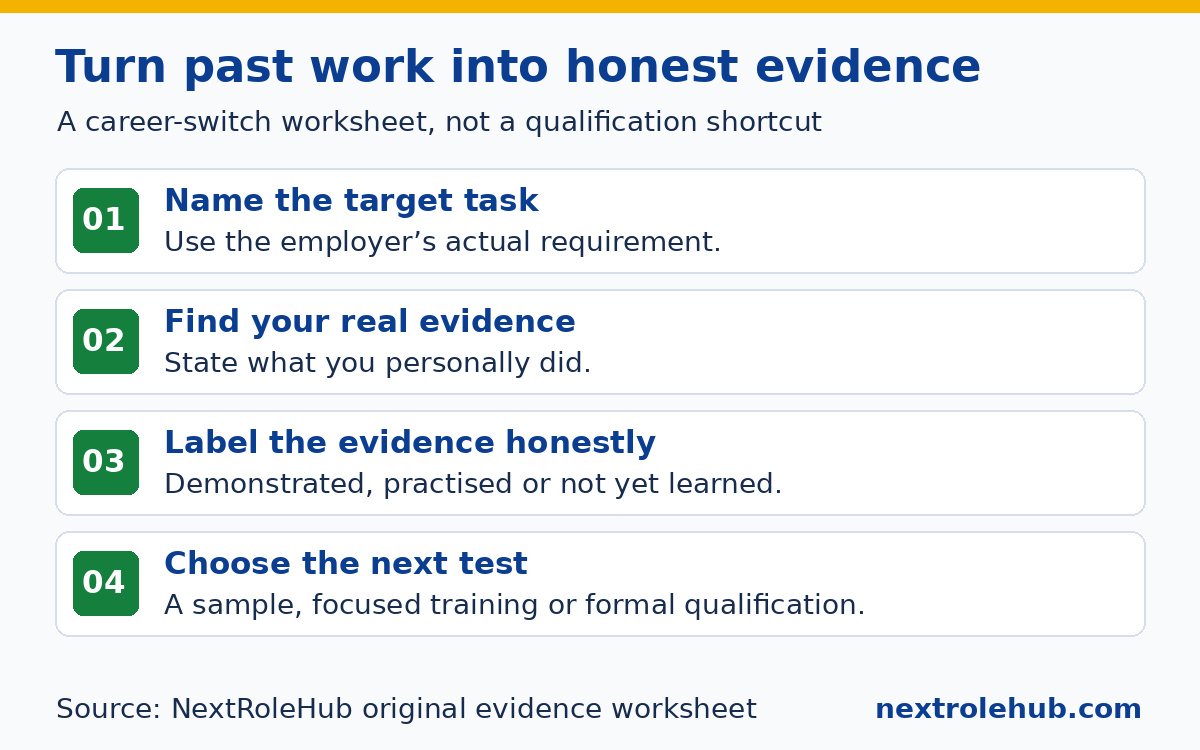
Use this worksheet to decide what you already bring and what still needs work. The entries are hypothetical planning examples, not findings from a labour-market survey. Replace them with duties you actually performed and requirements from a saved employer advert.
| Target task | Existing evidence | Gap or next test |
|---|---|---|
| Maintain project action records | You genuinely organise meetings and track follow-up actions. | Learn the target team’s reporting format; produce a practice action log. |
| Explain a digital service to users | You actually demonstrate a product and document recurring questions. | Create a fictional onboarding guide and ask a practitioner to review it. |
| Clean and summarise a dataset | You currently enter records, but have not checked or analysed them. | Complete an assessed exercise; do not relabel data entry as analysis. |
| Perform a regulated professional duty | Your existing job gives relevant context but not the required qualification. | Confirm the recognised qualification and registration route before applying. |
Our first-job guide’s section on skills in Ugandan adverts covers the broader skills employers ask for. Here, the task is narrower: match each claimed skill to an example a recruiter can question. “Communication” becomes useful when you can describe an audience, the information you explained and how you checked understanding.
Keep three labels in your notes: demonstrated, practised and not yet learned. A classroom exercise belongs under practised; an authorised workplace responsibility belongs under demonstrated. This prevents a weekend project from quietly turning into years of claimed employment experience.
Two career-switch CV rewrites that keep the facts intact
These fictional rewrites show how to foreground relevant work without changing job titles, inventing results or hiding dates. Use a rewrite only if every action is true of your experience. The point is to explain relevance, not to make an unrelated history look identical to the new job.
Example 1: branch customer support to digital-service operations
Before: “Responsible for customer enquiries and helping customers use services.”
After: “Guided customers through digital-service registration, documented recurring access problems and referred unresolved cases to the authorised support team.”
The rewrite gives a digital-operations recruiter concrete work to assess: onboarding support, issue documentation and escalation. It does not claim software development, product ownership or responsibility for resolving faults outside the applicant’s authority. Keep the original job title in the employment history.
Possible profile: “Customer-support professional with experience explaining digital services and recording user issues. Seeking an operations-support role that uses customer feedback, clear documentation and disciplined follow-up.” Add a tool or result only if you can support it. Do not call yourself a product manager because you helped customers use an app.
Example 2: office administration to project support
Before: “Handled office work, meetings and reports.”
After: “Prepared meeting packs, maintained action records and followed up agreed deadlines with colleagues before compiling updates for the supervisor.”
This makes coordination and reporting visible without claiming responsibility for a whole project. If the vacancy requires budget ownership, procurement authority or donor reporting that you have not done, the rewritten bullet does not close those gaps. Record them separately and look for an appropriate support-level entry point.
Possible profile: “Administrator experienced in organising meeting records and tracking follow-up actions. Interested in project-support work involving scheduling, document control and progress updates.” Explain an actual relevant assignment underneath. Keep the rest of your CV chronological so employment dates and progression remain easy to check.
For the document structure, supporting documents and referee rules, use our complete Uganda CV guide. Do not replace an employer’s compulsory degree or registration requirement with a skills-based layout and hope it will disappear.
Test the new work without exposing employer information
A useful work sample answers one practical question: can you perform a small version of the target task? A project-support applicant could produce a fictional activity schedule with dependencies and an action log. An aspiring reporting assistant could clean a public dataset and explain the checks made before summarising it.
Use public, fictional or expressly authorised material. Do not upload customer names, bank records, patient information, internal pricing or beneficiary lists into a portfolio. Replacing names may not be enough if the remaining details identify people or reveal an employer’s confidential operations.
Label the sample accurately: self-directed practice, course assignment or authorised volunteer project. Add a short explanation of the problem, your method, limitations and what you would improve. A polished screenshot without the underlying reasoning gives a reviewer little to assess.
Ask a practitioner a focused question: “Which part of this sample would fail in your normal workflow?” That invites useful criticism rather than a vague endorsement. For volunteer or freelance work, agree the scope, supervision, payment position and permission to show the output before starting. Do not perform regulated duties without the required authority.
A 90-day career-switch plan with a decision at each stage
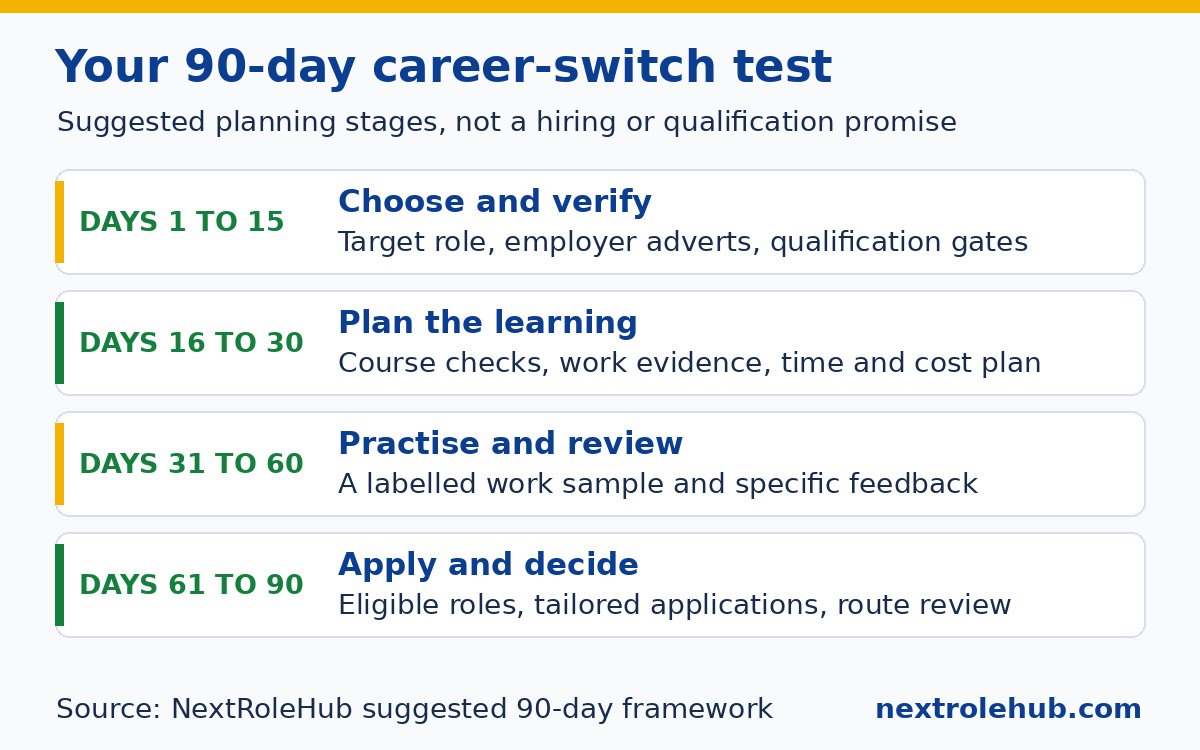
Use the following as an adjustable planning framework. Ninety days can establish whether a route is credible; it cannot compress a degree, supervised professional training or recruitment process into one quarter. If your target requires formal qualification, the final decision may be to enrol rather than to resign.
| Planning period | Work to complete | Decision or evidence |
|---|---|---|
| Days 1 to 15 | Choose a target role, compare employer adverts and check qualification gates. | Continue, choose a nearer role or investigate a formal training route. |
| Days 16 to 30 | Get course details where needed and list transferable work evidence. | A written learning choice and a realistic time-and-cost plan. |
| Days 31 to 60 | Complete a focused practice task and obtain specific feedback. | A labelled sample, corrected after review, plus a list of remaining gaps. |
| Days 61 to 90 | Tailor applications to eligible roles and review responses. | Continue the route, change the entry level or revise the learning plan. |
Before reducing paid work, list essential household costs, debt payments, study charges and transition expenses. Compare them with income you can rely on, not a hoped-for consultancy or an assumed salary increase. There is no universal pay cut or recovery period that makes a career change safe for every household.
Check your actual employment terms and any outside-work restrictions. Do not promise an immediate start before understanding your obligations. If you eventually receive an offer, assess the written duties, package and conditions separately from your enthusiasm for the new field.
Track application evidence, not just volume. No replies may mean missing essentials, unclear positioning or a weak sample; it does not automatically mean you need another certificate. Interview invitations followed by technical rejection suggest a different gap. Record specific feedback when available and avoid inventing reasons for an employer’s silence.
Career-switch questions that affect the decision
Is 40 too late to change careers in Uganda?
Age alone does not answer the eligibility question. Compare your qualifications and relevant work with the vacancy, including any stated age conditions. A nearby function may use more of your experience than a complete restart. Also test the study commitment, income implications and duty station. Do not assume either that every employer rejects older applicants or that age can never affect a particular recruitment process.
Can I change careers without a new degree?
For some roles, yes, if you meet the employer’s existing requirements and can demonstrate the missing skills through another route. For others, a specified degree or professional qualification is essential. Read the actual vacancy and ask the relevant body where registration applies. A short course can build capability; it cannot cancel a mandatory academic or licensing condition.
Do I have to start again as an intern?
Not necessarily. Look first for roles using responsibilities you already perform, even if the sector is new. An internship may make sense when the work is genuinely unfamiliar, but check its eligibility rules, supervision and costs. Do not assume a graduate programme accepts experienced career changers. Choose the entry point from the requirements, not from a blanket rule about starting at the bottom.
Should I tell my manager before exploring a different field?
Consider your workplace relationship and the purpose of the conversation. An internal development discussion may reveal a relevant assignment or transfer route. An external exploratory search is a separate matter. Keep your current duties and confidentiality obligations intact, and do not use a manager as a referee without permission. You can discuss development without claiming that you have already decided to resign.
How do I explain the switch in an interview?
Connect the target work to an honest example, then describe the preparation you have completed and the gap you still recognise. Keep the explanation about fit rather than criticising the old sector. For a fuller response about departure circumstances, use the interview guide’s section on explaining why you left a job. Your spoken answer should agree with your application and employment dates.
What if I try the new field and dislike the work?
Treat that as information before making a larger commitment. Identify what failed: the task itself, the learning method, the schedule or the particular organisation. A small practice assignment can reveal that you prefer coordinating work to producing technical outputs, for example. Revisit a related role rather than buying another course immediately. Keep records of skills gained that remain useful in your current work.
Choose the next action your evidence supports
A credible career change in Uganda connects a real target role with a verified entry route and work you can demonstrate. Begin by saving an employer advert and completing the evidence worksheet. If you meet the essentials, prepare the missing sample or tailored application. If you do not, investigate the recognised route before spending money.
At your 90-day review, choose deliberately: apply, keep testing, pursue formal study or change the target. Keeping your current income while you resolve a qualification gap is a valid outcome. The useful result is a better-supported decision, not a new job title you cannot yet defend.