NGO graduate trainee Uganda searches lead to several different routes: named trainee programmes, graduate placements and UN internships. They are not interchangeable. ActionAid Uganda published a graduate and internship placement notice in 2026, while CARE Uganda retains information about an older trainee cohort. Neither page establishes a new open intake today.
For a Ugandan graduate, the first decision is not which organisation sounds most impressive. It is whether the opportunity accepts your academic status, experience and intended location. A student internship may exclude someone who finished university too long ago. A UN graduate programme may require experience rather than accept every new bachelor’s graduate.
This guide compares the official routes, separates past adverts from standing programme information, and explains the checks to make before preparing an application. It also includes an eligibility worksheet and an example of turning university work into relevant evidence. It is not a list of vacancies confirmed open in Uganda. For the wider search process, use our guide to finding NGO jobs in Uganda; the focus here is choosing the right graduate entry route.
Last checked: 18 November 2026 against ActionAid Uganda’s placement notice and the official CARE, UNICEF, UNDP, UNHCR and UN Careers pages linked below. The standing UN pages do not show clear revision dates; CARE’s page explicitly refers to 2022 and 2023.
Table of Contents
Which NGO graduate trainee Uganda routes are confirmed?
Official sources confirm ActionAid Uganda graduate placements, an older CARE Uganda trainee programme, and global internship routes at UNICEF, UNDP and UNHCR. A programme page proves that a route exists or existed, not that Uganda applications are open. Check the individual vacancy, eligibility rules and deadline before submitting documents.
| Route and official source | Eligibility or structure confirmed | Status and Uganda limitation |
|---|---|---|
| ActionAid Uganda placements | The 2026 notice accepted second- or third-year students and relevant bachelor’s graduates from the preceding two years. Placements: 3 to 6 months. | The listed 22 June 2026 deadline has passed. This is a past Uganda advert. |
| CARE Uganda trainees | The page describes a one-year cohort in 2022 to 2023. | Historical programme information; the page says no trainee jobs are available. |
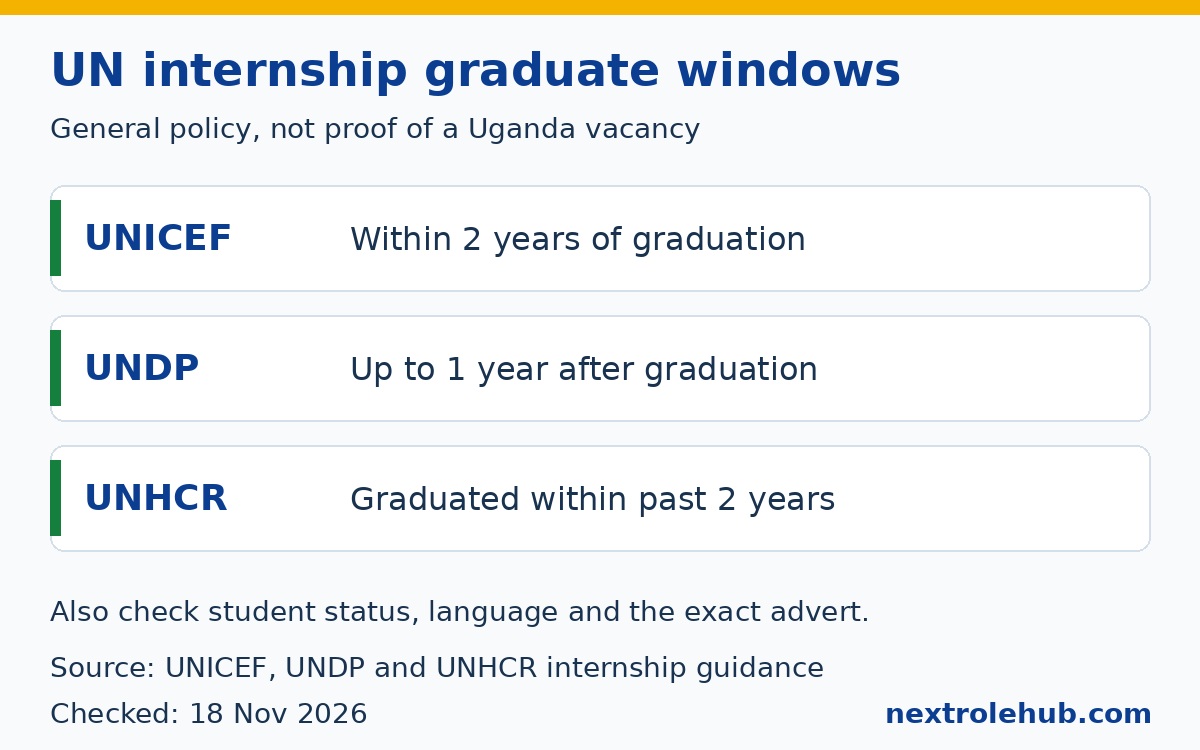
| UNICEF internships | Students and graduates within two years; minimum age 18. Normally 6 to 26 weeks. | Global policy, not confirmation of a current Uganda vacancy. |
| UNDP internships | Master’s students, final-year bachelor’s students and graduates up to one year after graduation. Normally up to 6 months. | The specific vacancy sets the assignment and application details. |
| UNHCR internships | Eligible students and graduates within two years; at least two years of undergraduate study completed. Normally 2 to 6 months. | Country-office opportunities depend on available assignments and supervision. |
| UNDP Graduate Programme | A separate two-year international assignment; bachelor’s and master’s applicants have different experience conditions. | The dedicated page says the next campaign is under consideration. No open Uganda intake established. |
The comparison deliberately leaves out acceptance rates and assumed annual intake months. The checked sources do not establish those figures. A global internship policy also cannot tell you how many places an office in Kampala will offer, or whether it is recruiting at all on the day you apply.
What ActionAid and CARE actually advertised in Uganda
ActionAid: use the closed advert to understand the route
ActionAid’s original notice is more useful than a copied job-board summary because it gives both the placement terms and the application instructions. It lists Kampala and regional offices in the north and east, with opportunities in HR and administration, communications, procurement, programmes and finance. Programme work includes monitoring, evaluation and learning.
Its opening sentence mentions third-year students, but its fuller eligibility section also includes second-year students. That is why you should read beyond a search excerpt. The same notice accepts relevant bachelor’s graduates who completed within the preceding two years. Those are conditions from that particular closed advert, not permanent rules for every future ActionAid placement.
The application required one PDF containing a cover letter, updated CV and certified academic documents where applicable. Keep that packaging distinction in mind: separate attachments would not follow those instructions. Do not email an application against the old notice now; its 22 June 2026 deadline is past, and no next intake date is established here.
CARE: a historical cohort is not a current recruitment calendar
CARE’s graduate page describes its second cohort receiving a year of practical experience in 2022 to 2023. It also says that no graduate trainee jobs are available at the moment. This is evidence of a previous programme, not proof of annual recruitment or an open 2026 application window.
The page contains wider recruitment guidance, but a later vacancy could use different instructions. Use a new dated notice to establish the next cohort’s eligibility, documents and submission method. Do not copy a past programme’s duration into an offer comparison unless the new advert repeats it.
How do UNICEF, UNDP and UNHCR internship rules differ?
UNICEF and UNHCR generally include graduates within two years of completing their studies; UNDP’s internship guidance uses a shorter, one-year graduate window. Student eligibility differs too. These are global starting conditions, not a shared UN application rule. Each vacancy can add qualifications, language requirements and assignment-specific conditions.
UNICEF: age, graduation timing and language matter
UNICEF’s official internship page sets a minimum age of 18 and accepts people studying for an undergraduate, graduate or PhD qualification, as well as those who graduated within the previous two years. It requires proficiency in at least one working language: English, French or Spanish. The office’s working language may also matter.
Its policy includes restrictions concerning immediate relatives working at UNICEF and other relatives in the reporting line. Read those conditions rather than assuming academic eligibility is enough. Internships normally last between six and 26 weeks, on a full-time or part-time basis. The page directs applicants to individual vacancies; it does not promise a placement in Uganda.
UNDP: distinguish internships from its Graduate Programme
UNDP’s People Programmes page covers internships for those completing a master’s, final-year bachelor’s students and recent graduates up to one year after graduation. It describes placements lasting up to six months, exceptionally nine when completed for academic credit. In-person and remote arrangements depend on the vacancy.
If your graduation date is close to a cutoff, check the exact notice for whether the condition is measured at application or commencement. Do not assume submitting a form before your anniversary settles the issue. The separately named UNDP Graduate Programme has different experience requirements, covered below.
UNHCR: check study completion and insurance responsibilities
UNHCR requires at least two years of undergraduate study in a relevant field and accepts eligible current students or graduates who completed within two years of applying. Its page also specifies English proficiency of at least B2, restrictions on immediate relatives and cumulative limits on previous UNHCR internships.
Normal placements run for two to six months. Extensions can reach a cumulative eight months full-time or 12 months part-time. Before starting, candidates must arrange suitable medical insurance and show evidence of coverage. That is a real preparation cost to investigate, not a reason to send money to someone claiming to reserve your place.
UNDP graduate recruitment, YPP and JPO are separate routes
The word “graduate” does not always mean “no experience”. UNDP’s dedicated Graduate Programme page currently describes a relevant master’s degree with at most one year of relevant experience, or a relevant bachelor’s with at least two and at most three years. It also requires readiness for a two-year assignment in another country.
A new bachelor’s graduate should therefore not assume this is the same route as a UNDP internship. Compare your qualification and actual work history with the specific campaign. Do not hide employment dates to fit an experience ceiling or treat academic attendance as professional experience unless the application rules explicitly allow it.
There is a status inconsistency worth flagging: UNDP’s broader People Programmes page says the next campaign is in progress, while its dedicated Graduate Programme page says it is under consideration. Without a verified live vacancy, neither statement establishes an open application window. Follow the dedicated programme page through to a dated advert before applying.
The UN Secretariat Young Professionals Programme (YPP) is different again. It recruits through an entrance examination and restricts eligibility to nationals of participating countries, with the country list changing by year. This guide does not establish Uganda’s inclusion in the current list, so it does not present YPP as automatically available to Ugandan nationals.
Junior Professional Officer opportunities also have sponsorship and nationality conditions. UNDP’s People Programmes guidance describes a route aimed at young professionals from donor countries with at least two years of experience. Read the specific sponsor’s rules before investing time in an application; a UN logo does not remove a nationality restriction.
Build an eligibility worksheet before writing a cover letter
Use the worksheet below for each new opportunity. It is an editorial decision tool, not an employer scoring system. Mark a requirement as confirmed only when the actual advert and your documents support it. An unresolved mandatory condition needs clarification, not a persuasive sentence in your motivation statement.
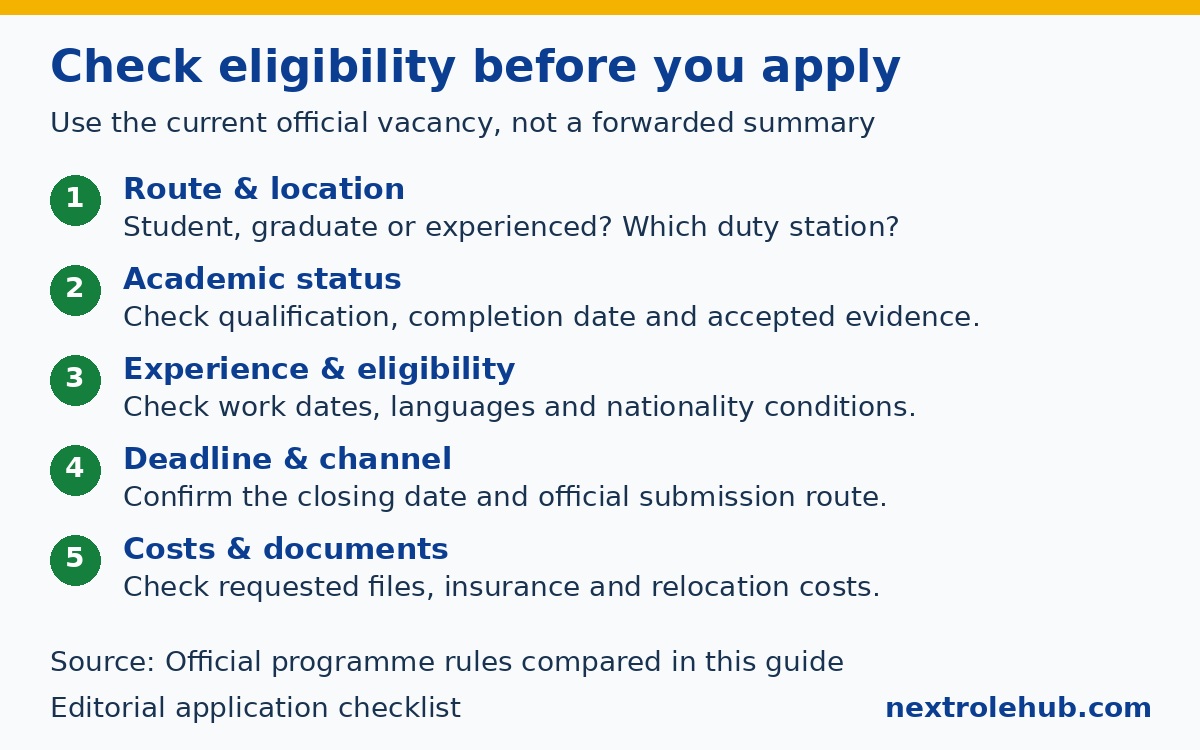
| Check | What to record | What should stop submission |
|---|---|---|
| Route and location | Exact title; student, graduate or experienced route; duty station. | A global page with no individual vacancy or an unsuitable location. |
| Academic status | Qualification, completion date and evidence accepted by the employer. | A student-only route when you are no longer a student. |
| Experience and eligibility | Actual dates, required languages and nationality conditions. | A mandatory condition you cannot meet truthfully. |
| Deadline and channel | Official closing date and application destination. | A passed deadline or a destination you cannot verify. |
| Costs and documents | Requested files, insurance and relocation responsibilities. | A fee request for shortlisting, or costs you cannot yet assess. |
For example, imagine a Ugandan bachelor’s graduate whose studies ended 18 months ago. UNICEF’s and UNHCR’s general two-year graduate windows may still be relevant, subject to the other requirements. UNDP’s one-year internship window is a different constraint. This illustrative comparison is not a finding that the person qualifies for any current vacancy.
Record academic completion accurately rather than using the graduation ceremony as a convenient substitute. If a notice is unclear about a completion letter or pending certificate, ask the contact found through the employer’s official page. Save the response beside the advert so you can explain the basis for your application.
Prepare evidence for the placement’s actual work
ActionAid’s closed notice provides a practical preparation map: record-keeping, programme support, data work and communication appear among its duties. Those tasks explain why a relevant university project can matter. They do not mean that listing every development-sector term on a CV will make you eligible.
- Choose one function you can support. A statistics project may fit data support; an accounting attachment may fit finance records. Use the vacancy’s actual duties.
- Select a genuine output. Identify a report, checked spreadsheet, meeting record or other work you personally helped produce.
- Explain your contribution and review step. Separate work you completed from work your supervisor approved.
- Protect confidential information. Prepare a redacted or fictional demonstration if you need a sample, and label it accurately.
Here is an original practice example, not a real applicant’s history: “For my university research assignment, I checked questionnaire entries against the collection forms, recorded missing responses and prepared a summary for my supervisor.” Replace it with your own work. Do not add a sample size, impact percentage or software package unless it is true.
A communications applicant could describe checking consent before sharing an approved story. A procurement applicant could explain how supporting records were organised during an attachment. Keep the limits visible: assisting with documentation is not the same as approving a purchase or managing a grant.
For layout, use our CV formats for fresh graduates in Uganda. For comparisons outside development work, see the bank graduate trainee guide and MTN and Airtel graduate routes. Those are different employment pathways, not substitutes for the NGO placement’s own criteria.
Are these placements paid, and what costs remain?
UNICEF confirms a monthly stipend; a travel and visa contribution may be available when funding permits. UNDP confirms internship stipends that vary by assignment country and working arrangement. UNHCR describes an allowance for interns without outside financial support, subject to its published rules. These statements do not establish one Uganda-wide monthly amount.
The checked ActionAid notice and CARE trainee page do not publish a verified monthly trainee pay figure. This guide therefore gives no estimated UGX salary range. Ask for the actual written stipend or salary, payment timing and any conditions before deciding whether you can afford the placement.
For a Kampala assignment, compare the confirmed payment with your own transport and accommodation costs. For a regional or international assignment, clarify travel, insurance and relocation responsibilities. UNHCR’s page distinguishes travel support from visa and insurance responsibilities; do not assume every expense is covered simply because an allowance exists.
Also ask what happens when training ends. A placement offers a defined learning or work period, not an automatic permanent post. Keep applying for suitable opportunities while awaiting results. UNHCR expressly states that recruitment fees are not charged; a payment request to secure shortlisting should stop the process while you independently verify it.
Questions to resolve before choosing a graduate route
Can I apply while waiting for my degree certificate?
Use the vacancy’s stated evidence requirements. Finishing examinations, receiving confirmed results and being awarded a qualification are not necessarily the same event. If the employer accepts a completion letter or transcript, follow that instruction. Otherwise seek clarification through an official contact, and describe your present status accurately rather than entering an award date you cannot support.
What if I graduated more than two years ago?
Do not assume every early-career route is closed, but stop treating recent-graduate internships as your only option. Check junior vacancies and experience-based programmes against your actual record. UNDP’s bachelor’s Graduate Programme route, for example, describes a specific experience range. That does not guarantee eligibility or an open campaign; it shows why each pathway needs a separate check.
Can a business or accounting graduate apply for NGO placements?
Potentially, where the advertised function and degree requirement match. ActionAid’s past Uganda notice included finance, procurement and HR-related placements rather than only programme delivery. Use a new advert to confirm the accepted disciplines. Your preparation should connect genuine coursework or attachment tasks to that function, not imply that every NGO placement accepts every business qualification.
Does a remote UN internship let me work from Uganda?
Only if the particular vacancy and employer-approved arrangement permit it. UNDP describes remote internships, while UNHCR discusses telework subject to approval. Neither statement means every assignment can be performed from any country. Confirm permitted location, working hours, equipment and any applicable conditions before accepting, especially if a role’s duty station is outside Uganda.
Should I send one combined PDF to every organisation?
No. That instruction appeared in ActionAid’s specific 2026 placement notice. Another employer may require separate uploads or a full portal profile. Keep editable source documents, then package the application as the current advert requests. Open the final file to check that pages are readable and complete; a document saved on your device is not proof of successful submission.
Can I apply to several UN agencies at once?
Yes, subject to each vacancy’s instructions, but assess each route separately. The UNICEF, UNDP and UNHCR policies do not share one graduate cutoff or one application form. Keep a record of what you submitted and the conditions you checked. Do not copy an agency name, eligibility answer or motivation statement into a different application without reviewing it.
Choose your next route from evidence, not an old advert
For an NGO graduate trainee Uganda search, separate a confirmed programme from a confirmed opening. ActionAid’s past notice and CARE’s historical cohort show what has existed locally. UNICEF, UNDP and UNHCR offer distinct internship frameworks, while UNDP graduate recruitment and YPP carry different conditions.
Start with your real completion date and experience. Choose the routes that might fit, open an individual official vacancy, and complete the eligibility worksheet before tailoring your evidence. When an advert is closed or a campaign status is unclear, prepare for the next verified opportunity rather than submitting against yesterday’s instructions.