ERB registration Uganda applications start with the Board’s online system, but the difficult work is usually proving your training and engineering responsibility. A degree certificate alone does not complete the application. You need the right registration route, supporting reports and recommendations that match the work you actually performed.
Last checked: 21 November 2026 against the ERB permanent-registration checklist uploaded in September 2026 and the official ERB registration portal. The January 2025 ERA-1 guidance is older than 12 months and is identified below when used.
This guide focuses on an individual applying as a Registered Engineer through the permanent-registration route for UIPE corporate members and East African direct applicants. It is not a guide to registering an engineering company. Technicians, technologists and applicants seeking temporary registration need the separate instructions for their categories.
The practical problem is that older forms remain available beside newer online instructions. Following an old paper checklist without checking the current requirements can leave you collecting the wrong material. Here, the newer upload checklist is separated from the older report-writing guidance, so you can use each for the right purpose.
You will find an eligibility check, an evidence table, a report-planning example and a submission sequence. Where a complete current cost or processing period could not be confirmed, the guide says so rather than promising a price or approval date.
Table of Contents
ERB registration Uganda: who can apply as an engineer?
For the standard Ugandan degree-holder route, ERB requires an engineering degree, engineering employment, corporate professional membership and a minimum age of 25. Its published requirements specify two years of supervised pupillage followed by two years of responsible engineering experience. Applicants must also provide the reports and sponsor evidence required for their route.
Those conditions come from the Board’s registration questions and answers. The degree must be acceptable to the Board; do not assume that a job title or an unrelated technical qualification establishes eligibility. The older ERA-1 guidance specifically describes supervised training and subsequent responsibility under a registered engineer.
| Check | What to establish before applying |
|---|---|
| Qualification | An engineering qualification recognised for the route you are using. |
| Age | At least 25 for the standard national degree-holder route described by ERB. |
| Experience | Two years of pupillage, then two years of responsible engineering work under registered-engineer supervision. |
| Membership | Corporate membership, not simply a student or graduate membership card. |
| Sponsors | Three registered engineers in your specialisation, paid up with ERB and UIPE, providing stamped recommendations. |
ERB and the Uganda Institution of Professional Engineers (UIPE) are not interchangeable credentials. The Board handles professional registration; the cited permanent-registration checklist also asks for corporate-membership evidence. If you hold graduate membership only, resolve that difference before treating the application file as complete.
The ERB application-guidance page separates permanent applications, non-EAC temporary applications, and technician or technologist applications. If your qualification, nationality or professional history does not fit the standard route above, start with that category selector and request guidance on your circumstances.
Build an evidence file before opening the application
Use the table below as a working index for the September 2026 permanent-registration checklist. The right-hand column is a preparation check, not an additional Board rule. It helps you spot the difference between having a document somewhere and having a usable copy ready for the application.
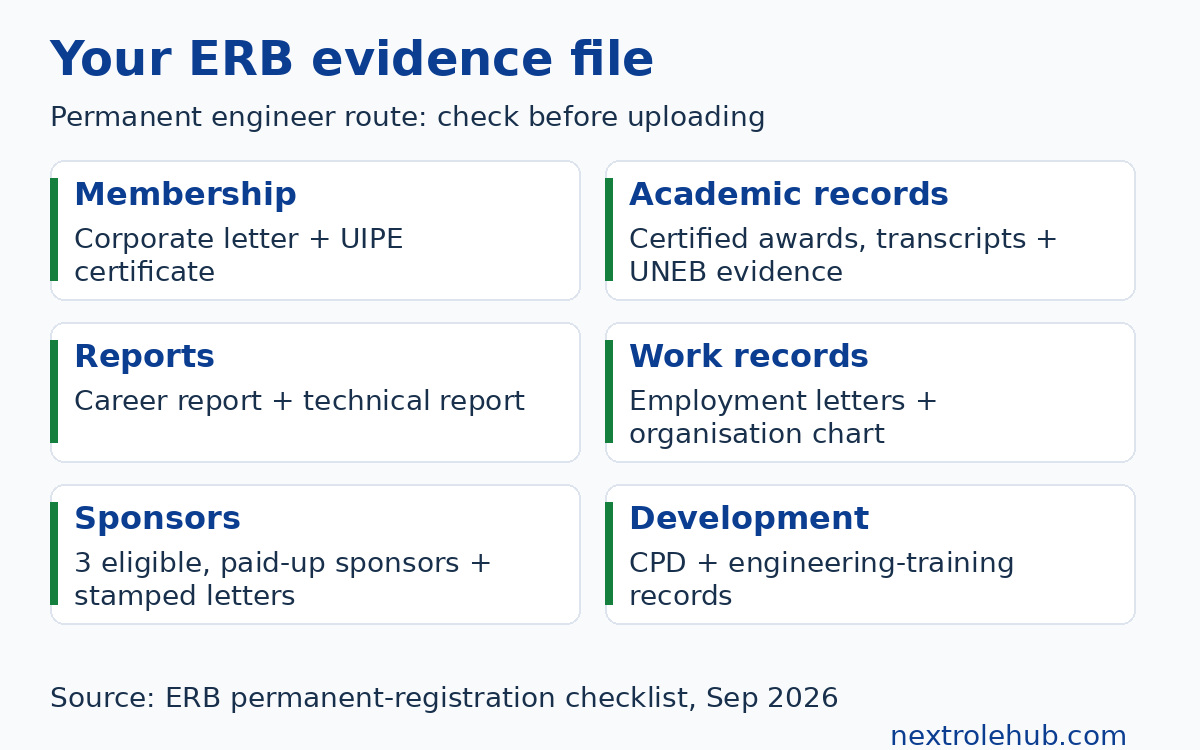
| Evidence requested by ERB | Preparation check |
|---|---|
| Corporate-membership letter and UIPE corporate certificate | Scan the letter in colour and check the membership category. |
| Academic certificates and transcripts | Check certification and legibility; include the UNEB certificates and verification letters requested. |
| Career report | Connect employment periods, supervisors, responsibilities and engineering tasks. |
| Employment letters or service contracts | Make dates and roles agree with the career history. |
| CPD or engineering-training evidence | Collect the relevant records you actually hold. |
| Current employer’s organisation chart | Show where your position sits in the reporting structure. |
| Technical report | Include stamped drawings and calculations where needed. |
| Three sponsor recommendations | Check specialisation, current paid-up status and stamps. |
For each file, record whether it is ready, needs certification or requires someone else’s action. Contact former employers early if a service letter is missing. A document request is easier to manage while you still know who holds the personnel or project records.
Check names across certificates, membership records and employment letters. If they differ, ask ERB what supporting explanation it needs. Do not edit a certificate or conceal the difference. Keep original documents safe and create clear application copies rather than circulating originals unnecessarily.
Your supervisors and sponsors serve related but different purposes. The work history identifies who supervised your training and employment; the current checklist separately asks for recommendations from three sponsors. Do not assume that an ordinary employment reference automatically satisfies the sponsor requirement.
Write a career report and a technical report that do different jobs
The career report explains your professional development over time. The technical report examines engineering work in enough detail for your competence to be assessed. Sending the same career narrative twice under different titles does not give the Board those two kinds of evidence.
Career report: make responsibility traceable
The ERA-1 form and guidance uploaded in January 2025 asks for a chronological career account covering positions, responsibility, supervising engineers, engineering tasks, project size or value, lessons and challenges. Treat this older document as report-content guidance, alongside the newer online submission checklist.
Build a private planning table with these columns: period, employer, project, supervising engineer, personal task, responsibility and supporting record. This is an organisational aid, not a compulsory ERB template. It makes gaps visible before you turn the history into a narrative.
For example, an electrical applicant might separate assisting with installation drawings from preparing test records under review. A civil applicant might distinguish recording site measurements from authorising quantities. These are illustrative distinctions, not claims about work you have done. Use only duties that your records and supervisors can support.
Explain changes of employer or project clearly. If several assignments ran at the same time, show the overlap honestly instead of making concurrent work look like additional elapsed years. Your report should let an assessor follow your actual development without reconstructing it from unrelated attachments.
Technical report: show your decisions and supporting work
The older ERA-1 guidance allows engineering functions beyond design, including installation, operation and maintenance, production, procurement, audit, research and teaching. It says you can concentrate on areas where you exercised engineering judgement rather than pretending to have delivered an entire project cycle.
A useful planning sequence is: define the problem, identify your role, explain the method and constraints, show the work you performed, and discuss the result and limitations. That sequence is editorial advice, not an official prescribed heading order. Match any current ERB report template supplied for your application.
The January 2025 guidance specifies a technical-report length of 2,500 to 6,000 words. It also addresses supporting calculations, certified drawings and bills of quantities. The newer checklist specifically calls for stamped drawings and calculations where necessary. If your engineering function produces different evidence, ask the Board how to present it instead of inventing drawings or quantities.
Keep project information accurate and obtain permission before sharing restricted employer or client material. If a record cannot be disclosed, discuss an acceptable alternative with ERB. A blank appendix reference or a borrowed calculation is not a substitute for evidence of your own contribution.
Apply through the official ERB online system
The portal supports applications, document uploads and progress tracking. The September 2026 checklist gives the online route explicitly. The sequence below follows those published tasks; it does not claim to reproduce private account screens, upload limits or every button you will see after signing in.
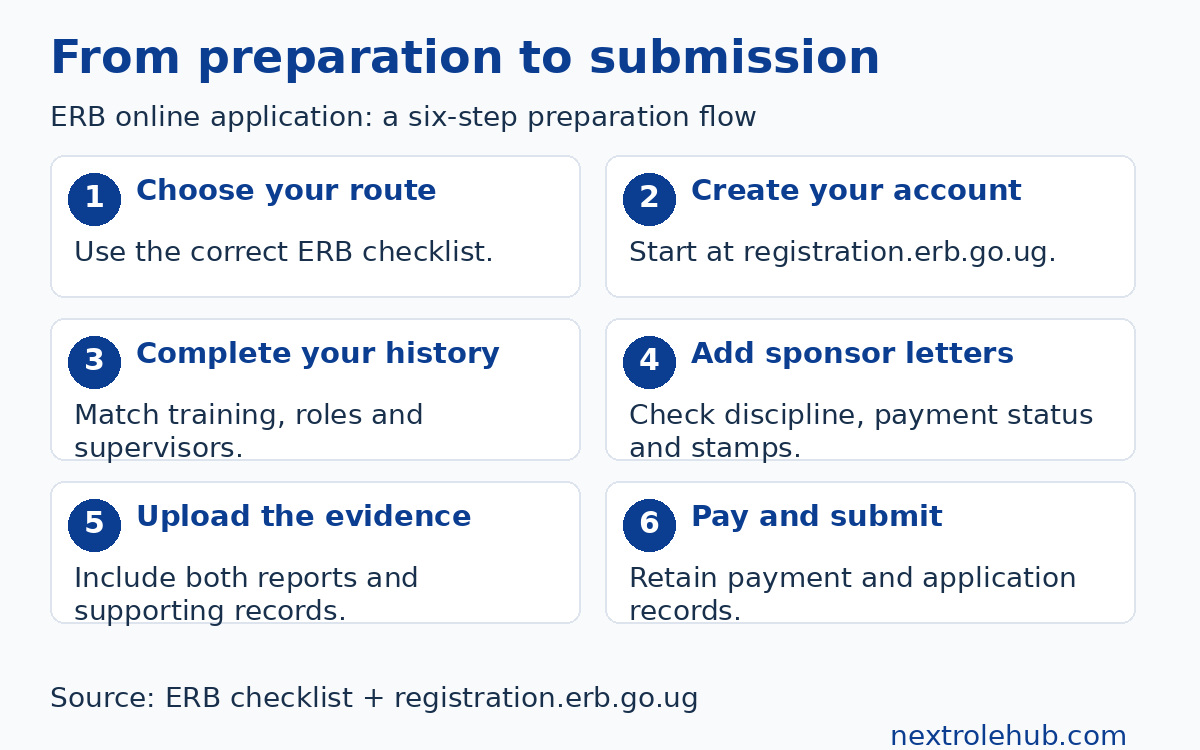
- Identify the correct category using the Board’s application guidance. Keep its current checklist beside your files.
- Create your account through registration.erb.go.ug. Use contact details you control and can continue accessing.
- Complete the biodata and career information. Pay particular attention to training dates, subsequent employment and the engineers who supervised you.
- Add the stamped recommendations from your three eligible sponsors. Check that each letter relates to your application and specialisation.
- Upload the career-report material and technical report with their supporting evidence, following the system’s current instructions.
- Pay through a route published by ERB, complete the submission process and retain the payment and application records made available.
After uploading, open the saved files if the system allows it. Check page order, readable stamps and complete appendices. A successful file selection on your computer does not prove that the final application contains the correct version.
The older paper checklist asked for bound copies and a flash drive; the newer checklist describes online submission. Do not make an unnecessary journey based only on the older instructions. Equally, provide originals or hard copies if the Board specifically requests them for your case.
What does ERB registration cost? Separate application from later fees
The September 2026 permanent-registration checklist states an application fee of UGX 400,000. It lists payment through the system, bank or MTN Mobile Money. That is an application charge, not a verified all-inclusive price for corporate membership, registration and every later annual obligation.
| Cost item | What this guide can confirm |
|---|---|
| Permanent-route application fee | UGX 400,000 in the ERB checklist uploaded in September 2026. |
| UIPE membership costs | Separate from the cited ERB application charge; confirm your membership category and current charges. |
| Registration and annual obligations | Request the current itemised amounts applicable to your route before budgeting or paying. |
| Document preparation | Certification, scanning or travel may involve your own costs; no standard allowance is assumed here. |
The Board publishes an ERB fee-structure page, but a complete current schedule could not be reliably extracted from that page during this check. Older official material lists other charges, which should not be silently combined into a current total. Ask for an itemised quotation or payment instruction for your category.
Before authorising payment, compare the recipient and payment purpose with the Board’s current instructions. Use your name and the requested payment reference. Keep the receipt linked to your application record. Do not share a mobile-money PIN with anyone offering to handle registration for you.
Evidence gaps that are easier to fix before submission
A polished report can still leave the assessor unable to verify a period of work or a claimed decision. Use this check before paying and submitting; it targets the places where the published requirements ask for corroboration, rather than promising that a neat file guarantees approval.
- Unclear supervision: identify the engineer, dates and work concerned, not just the employer’s company name.
- Wrong sponsor category: check the sponsor’s discipline and paid-up position instead of relying on seniority or friendship.
- A job-description report: replace generic duties with your own tasks, judgement and supporting records.
- Missing technical support: reconcile appendix references with the drawings, calculations or other records actually supplied.
- Conflicting dates: make the biodata, employment letters and career report consistent without changing true facts.
- An assumed exemption: obtain confirmation for a non-standard experience route rather than shortening the standard pathway yourself.
For a diploma-to-degree applicant, the older ERA-1 guidance describes a possible pupillage waiver after at least four years of demonstrable engineering practice following an ordinary or higher diploma and subsequent upgrading to a recognised engineering degree. This is not permission for every graduate to skip supervised training. Ask ERB to confirm how your qualification history is assessed.
After submission: track the case without assuming approval
Keep a copy of what you submitted and monitor the official account and contact channels for requests. If ERB asks for clarification, respond to the specific issue with the correct replacement or supporting record. Retain enough version history to know what changed.
A guaranteed current approval period was not confirmed in the ERB material reviewed. Do not plan a job start around an assumed one-month turnaround. Ask the Board about the present assessment sequence and expected timing for your category, especially where an employer needs registration evidence by a particular date.
Submission, registration and annual practising-licence renewal are different stages. The portal offers both first-registration services and renewal functions. Do not describe a payment receipt or an application awaiting assessment as a registration certificate or a current practising licence.
The Board’s published contact is +256-393-194-942 or [email protected], at the Management Support Unit Building, Plot 2 Gloucester Avenue, Kyambogo. Confirm any visit arrangements through the Board before travelling, particularly if your question can be resolved through the online application.
For employment planning, our engineering pay guide explains why professional registration is not an automatic salary promise. Use the Uganda CV guide to describe your actual credential accurately when applying.
Questions applicants ask about engineer registration
Can a fresh engineering graduate register immediately?
Not through the standard degree-holder route merely by holding a new degree. ERB’s published conditions include age, corporate membership and supervised practical experience. A new graduate can start collecting training records and identifying suitable supervision while working towards eligibility. Our first-job guide for Ugandan graduates addresses the separate search for entry-level employment.
Can a diploma holder use this engineer application checklist?
Do not assume this permanent engineer checklist is your category. ERB provides a separate route for technicians and technologists and explains its diploma requirements in its registration answers. If you later upgraded to an engineering degree, ask how the Board treats your earlier practice. Qualification history matters more than the engineering title used by an employer.
Is a CV enough instead of a career report?
A CV can help you reconstruct your employment history, but the published application requirements ask for a career report. The report must explain responsibilities, engineering work and supervision in greater detail than a recruitment summary. Prepare the requested report and supporting records; do not substitute a CV unless ERB gives specific instructions permitting that in your case.
Must the technical report cover a whole construction project?
The older ERA-1 guidance does not require every applicant to describe the entire project cycle. It recognises several engineering functions and focuses on work demonstrating your own professional judgement. Choose material that supports your competence in your discipline. An operations or maintenance applicant should not invent construction responsibilities simply to imitate another applicant’s report.
Does creating an account mean I have a practising licence?
No. An account provides access to the application and renewal system. It does not establish that the Board has accepted an application, entered you on the register or issued a current licence. Keep the documents for those stages separate and use only the professional status you can currently prove when completing an employer’s application form.
Can someone guarantee registration if I pay them?
A report-writing service or intermediary cannot replace the Board’s assessment or make unsupported work history genuine. Keep control of your account, verify official payment instructions and read the complete submission before it is sent. Advice can help organise evidence, but the qualifications, recommendations and engineering work must remain yours and must be capable of verification.
Choose the next action your evidence supports
For ERB registration Uganda, start with eligibility rather than a payment. If you meet the standard route, assemble the membership evidence, obtain suitable sponsor recommendations and test both reports against the current checklist. If you do not yet qualify, use the same checklist to plan supervised work and keep the records you will need later.
When you are ready to look for a role, browse engineering vacancies in Uganda and read each employer’s exact professional-registration requirement. For petroleum-sector roles, our Uganda oil and gas careers guide explains the separate employer and application routes. Registration supports professional practice; it does not replace applying for a suitable job.