CPA Uganda requirements give you more than one entry route: you do not need an accounting degree just to apply. The bigger decision is how you will fund examinations, study around work and build the practical experience needed for full membership of the Institute of Certified Public Accountants of Uganda (ICPAU).
A school-leaver comparing professional study with university has a different starting point from a degree-holder seeking exemptions. A working accounts assistant also needs to separate student admission from examination completion and professional membership. Paying the registration fee does not complete any of the later stages.
This guide helps you check your documents against the official entry routes, understand the published 2026 charges and prepare a registration file. It also explains what to ask about exemptions, how Practical Experience Training (PET) works and why the approaching December examinations are not an invitation to register late.
The focus is the decision to start CPA(U), not another salary comparison. For the relationship between qualifications and employer requirements, use our accountant salary and qualification guide. No course can promise you a particular appointment or pay rise.
Last checked: 20 November 2026 against ICPAU registration guidance and the official brochures and calendar linked below. Fees shown are published 2026 charges, not a quotation for 2027.
Table of Contents
What are the CPA Uganda requirements?
You can apply through a recognised degree, an eligible diploma or professional qualification, or the specified school-certificate route. For the latter, ICPAU requires at least two UACE principal passes plus five UCE credits, including English Language and Mathematics, or equivalents. Admission does not automatically give you exemptions or professional membership.
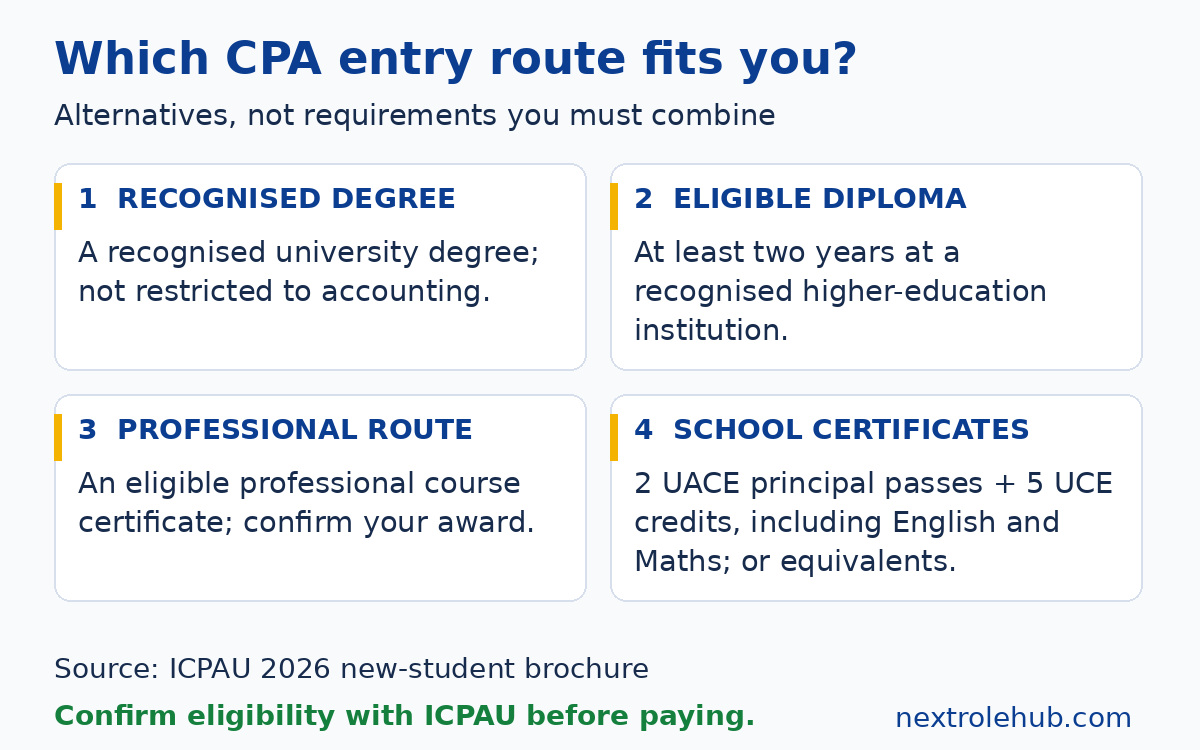
The 2026 new-student brochure sets out the alternatives below. These are different routes, not qualifications that every applicant must hold together. Check the route that matches your actual award before paying a tuition provider.
| Your starting qualification | What the official route requires | What to confirm |
|---|---|---|
| University degree | A degree from a recognised university | Recognition and any exemption assessment; the route is not restricted to accounting degrees. |
| Diploma | At least two years of study at a recognised higher-education institution | Whether your particular award and institution meet the route. |
| Professional qualification | An eligible professional course certificate | Ask ICPAU to assess the exact examining body and award. |
| School certificates | At least two UACE principal passes plus five UCE credits, including English and Mathematics, or equivalents | Both certificates matter; UCE alone is not the stated direct-entry route. |
ICPAU also identifies recognised accounting-technician qualifications in its CPA qualification guidance. If your certificate title differs from the examples, send the actual award for assessment. A training school saying that it will admit you to classes is not the same as ICPAU accepting you as a student.
For example, a hypothetical applicant with a recognised non-accounting degree can investigate degree entry without first buying another degree. That applicant still needs an assessment of exemptions and a learning plan for unfamiliar accounting subjects. Meeting admission conditions does not mean the course will begin at an advanced level.
Understand the papers before assuming exemptions
The 2026 continuing-student brochure describes 18 papers across four levels under the 2023 to 2027 syllabus. The final paper is Integration of Knowledge. The programme moves beyond introductory bookkeeping into reporting, taxation, assurance, financial management and professional judgement.
| Level | Papers in the published structure | Planning implication |
|---|---|---|
| I | Papers 1 to 6 | Check which foundations you need to study and which exemptions are approved. |
| II | Papers 7 to 11 | Build your next sitting around the progression rules, not simply available class times. |
| III | Papers 12 to 17 | Allow preparation for advanced professional subjects. |
| IV | Paper 18: Integration of Knowledge | Level III must be completed before registration for Level IV. |
ICPAU assesses exemptions paper by paper. Its exemption instructions tell applicants to present their academic transcript to Student Engagement Officers, pay for approved exemptions and accept them in the portal before examination registration. A degree title alone does not establish your personal exemption list.
The exemption schedule in the 2026 brochure is dated 31 December 2025. Do not infer entitlement from a similarly named programme or a former student’s experience. Confirm the institution, exact qualification and assessment relevant to your record. Exemptions are chargeable; they reduce examination work, not necessarily every related cost.
Progression also affects timing. The brochure generally requires completion of a lower level before the next, with a stated exception where at most two papers remain at Level I or II. Some paper combinations are prohibited. Ask ICPAU to check your proposed combination instead of building a timetable from the exception alone.
Budget for separate charges, not one course price
The official 2026 brochure separates registration, annual renewal and NCHE charges from examination fees. Tuition is another budget item: a training provider’s teaching quote should not be assumed to include payments to ICPAU. The table below combines the published charges into a planning reference, not an all-inclusive offer.
| Charge | Published normal fee, UGX | Basis |
|---|---|---|
| Student registration | 160,000 | Student registration, separate from examination entry |
| Annual renewal | 130,000 | Annual studentship charge |
| NCHE | 20,000 | Separate charge with its own payment instructions |
| Level I examination | 115,000 | Per paper |
| Level II examination | 125,000 | Per paper |
| Level III examination | 135,000 | Per paper |
| Level IV examination | 350,000 | Whole level, not a per-paper comparison |
Source: sections 6.1 and 6.2 of the 2026 CPA continuing-student brochure. It also lists late examination charges, but those charges do not create a right to register after the published deadline. NCHE payment goes through the URA portal, and students must notify ICPAU through their student accounts.
Build your own worksheet with an amount, payment date and evidence column for each item. Add the provider’s written tuition quote, materials, transport and any accommodation needed for classes or examinations. Leave uncertain items blank until confirmed. Do not turn a subtotal into a headline claim about the entire qualification.
If an employer offers study support, establish what it covers in writing. Examination reimbursement, tuition sponsorship and paid study leave are different benefits. Check any pass condition or repayment clause before relying on the support. A promise of reimbursement later still leaves you needing the money when payment falls due.
Prepare your application in the right order
Use the official ICPAU student application portal reached through ICPAU’s website. Its document checklist is more specific than simply “bring your certificates”. Prepare readable files before beginning, and keep a private copy of the application number and payment evidence.
- Check eligibility and exemptions first. Gather the actual certificates and transcripts for the route you intend to use. Resolve uncertainty with ICPAU rather than selecting a convenient qualification label.
- Prepare identification and the photograph. The portal requests a scan of the original National ID or passport details page, plus a colour passport photograph on a white background. It gives additional permit requirements for non-East African applicants.
- Prepare academic files. The portal requires academic documents in PDF, including front and back where present, and says uploads must not exceed 8 MB. Check every page is legible before uploading.
- Check names and arrange a referee. Names must agree with supporting records; a change needs legal evidence. The referee must fit the portal’s permitted categories and cannot be a close relative.
- Complete the online form, then pay using the application number. Continuing students use their ICPAU ID for relevant payments. Use the current official instructions rather than a number supplied in an unsolicited message.
- Complete confirmation requirements. The portal lists a signed application, payment proof, original or certified academic records and a CV for presentation at ICPAU offices. Confirm the photograph quantity directly because the page displays inconsistent wording.
The photograph inconsistency is a reason to ask the Institute, not a reason to guess. Contact [email protected] and state your application number if you already have one. Do not send identity documents to a stranger offering to correct the application for you.
A CV requested for student registration is not an invitation to inflate your experience. Use accurate education dates and describe any placement honestly. Our fresh-graduate CV formats can help organise a short record without inventing employment.
December 2026 exams: registration is already closed
The official 2026 examination calendar marks December registration as closed. It schedules the examinations for 7 to 11 December 2026, after normal registration from 15 to 30 September and late registration from 1 to 15 October. These entry windows are past as at 20 November.
Late entry was for continuing students only. A person seeing CPA revision classes advertised in November should not assume that enrolling in tuition also secures a December examination place. Check the official portal record and contact ICPAU about your circumstances before making payments.
If you have not entered, use this period to resolve admission, exemptions and a realistic study budget for the next published opportunity. This guide does not supply unverified 2027 dates. If you are already entered, follow your own examination record, the current timetable and official notices for your papers and centre.
Plan practical experience while planning examinations
Passing papers and completing the membership process are different stages. ICPAU’s Practical Experience Training guidance requires at least three years of suitable practical training, covering at least three technical fields and all specified non-technical fields. A job title or length of service alone does not demonstrate that coverage.
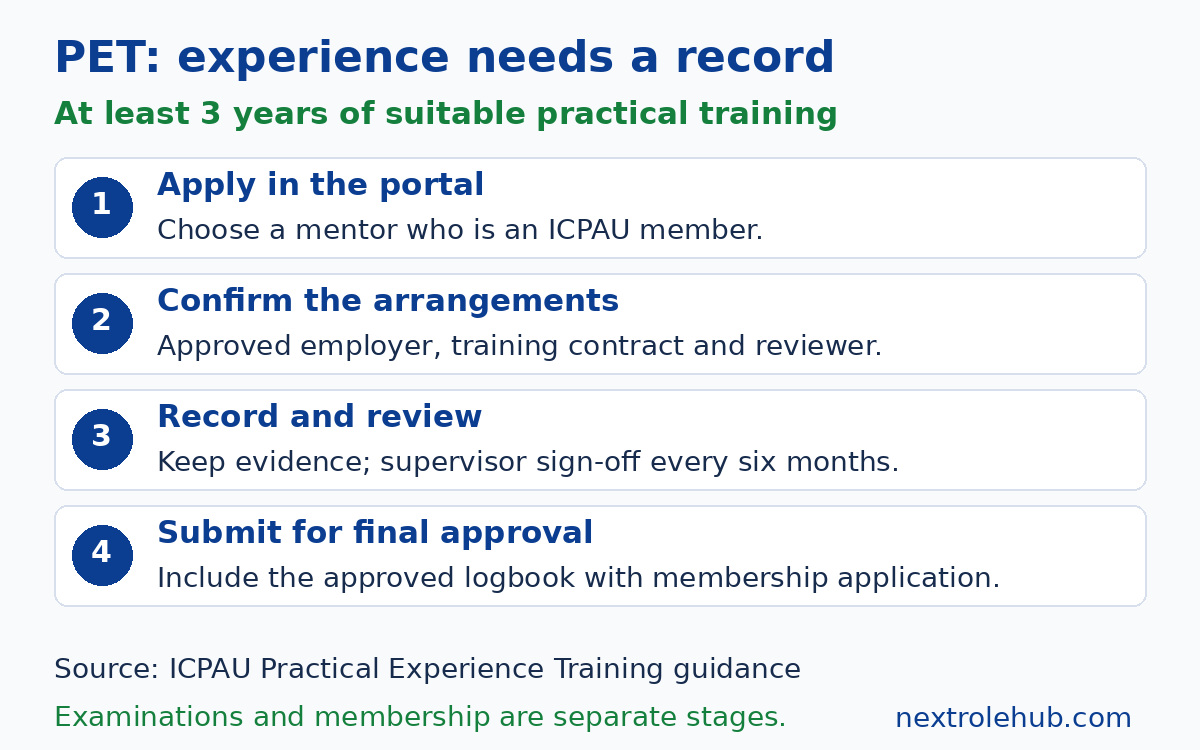
The Institute uses an electronic logbook supported by verifiable evidence. Your supervisor must be an ICPAU member, and the programme includes employer approval and a training contract. Plan how your actual work will be assessed rather than assuming that any office job automatically qualifies.
- Apply through the PET area of the portal using your registration number or ICPAU ID, and nominate a mentor whose membership number you know.
- Wait for approval and follow the training-contract and employer arrangements. ICPAU assigns a staff reviewer after approval.
- Record relevant work and supporting evidence in the electronic logbook. Arrange supervisor sign-off semi-annually; ICPAU reviews logbooks every six months.
- At the end of the training contract, submit the logbook for final approval and include it in the full-membership application as required.
ICPAU allows retrospective recording, but that does not mean every past duty will be accepted. Ask how your previous work should be evidenced and reviewed. Keep employer and client confidentiality intact: agree what can be recorded and shared through the authorised process rather than uploading unrestricted finance files.
The full-membership page separately lists an application, PET logbook, academic records and recommendations, including one from a full ICPAU member who knows the applicant. Its attachment is a 2024 membership brochure and the page has no visible update date. Confirm current membership charges directly instead of treating that older material as a fresh quotation.
Choose a role family before expecting a return
ICPAU identifies financial accounting, management accounting, internal audit and tax-related work among the career directions associated with CPA study. These are possible directions, not entry-level jobs awarded on registration. Senior titles in a course brochure are not a promised first appointment.
Start with one real employer advert from the accounting and finance jobs page, then verify the original source. Mark the required degree, professional status and experience separately. An advert accepting part qualification presents a different application decision from one requiring completed examinations and membership.
For banking, distinguish finance or audit work from customer service, sales and digital-channel operations. Our banking careers guide explains the role families. CPA should address an identifiable requirement, not serve as a generic purchase because a job happens to be in a bank.
Career changers should also test the work before committing to a long study plan. Use our career-change planning guide for an evidence worksheet. A hypothetical administrator moving towards accounts support may need relevant supervised tasks as well as examinations; a new course does not rewrite previous duties.
Checks that prevent an expensive false start
Before paying, separate the decisions made by ICPAU, the tuition provider and an employer. Each controls something different. Admission to classes cannot approve exemptions, an examination pass cannot confirm PET coverage, and course completion cannot replace an employer’s mandatory experience requirement.
- Get an eligibility answer tied to your actual award, especially where the institution or qualification needs clarification.
- Ask for the current exemption decision before choosing papers or calculating the remaining cost.
- Request a written tuition quote stating what is excluded and whether the study schedule fits your work and travel.
- Check progression rules and the official registration window before paying for an examination plan.
- Identify how to obtain relevant work, an eligible supervisor and evidence for PET.
- Keep student, examination-completion and membership claims distinct on applications and professional profiles.
A useful question to a provider is: “Which fees in this quotation go to you, which go to ICPAU, and which depend on my assessed exemptions?” Ask ICPAU separately about the Institute’s charges. Comparing the answers is more useful than choosing the smallest advertised monthly instalment.
CPA entry questions worth resolving before enrolment
Can I study CPA in Uganda without a university degree?
Yes, if you meet another published entry route. ICPAU accepts specified diploma and professional routes, as well as UACE with at least two principal passes together with the required UCE credits. A degree is therefore not compulsory for every applicant. Send your own records for assessment if you are unsure which alternative applies; do not treat UCE alone as the stated direct-entry route.
Can I study privately instead of attending full-time classes?
The 2026 new-student brochure recognises full-time, part-time, private and correspondence study options. Private study does not remove the examination or progression requirements. Compare the available materials, your existing accounting knowledge and the time you can protect for practice. Before buying tuition, ask what teaching and assessment support the provider actually supplies and which separate Institute charges remain your responsibility.
Does my degree automatically give me CPA exemptions?
No. Admission through a recognised degree and exemption from particular papers are separate decisions. ICPAU assesses recognised qualifications against subjects and directs applicants to present their transcripts to Student Engagement Officers. Confirm the approved papers and applicable charges before accepting exemptions in the portal. A former classmate’s list is useful only as a question to investigate, not proof of your own entitlement.
What if I hold ACCA or another foreign accountancy qualification?
ICPAU has a specific foreign-accountancy-qualification assessment route. Its exemption guidance says some applicants may need Uganda-related papers, including law, public financial management, assurance or advanced taxation. Do not assume that every foreign qualification receives the same decision or that holding it automatically completes local membership. Ask the Institute to assess your exact qualification and explain the remaining examinations and membership requirements.
How long will it take me to complete CPA(U)?
There is no single personal completion time established by these sources. Your pace depends on exemptions, progression restrictions, preparation and examination results. Separately, full membership requires the prescribed practical training. Build a plan from assessed papers and relevant work rather than a tuition seller’s fastest completion example. Do not add or overlap study and PET periods yourself without confirming what ICPAU will recognise.
Can I request examination support for a disability?
The 2026 new-student brochure asks students with special needs to notify the Public Accountants Examinations Board so suitable consideration can be arranged. Contact ICPAU early about your specific needs, the evidence required and the arrangements available. Do not assume that ordinary student registration communicates the request or that an adjustment is approved simply because a tuition provider knows about it.
Decide what to do before your first payment
CPA Uganda requirements are the first gate, not the complete career plan. Confirm your entry route and exemptions, separate the Institute’s charges from tuition and identify how relevant practical work will be supervised. Keep the December 2026 registration closure in view and wait for verified future dates rather than assuming an intake.
Your next action is to compare your documents with ICPAU’s official registration guidance and resolve any uncertainty with Student Engagement Officers. Then prepare a written study-and-work budget. If a specific accounting role is your goal, keep its actual requirements beside that plan so the qualification addresses a gap you can name.