The CV mistakes job seekers in Uganda can fix before applying range from a wrong telephone digit to a qualification that sounds complete when it is still in progress. Start with errors that make your application inaccurate or incomplete. A prettier template will not repair those problems, and silence from an employer does not prove your CV was the cause.
This is a repair guide for a CV you already have, not another template to fill in. Keep the vacancy notice beside your document and check each claim against your records. You will learn which problems to fix first, how to replace vague statements without inventing numbers, and how to test the actual attachment rather than the editable original.
The examples below are fictional illustrations, not candidate results or instructions to copy someone else’s experience. For a full document structure, use our guide to writing a CV in Uganda. Here, the goal is narrower: find the weak point, correct it honestly, and make sure the correction survives into the application you submit.
Last checked: 16 November 2026 against Public Service Commission ORAMIS guidance, UNICEF application guidance and the Bank of Uganda Medical Consultant advert dated 10 August 2026. The Bank advert closed on 21 August 2026 and is used only as a past example. The PSC and UNICEF guidance pages do not display an update date.
Table of Contents
CV mistakes to fix first
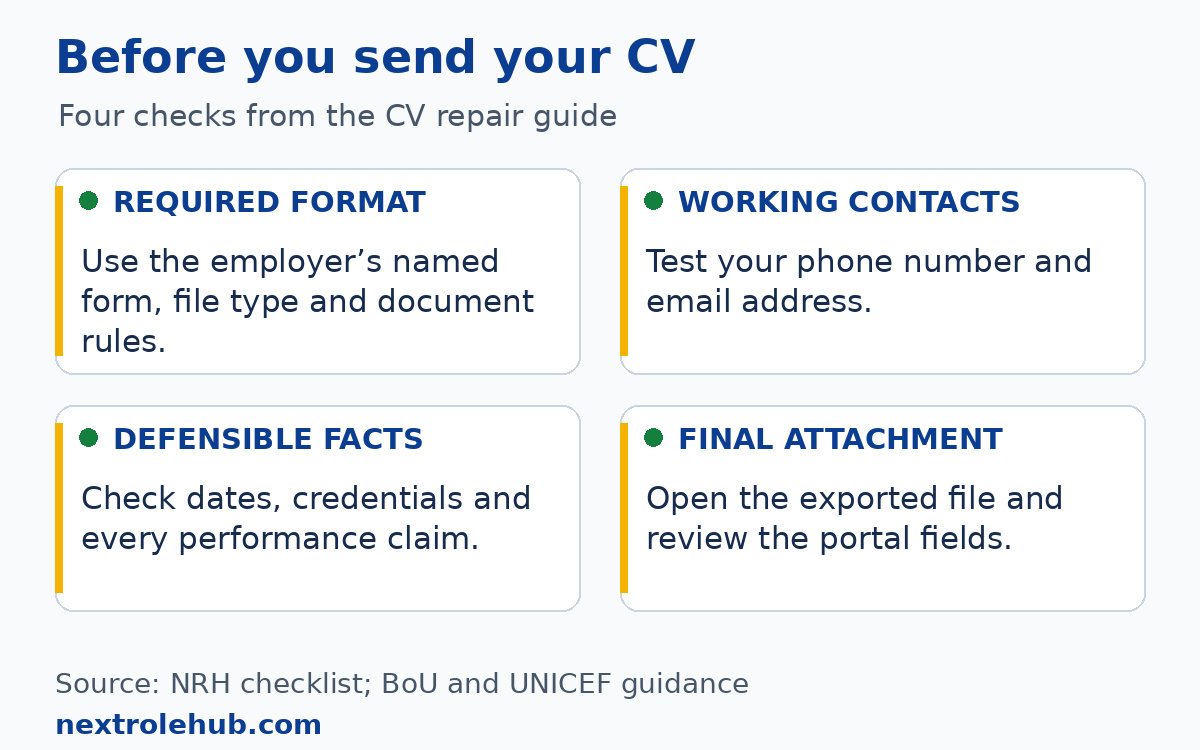
Fix incorrect contact details, false claims, missing compulsory information and an unreadable attachment before adjusting design. Next, make your relevant experience easy to verify and reconcile dates across your documents. These checks improve the quality of an application; they cannot guarantee a shortlist or explain every employer’s decision.
Use this original diagnostic table on the version you plan to send. The priority labels are an editing aid, not an employer scoring system. If a compulsory qualification is absent, check your eligibility before spending time polishing the document.
| Warning sign | Check | Repair |
|---|---|---|
| Employer specifies a CV form | Compare your file with the named form | Replace the template first |
| Telephone or email may be wrong | Test both contact routes | Correct every saved version |
| Relevant evidence is buried | Underline proof of each essential requirement | Move that evidence upwards |
| Bullets contain only adjectives | Ask what work each claim describes | Name a task and its output |
| A percentage has no basis | Find the calculation and underlying records | Remove unsupported precision |
| Dates differ between documents | Compare CV, portal and records | Reconcile the timeline |
| Study is described as completed | Check the actual award status | State the status accurately |
| Attachment is difficult to read | Open and copy text from the final file | Re-export and inspect |
| Referee has not agreed | Confirm permission and current contacts | Update or replace appropriately |
| File mentions a different vacancy | Search for old employer and role names | Save a clean role-specific copy |
1. Using your favourite template instead of the required form
A CV can be well written and still be the wrong document. Before changing colours or margins, check whether the employer names a particular CV form, page limit or document arrangement. Save those instructions with the vacancy notice so a general online tip cannot override them.
The past Bank of Uganda Medical Consultant advert required its standard CV form and explicitly said candidates using a different format would be disqualified. It also required certified academic and training documents in the stated submission arrangement. That was a rule for that recruitment exercise, not proof that every Ugandan bank has identical requirements.
For PSC recruitment, the official ORAMIS guidance describes an online application process. Do not assume a paper form, an emailed CV or a requirement from an old vacancy applies to a new one. Other commissions and employers may publish different instructions.
2. Leaving a broken contact route at the top
One transposed digit can make a suitable candidate difficult to reach. Compare the number on the CV with the number in the portal, then ask someone to call it. Send a test email to the address you have typed, and check that you can access its inbox.
If you use a shared telephone, consider whether a recruiter’s call can reach you reliably. Do not list an old work email you no longer control. An address based on your name is easier to recognise than an unexplained nickname, but accuracy and access matter more than finding a perfect address.
Check any professional-profile link from the exported file, not just the original document. A neat-looking label can hide a broken destination. Remove an optional link if you cannot make it accurate and useful before submitting.
3. Making the reader hunt for your relevant experience
A long work history can still hide the reason you fit this vacancy. Highlight each essential requirement in the advert and find its evidence in your CV. If the reader must piece it together from unrelated roles, change the emphasis, not your employment history.
Fictional example: a shop supervisor applying for a stock-records role leads with “seeking a challenging position”. A more useful opening identifies experience checking delivery notes, recording stock movements and investigating differences, if those tasks are true. The rest of the document should then show where that work happened.
UNICEF’s official CV guidance recommends leading with key expertise and following it with relevant experience. That supports relevance, not a universal wording formula. Keep official job titles intact; explain transferable responsibilities in the bullets instead of renaming yourself to match the vacancy.
4. Replacing evidence with impressive-sounding adjectives
“Excellent communicator” tells a reader what you think of yourself. It does not show the audience, situation or work involved. A CV full of similar claims can take up two pages without giving an interviewer anything concrete to ask about.
Fictional rewrite: replace “highly organised administrator” with “maintained the incoming-mail register, routed correspondence to the responsible officers and checked outstanding items before weekly review”. This describes observable work. Use it only if it matches your own duties; the point is the level of detail, not the sentence itself.
Try the same test on software claims. If you write “advanced Excel”, identify the functions or tasks you can perform without help. A narrower statement about maintaining a purchase register or checking duplicate entries is more credible than a broad skill label you cannot explain.
5. Adding percentages because a CV tip said every bullet needs one
Numbers help only when they mean something and can be supported. “Improved efficiency by 60%” is not evidence if you cannot explain the starting point, measure, period and your own contribution. Never turn a rough impression into a precise performance claim.
Instead, look for a verifiable deliverable: a completed reconciliation, a filing system you maintained, a training session you helped deliver, or an approved report. Frequency can also add detail when accurate. “Prepared the weekly dispatch register” is useful without an invented percentage.
Separate personal work from team outcomes. If colleagues generated sales and you prepared the reports, say that you prepared the reports. Keep confidential customer, patient and beneficiary details out of the CV. A recruiter needs enough context to understand the work, not access to protected records.
6. Letting your CV and application form tell different timelines
Compare dates across your CV, portal entries and supporting records. Look for a role marked “present” after it ended, a graduation date confused with a study-completion date, or two full-time jobs that appear to overlap without explanation. Check records before making a correction.
Use a consistent month-and-year convention when you know the dates. If work was part-time, a temporary assignment or concurrent volunteering, label it clearly. Do not add overlapping periods together to inflate the amount of experience you claim.
A career break does not need a personal essay. If a brief explanation is useful, describe it factually and disclose only what you are comfortable sharing. Do not invent consultancy work to fill a gap. UNICEF’s recruitment FAQ treats advertised experience as a minimum requirement, so accurate dates matter more than a tidy-looking timeline.
7. Presenting a pending award or limited role as something bigger
An unfinished qualification is not a completed award. State the course and its actual status, distinguishing study in progress, coursework completion and an award already received. Check the wording against your institution’s records rather than assuming these stages mean the same thing.
Apply the same discipline to professional registration and job titles. If an employer requires a current practising licence, a related degree alone does not establish that you hold it. If you supported a supervisor, do not describe yourself as the department head. Explain responsibility without promoting yourself on paper.
The past Bank of Uganda notice also warned against concealed or falsified information. Treat any uncertainty as a reason to verify your wording before submitting. If you do not meet a mandatory requirement, a polished description cannot create the missing credential.
8. Checking the editable CV but not the uploaded attachment
Your word-processing document can look fine while its exported version loses text, cuts off a line or rearranges the reading order. Open the exact attachment on another device if possible. Inspect every page, including the bottom of the last page.
Try selecting the text and copying it into a plain-text editor. Check that your name, contact details, dates and headings appear in a sensible order. This is a practical warning test, not a certificate that every recruitment system will interpret the file correctly.
Follow the employer’s file-type and size instructions. Keep a simple text-based version available rather than relying on a screenshot or image-only CV. If a portal fills fields from your document, inspect those fields too. Our guide to ATS applications in Uganda explains the separate issues of file reading, profile completion and screening answers.
9. Listing a referee who cannot confirm your work
A prestigious title does not make someone a useful referee if they barely know you. Choose a person who can explain the relevant relationship and has agreed to be contacted. Confirm their current title, email and telephone number before sharing them.
Follow the advert’s requested number and type of referees. Do not replace an expressly requested list with “available on request”. Equally, do not assume another employer needs a full contact list simply because the last vacancy did.
A graduate might approach a placement supervisor or lecturer who directly assessed their work. An experienced applicant might use an appropriate former supervisor. If contacting your current employer would be sensitive, look for the application’s consent options or published recruitment contact rather than inventing a referee or sharing someone’s details without permission.
10. Sending yesterday’s tailored CV to today’s employer
The final version can still contain another employer’s name, an old target role or a borrowed sample sentence. Search the document for names from your previous application and for visible editing remnants. Check comments, tracked changes, headers and footers before exporting a clean copy.
Give the file a clear name, such as Surname_Firstname_CV_RecordsAssistant.pdf, unless a specific naming rule is supplied. Then attach it and open it again from the email draft or upload preview. Do not assume that selecting the right folder means you selected the right file.
This is also the moment to reconcile the CV with the letter and portal answers. A correct attachment does not fix an incorrect screening response. For submission routes and confirmation records, use our guide to applying for jobs in Uganda rather than sending extra versions through unrelated channels.
A repair order for the CV you already have
Work through these passes in order. They are a practical editing sequence, not a promise about how an employer will shortlist. Start with the vacancy notice and end with the submitted-file preview, because errors can be introduced between the two.
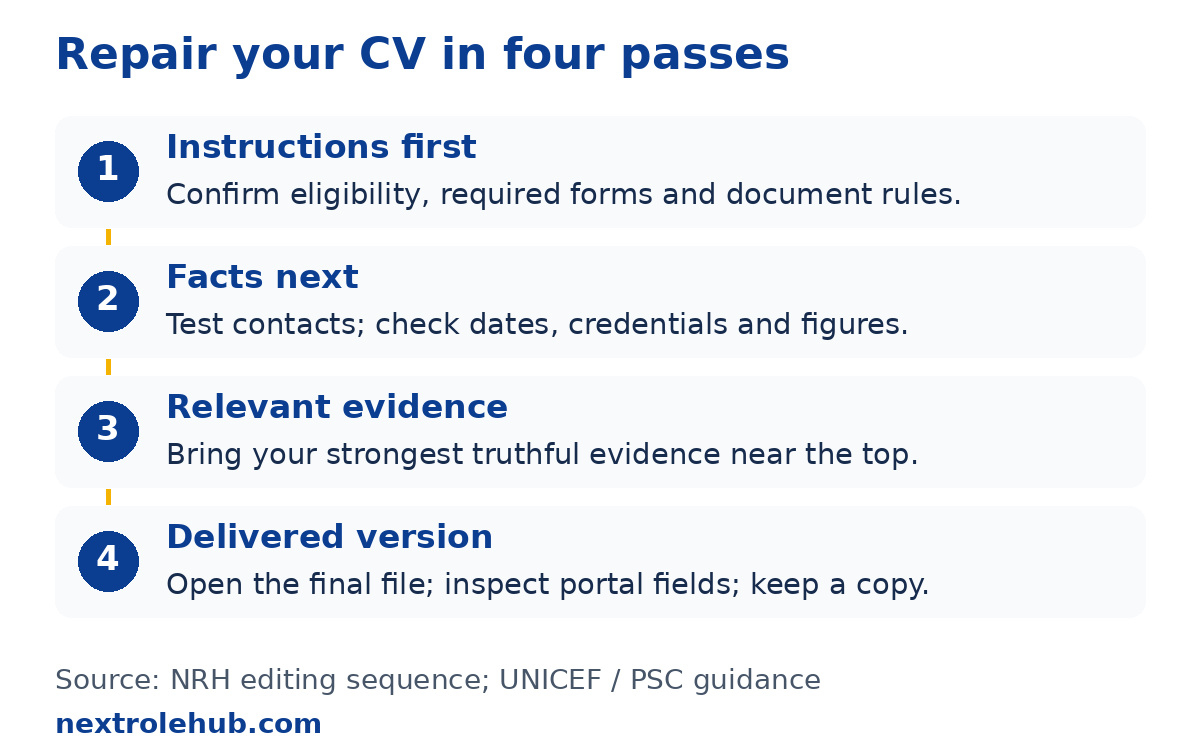
- Check eligibility and instructions. Confirm compulsory qualifications, required forms and document rules. Stop and verify anything unclear.
- Check facts. Test contact details, reconcile dates and remove unsupported qualifications, skills or performance figures.
- Check relevance. Make the strongest truthful evidence visible near the top without deleting information the application expressly requires.
- Check the delivered version. Open the final file, inspect extracted portal fields and retain the exact copy you submit.
Do not rebuild the whole CV when one section is weak. If the experience is relevant but hidden, reorder it. If the bullets are vague, replace one claim at a time with observable work. If the file fails the reading test, repair the format before rewriting the content.
Questions that come up while repairing a CV
Should I resend a CV after noticing a mistake?
Separate a material error from a small cosmetic issue. If contact details, eligibility information or a factual claim are wrong, check whether the portal permits an update or the advert provides a correction route. Use that route and identify the corrected information clearly. Do not create duplicate accounts or withdraw an application without understanding whether resubmission is allowed.
Does no reply mean my CV was rejected?
No. A lack of response does not reveal the reason or even establish that review is complete. The employer may contact only shortlisted applicants, still be reviewing, or use another notification channel. Check the advert and your application status where available. Improve errors you can verify, but do not buy a new template on the assumption that design caused the silence.
Can I use AI to improve a CV without making it inaccurate?
Use it as an editor, not a source of achievements. Ask for clearer wording around facts you supply, then compare every changed sentence with your records. Remove invented tools, duties, figures and qualifications. Avoid uploading confidential work information or other people’s personal details. You remain responsible for the version sent to the employer and for explaining its claims at interview.
What if I cannot remember an exact performance figure?
Do not guess. Check records you are authorised to use or describe the task and output without a number. A clear account of preparing a dispatch register is better than an unsupported claim about saving money. If you use a team result, explain your own contribution. Never move confidential files into a job application just to prove a CV bullet.
Must I explain why I left every previous job?
Not in every CV. Answer when the application form or employer asks, and keep the explanation accurate and consistent across documents. Do not use a CV bullet to attack a former supervisor or disclose a colleague’s private circumstances. If the reason needs context, prepare a concise explanation for the appropriate stage rather than changing dates to conceal it.
Send a document you can defend at interview
Fixing the CV mistakes you can control starts with accuracy, not decoration. Use the required format, keep the timeline consistent and make your relevant work visible. Open the final attachment before sending it, then retain that version so you know exactly what the employer received.
When you are ready to look for a suitable vacancy, compare our job websites in Uganda and verify the advert with the employer. If shortlisted, use the Uganda interview questions guide to practise explaining the evidence behind your CV. A sentence you cannot explain honestly is a sentence to fix before you apply.